This manual is for MHA FPX 5064 Assessment 3, start to submission. The third deliverable is the unglamorous half of a systems project, and it is where the criteria written about implementation and risk are won: a cost model that runs years past the invoice, testing in tiers with named sign-off owners, conversion rules for the records that will not convert, and a go-live with entry criteria and a point after which rollback stops being possible. Your scoring guide decides the format. Below is the method our tutors apply, a criterion-keyed structure, and an annotated sample excerpt. Rather have it built? A premium original sample comes back within 24 to 48 hours, with free revisions until every criterion clears. Capella's catalog lists the course as MHA-FPX5064, and some courserooms print MHA5064; both point to this same Assessment 3.
One honesty note before the manual: Capella revises courses and scoring guides over time, so always write to the exact scoring guide attached to your assessment in the courseroom. The course identity above is verified on capella.edu; the method and structure below are our tutors' approach to it, not Capella's official rubric text.
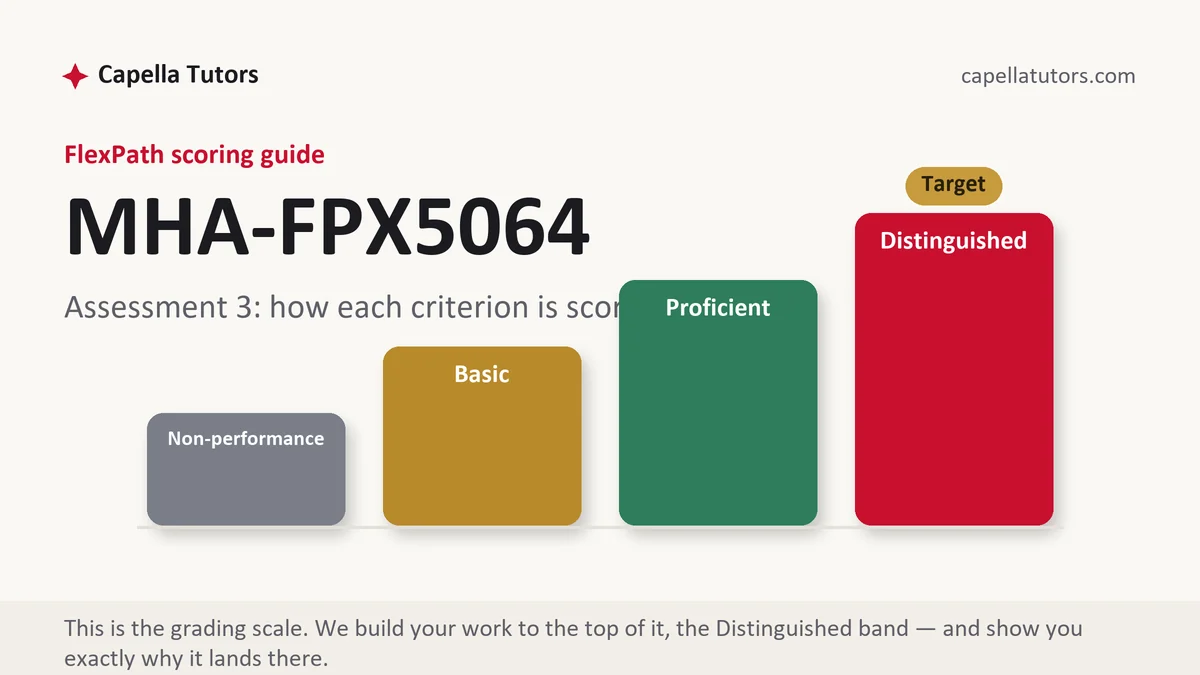
How MHA FPX 5064 Assessment 3 is scored
The four levels apply criterion by criterion, and on an implementation deliverable they measure how far past the purchase your thinking went:
| Level | What it means on an implementation and cost of ownership deliverable |
|---|---|
| Distinguished | A multi-year cost model with escalation, internal staffing and exit pricing, assumptions listed line by line, testing tiers with sign-off owners, and a go-live carrying entry criteria and a dated rollback point. |
| Proficient | Costs are itemised and a phased plan exists. Escalation and exit costs are absent, and the go-live has a date rather than a decision structure. |
| Basic | The quoted price treated as the cost, a timeline of activities, and testing described as a period rather than as tiers with criteria. |
| Non-performance | No cost model, or an implementation plan with no risk content at all. A date is not a plan and the criterion reads it as absent. |
A defect found in analysis is corrected in a document; the same defect found in production is corrected in a change order. Say that in your own words somewhere in the risk section, with the price attached.
The MHA FPX 5064 Assessment 3 method, step by step
-
Split one-time from recurring before you total anything
Licence or first year subscription, implementation services, conversion, each interface, hosting commitments and clinical backfill on one side. Maintenance or subscription, the internal positions the system creates, interface monitoring, training for new hires and the periodic upgrade projects on the other. Two columns, five years, one table.
-
Apply the escalation the contract actually states
Maintenance is usually a percentage of licence value and usually rises on a schedule. Model it rather than holding it flat, because a flat five year projection understates the commitment and any reader who has signed one of these agreements knows it.
-
Price the exit and the expansion
What an added interface costs after signature, what report writing costs, what happens at renewal, and what extracting your own data costs if you leave. Those terms carry money later, and a model that omits them is describing a smaller commitment than the organisation is making.
-
Build testing as tiers with owners and a blocking rule
Individual functions first, then the paths that cross systems, then a rehearsal by the people who will actually use it. Name who signs off at each tier and which defect severity stops the date, because a testing section with no blocking rule is a schedule with optimism written into it.
-
Write conversion rules for the records that will not convert
How much history moves, what happens to the records that fail validation, who reconciles them, and where the untranslatable data lives afterwards. Decide it in the document rather than discovering it in the cutover weekend.
-
Give go-live entry criteria and a rollback decision point
What must be true before the switch, who is in the command structure and for what hours, when rollback is still possible and when it stops being possible, and what the downtime procedure is on paper. Then self-score the draft against every criterion and submit early in the week.
A structure that maps to the criteria
Planning ranges our tutors use for an implementation deliverable; move them to match whatever your guide weights hardest.
| Section | What it must do | Guide |
|---|---|---|
| What is being implemented | The system, the scope, the sites, and the decision already taken that this plan executes. | ~150 words |
| Cost of ownership | One-time and recurring costs across a stated horizon, with escalation and every assumption listed. | ~350 words |
| Contract terms that carry money | Added interfaces, report writing, renewal, service levels, and the price of getting your data back. | ~200 words |
| Testing and conversion | Tiers, sign-off owners, blocking defect severity, conversion rules and the reconciliation owner. | ~300 words |
| Go-live and rollback | Model chosen and defended, entry criteria, command structure, rollback point, downtime procedure. | ~300 words |
| Risk and references | The requirement most likely missed and its later price, standards by version, current APA. | as needed |
Annotated sample excerpt
An original model excerpt from our team, written to show what a cost paragraph looks like when somebody has read the contract rather than the quote.
The subscription quoted for the population health platform is 318,000 dollars a year, and the five year commitment is not 1.59 million.1 Implementation and configuration are 240,000 once, four inbound interfaces at 38,000 each add 152,000, the payer attribution and claims feed needs a half-time analyst at 58,000 a year, the subscription escalates four percent annually under the quoted terms, and extracting the registry on exit is priced in the contract at 45,000, which brings the five year total to roughly 2.71 million with every assumption listed beneath the table.2 Go-live is phased by contract line rather than by clinic, entry criteria are a reconciled attribution file and two consecutive clean weekly claims loads, and the rollback point closes on the Friday before the first quality submission window.3
- 1Opens by rejecting the obvious arithmetic, which tells the evaluator immediately that the model is going somewhere the quote does not.
- 2Every recurring, internal and exit cost named, escalation applied, assumptions promised in the same sentence as the total.
- 3The cutover has a stated phasing logic, measurable entry criteria and a rollback point with a date. That is the difference between a plan and a calendar.
The full premium sample for your exact assessment, written fresh to your scoring guide and issue, is free to request. Study it, revise it into your own voice, and submit work you understand.
The five mistakes that cost Distinguished
- The quote as the cost. A total built from the price on the proposal, with maintenance escalation, internal staffing and exit pricing all missing.
- Testing as a week. A block of calendar labelled testing, with no tiers, no sign-off owners and no defect severity that would stop the date.
- Conversion assumed clean. No rule for the records that fail validation and no owner for reconciling them, which is what turns a cutover into a crisis.
- Go-live without a rollback point. A date with no entry criteria and no moment at which retreat stops being available, which reads as untested.
- No downtime procedure. A clinical system implemented with no written answer for the hours it is unavailable, which the risk criterion is specifically looking for.
Pre-submission checklist
- One-time and recurring costs separated across a stated horizon, assumptions listed
- Maintenance escalation applied at the rate the contract states
- Exit and expansion pricing included, with the contract clause identified
- Testing tiers with named sign-off owners and a blocking defect severity
- Conversion rules for failed records, with a reconciliation owner
- Go-live entry criteria, dated rollback point and downtime procedure written, self-scored D, submitted early in the week
Implementation plan due and the cost model stops at the licence?
Send the guide and whatever pricing you have been given. Eight people, research through final proofread, return a premium original sample in 24 to 48 hours with a multi-year model, assumptions listed line by line, and a cutover that has a rollback decision in it.