This manual is for MHA FPX 5064 Assessment 2, start to submission. Using Data for Decision Making asks you to examine the data available to a health care organization, usually the facility in your courseroom scenario: the types of internal data it generates, the external data sources it can draw on, how each is used in decisions, strategies for accessing and analyzing the data, the challenges involved, and the organization's unmet data needs. The grade turns on use. A list of data types scores lower than an analysis showing which decisions each source informs and where the gaps are. Below is the method our tutors use, a structure that maps to the criteria, and an annotated sample excerpt. Prefer to hand it off? A premium original sample for this exact assessment comes back in 24 to 48 hours, revised free until it meets the guide. Capella's catalog lists the course as MHA-FPX5064, and some courserooms print MHA5064; both point to this same Assessment 2. In current courserooms this assessment typically appears as "Using Data for Decision Making".
One honesty note before the manual: Capella revises courses and scoring guides over time, so always write to the exact scoring guide attached to your assessment in the courseroom. The course identity above is verified on capella.edu; the method and structure below are our tutors' approach to it, not Capella's official rubric text.
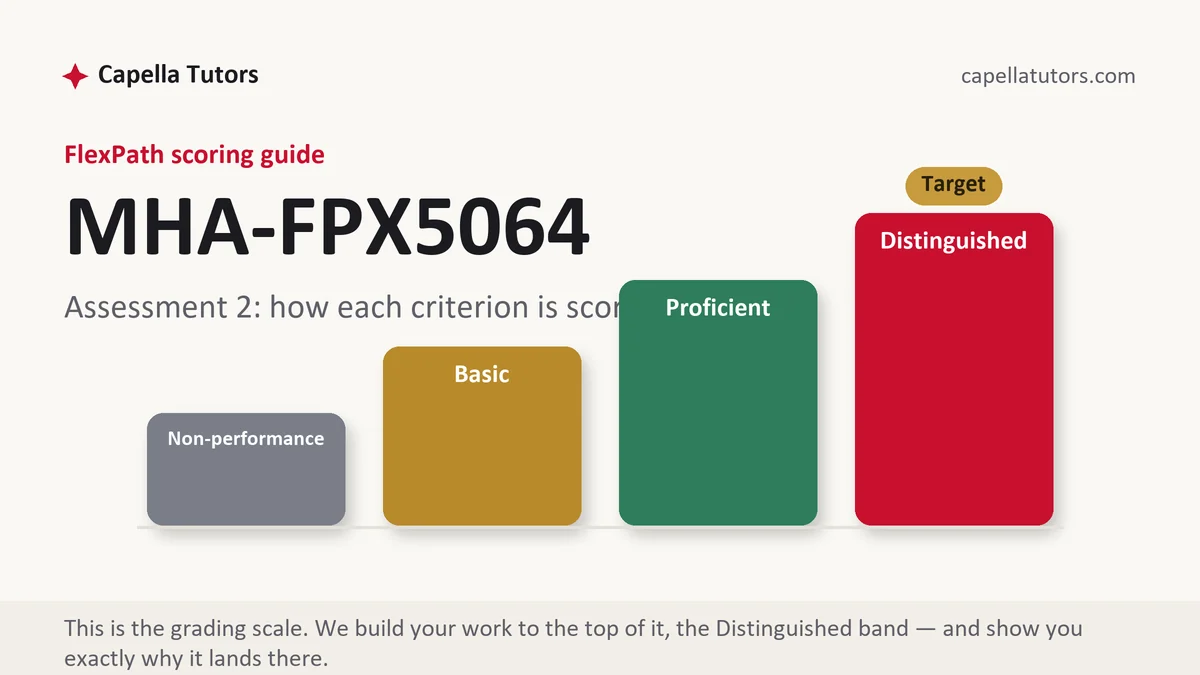
How MHA FPX 5064 Assessment 2 is scored
FlexPath does not use letter grades. Each criterion in the scoring guide lands on one of four levels, and the level descriptions are the real writing brief:
| Level | What it means on a data for decision making paper |
|---|---|
| Distinguished | Internal and external data types are identified with examples, their use in specific decisions is explained, access and analysis strategies are practical, challenges are addressed with solutions, and data needs are clearly stated. |
| Proficient | The paper is accurate and complete, but uses and needs are described generally. |
| Basic | The paper lists data types with little about decisions. |
| Non-performance | Internal or external data, the strategies or the data needs are missing. |
Use the organization in your scenario and connect each data source to a decision it actually makes or should make.
The MHA FPX 5064 Assessment 2 method, step by step
-
List internal data
Clinical, financial, operational and patient experience data the organization generates.
-
List external data
Benchmarks, public reporting, payer and population data.
-
Connect data to decisions
For each source, a decision it informs, such as staffing, service lines or quality priorities.
-
Describe access and analysis strategies
Data warehouses, dashboards, analytics staff and governance.
-
Address challenges
Data quality, interoperability, privacy and skills, each with a solution.
-
State data needs
What the organization is missing and why it matters.
A structure that maps to the criteria
Word counts are planning targets our tutors use, not Capella rules; follow the length and format your scoring guide states.
| Section | What it must do | Guide |
|---|---|---|
| Internal data | Types and uses at the organization. | ~200 words |
| External data | Sources and uses. | ~200 words |
| Strategies for accessing and analyzing data | Tools, people and governance. | ~200 words |
| Challenges and strategies | Problems and solutions. | ~150 words |
| Data needs and references | Gaps, then current APA. | ~125 words |
Annotated sample excerpt
An original model excerpt from our team, written to show the register that reaches the top of the guide. Learn the moves, then write your own version.
The medical center's internal patient satisfaction data show emergency department scores falling for three consecutive quarters, but on their own they do not say whether the problem is wait times, communication or discharge instructions.1 Combined with internal throughput data, which show door-to-provider times rising over the same period, and with external CMS benchmarks for comparable hospitals, the picture becomes a decision: the department is slower than its peers, and the satisfaction decline follows the delay.2 That is the kind of combined analysis the organization cannot yet do routinely, because patient experience and operational data sit in separate systems, which is the first data need this paper identifies.3
- 1Shows the limit of a single data source.
- 2Combines internal and external data to reach a decision.
- 3Identifies the data need that the analysis exposes.
The full premium sample for your exact assessment, written fresh to your scoring guide and topic, is free to request. Study it, revise it into your own voice, and submit work you understand.
The five mistakes that cost Distinguished
- A list of data types. Connect each source to a decision.
- Ignoring external data. Include benchmarks and public sources.
- Strategies without people. Say who analyzes and governs the data.
- Challenges without solutions. Pair each challenge with a response.
- No data needs. State what is missing.
Pre-submission checklist
- Internal data types and uses
- External data sources and uses
- Data connected to specific decisions
- Access and analysis strategies
- Challenges with solutions
- Data needs and current APA references
Want the data paper written?
Send the scoring guide and the scenario. Our team returns a premium original paper in 24 to 48 hours, revised free until it meets the guide.