This manual is for MHA FPX 5064 Assessment 1, start to submission. The opening deliverable is analysis, and analysis comes before design, before selection and long before anybody schedules a vendor demonstration. It asks you to write the current process step by step with volumes and timings attached, separate the problem from the product, and say what the organisation actually needs before naming anything that could be bought. Your scoring guide decides whether it arrives as an analysis, a briefing or a presentation with speaker notes. Below is our tutors' method, a structure keyed to the criteria, and an annotated sample excerpt. Prefer to hand it off? A premium original sample for this exact assessment is delivered in 24 to 48 hours, with free revisions until the guide is met. Capella's catalog lists the course as MHA-FPX5064, and some courserooms print MHA5064; both point to this same Assessment 1.
One honesty note before the manual: Capella revises courses and scoring guides over time, so always write to the exact scoring guide attached to your assessment in the courseroom. The course identity above is verified on capella.edu; the method and structure below are our tutors' approach to it, not Capella's official rubric text.
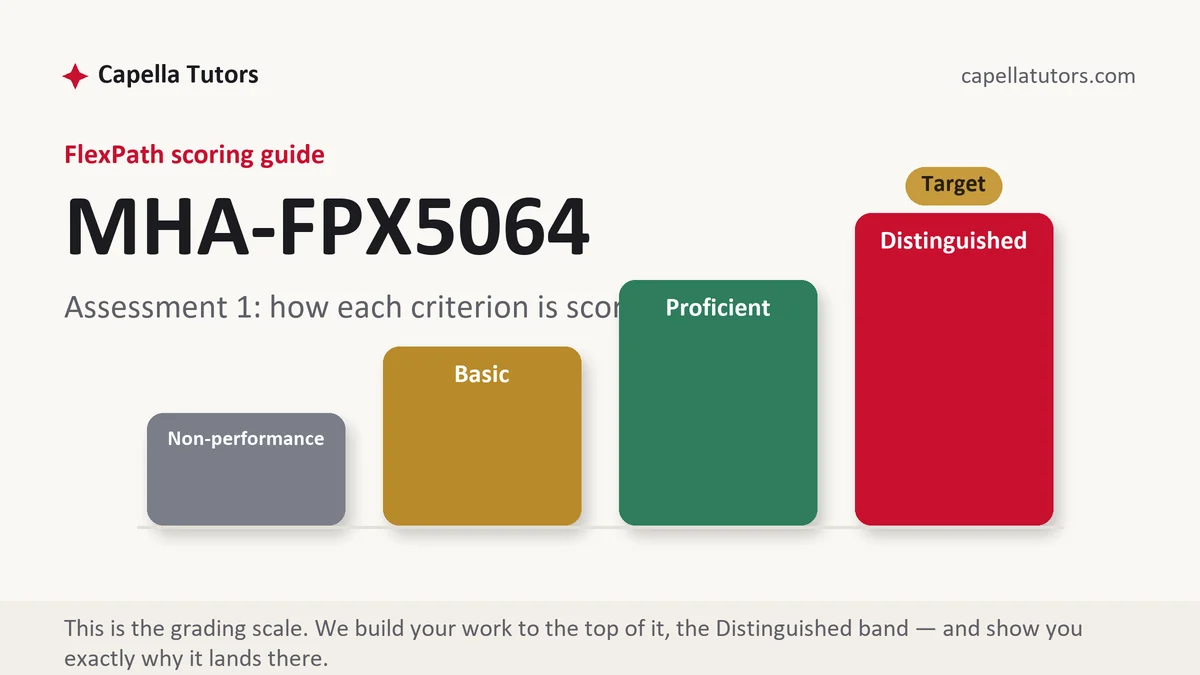
How MHA FPX 5064 Assessment 1 is scored
Every criterion lands on one of four levels, and on a current state analysis the levels read like this:
| Level | What it means on a current state systems analysis |
|---|---|
| Distinguished | The process is measured rather than described, estimates are labelled as estimates with their basis named, rework is quantified, and the problem is stated in terms no product name could satisfy. |
| Proficient | The workflow is documented accurately and the pain points are identified. Volumes and timings are partial, so the improvement has no baseline to be measured against. |
| Basic | A process described in adjectives, slow and inefficient, followed by a preferred product introduced before the requirement it answers. |
| Non-performance | No current state at all, or an analysis that is really a vendor summary. The criterion is empty rather than weak. |
Hold the line on sequence here. A registration process that takes eleven minutes because three systems ask for the same information is a design problem, and a fourth system will make it twelve.
The MHA FPX 5064 Assessment 1 method, step by step
-
Label every criterion with its phase
Analysis, design, selection or implementation. On this deliverable the analysis criteria carry the marks, and any paragraph that belongs to a later phase is unpaid work that also weakens the phase discipline the course is grading.
-
Walk the process and count the doors
Every path by which work enters, every hand it passes through, every system it is keyed into, and every point where it waits. Draw it as steps with actors, and mark the steps where the same information is entered twice, because duplicate entry is where the measurable waste usually lives.
-
Attach a volume and a time to each step
Monthly counts from a report, median handling times from a log or from a timed observation you describe. Where you have to estimate, say so in the sentence, give the basis, and keep estimates visually distinct from measured figures in any table.
-
Quantify the rework, not just the volume
Returned items, duplicates, corrections, chases. Rework as a share of total work is the most persuasive single figure an analysis can produce, because it converts a process complaint into a capacity number a finance reader recognises.
-
State the problem so no product name can answer it
Write the problem as a performance gap with a size: this share of intake is rework, this is what it costs in hours, this is the target. If a vendor's name would fit as the answer to your problem statement, the statement is a preference rather than a requirement.
-
Say what the data cannot tell you, then self-score
Which steps were not measured, which figures are estimates, which departments define an event differently. An analysis that discloses its own gaps invites less scrutiny, not more. Then grade each criterion yourself and submit early in the week.
A structure that maps to the criteria
Planning ranges our tutors use on a current state analysis; expand whichever section your own scoring guide weights heaviest.
| Section | What it must do | Guide |
|---|---|---|
| Setting and scope | The organisation, the process examined, its boundaries, and what sits deliberately outside them. | ~200 words |
| Current state, step by step | Each step with its actor, its system, its volume and its time, and every duplicate entry marked. | ~350 words |
| Where it fails | Waiting points, rework, duplicate records, and the share of total work each one consumes. | ~300 words |
| Data and definitions | The elements involved, how each is defined, and where two departments count differently. | ~250 words |
| The problem stated | The gap sized, the target set, and the statement written so no product name could satisfy it. | ~200 words |
| Limitations and references | What was estimated, what was not measured, internal reports and sources in current APA. | as needed |
Annotated sample excerpt
An original model excerpt from our team, written so the measurement register is visible. Take the moves and rebuild them from your own process.
A referral reaches the neurology clinic through four doors and leaves up to three records behind it.1 Faxed referrals arrive in a shared queue and are keyed into the practice management system by an intake coordinator at a median of 6.2 minutes each, timed across twenty observed cases; electronic referrals from affiliated practices arrive already structured; the remaining two paths, a telephone request and a portal message, are entered twice, once as a message and once as a referral, which is where the duplicates originate.2 Of 1,180 referrals logged in March, 214 were returned for missing authorisation and 61 duplicated a referral already open, so 23 percent of intake effort was rework rather than throughput, and both counts come from the practice management report rather than from an estimate.3
- 1Opens with the structural fault in one line. The reader knows the shape of the problem before any detail arrives.
- 2Each path carries its actor, its system and its timing, and the timing method is disclosed rather than implied.
- 3Rework quantified as a share of total work, with the source named. That percentage is the baseline every later claim will be measured against.
The full premium sample for your exact assessment, written fresh to your scoring guide and issue, is free to request. Study it, revise it into your own voice, and submit work you understand.
The five mistakes that cost Distinguished
- The product arrives first. A preferred system named in the introduction, which turns the whole analysis into a justification written backwards.
- Adjectives instead of counts. A workflow called cumbersome with no volumes, no timings and no rework rate to improve against.
- Estimates disguised as measurements. Invented figures presented in the same typeface as reported ones, with no basis given for either.
- One door assumed. Only the main intake path documented, so the exception paths that generate most of the waste never appear.
- Definitions unexamined. Two departments counting the same event differently, with the analysis reporting one number as though it were agreed.
Pre-submission checklist
- Every criterion labelled with its phase, and nothing from a later phase in the draft
- All entry paths documented, including the exception routes
- Volume and time attached to each step, with the timing method disclosed
- Rework quantified as a share of total work, sourced to a named report
- The problem statement written so that no product name could answer it
- Estimates labelled as estimates with their basis, self-scored D, submitted early in the week
Current state due and nothing is measured?
Tell us the process and the setting, and send the guide. Eight people, analyst through two QA reads, return a premium original sample in 24 to 48 hours with the process written step by step, timed where you have figures and openly estimated where you do not.