This manual is for MHA FPX 5042 Assessment 3, start to submission. The Coaching Session asks you to coach someone through a real goal and write it up: the context, the questions you asked and the responses you heard at each stage of the GROW model, goal, reality, options and will, and an analysis of how the session went and what you would change as a coach. The grade turns on the analysis. A record of questions and answers is required, but the top column rewards an honest evaluation of your coaching skill. Below is the method our tutors use, a structure that maps to the criteria, and an annotated sample excerpt. Prefer to hand it off? A premium original sample for this exact assessment comes back in 24 to 48 hours, revised free until it meets the guide. Capella's catalog lists the course as MHA-FPX5042, and some courserooms print MHA5042; both point to this same Assessment 3. In current courserooms this assessment typically appears as "Coaching Session".
One honesty note before the manual: Capella revises courses and scoring guides over time, so always write to the exact scoring guide attached to your assessment in the courseroom. The course identity above is verified on capella.edu; the method and structure below are our tutors' approach to it, not Capella's official rubric text.
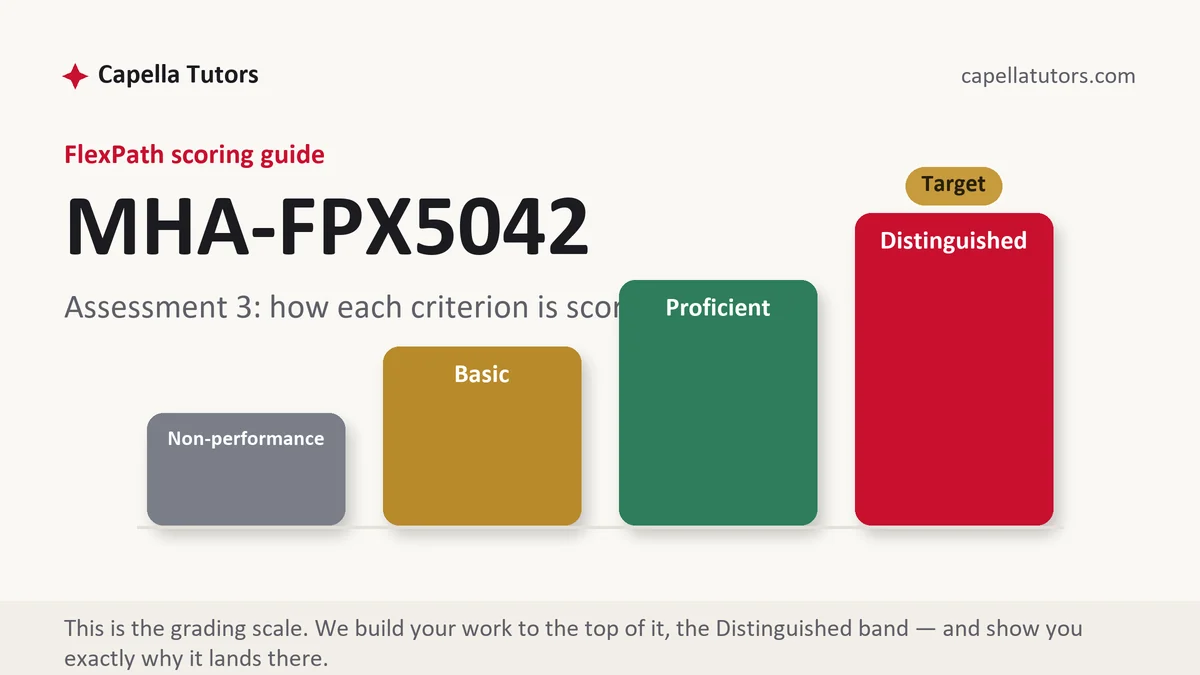
How MHA FPX 5042 Assessment 3 is scored
FlexPath does not use letter grades. Each criterion in the scoring guide lands on one of four levels, and the level descriptions are the real writing brief:
| Level | What it means on a coaching session write-up |
|---|---|
| Distinguished | The context is clear, each GROW stage has effective open questions and recorded responses, the session leads to a commitment, and the analysis evaluates your coaching with evidence and specific improvements. |
| Proficient | The session is documented completely, but the analysis is brief. |
| Basic | Questions are mostly closed or leading, and the analysis is general. |
| Non-performance | A GROW stage or the analysis is missing. |
Choose someone with a real goal and permission to use the session. Keep identifying details out unless your courseroom allows them.
The MHA FPX 5042 Assessment 3 method, step by step
-
Set the context
Who you coached, in general terms, and the goal they brought.
-
Ask goal questions
What they want to achieve and how they will know.
-
Ask reality questions
Where they are now and what has helped or blocked them.
-
Ask options questions
What they could do, generated by them rather than by you.
-
Ask will questions
What they will do, when, and how committed they are.
-
Analyze your coaching
Where you listened well, where you led, and what you would change, with evidence on coaching.
A structure that maps to the criteria
The record sections follow the GROW stages; word counts are planning targets our tutors use for the analysis.
| Section | What it must do | Guide |
|---|---|---|
| Context | The person and the goal, de-identified. | ~100 words |
| Goal questions and responses | Questions and answers. | record |
| Reality questions and responses | Questions and answers. | record |
| Options questions and responses | Questions and answers. | record |
| Will questions and responses | Questions and answers. | record |
| Applying GROW and coaching analysis | Evaluation of your coaching, then references. | ~300 words |
Annotated sample excerpt
An original model excerpt from our team, written to show the register that reaches the top of the guide. Learn the moves, then write your own version.
The reality stage was the strongest part of the session: by asking what had already been tried, I learned that he had attempted the change twice and stopped both times when his schedule shifted, which reframed the problem from motivation to planning.1 The options stage was weaker, because I offered two suggestions of my own before he had finished listing his, and the option he chose was one of mine, which the coaching literature would treat as advice rather than coaching.2 Next time I will hold my suggestions until he has given at least three options of his own and ask which one he would choose if I were not in the room.3
- 1Evaluates a stage with a specific moment and its effect.
- 2Identifies a weakness honestly and names the principle it breaks.
- 3States a concrete improvement.
The full premium sample for your exact assessment, written fresh to your scoring guide and topic, is free to request. Study it, revise it into your own voice, and submit work you understand.
The five mistakes that cost Distinguished
- Leading questions. Ask open questions that let the person think.
- Missing a GROW stage. Cover goal, reality, options and will.
- No commitment. End with a specific action and date.
- Analysis without evidence. Use coaching literature to evaluate yourself.
- Identifying details. Keep the person anonymous.
Pre-submission checklist
- Context described
- Goal, reality, options and will questions with responses
- Open, non-leading questions
- Commitment recorded
- Honest analysis of your coaching
- Current APA references
Want help writing up the coaching session?
Send the scoring guide and your session notes. Our team returns a premium original write-up in 24 to 48 hours, revised free until it meets the guide.