This manual is for MHA FPX 5042 Assessment 2, start to submission. The Personal Development Plan builds on the goals from Assessment 1: you set out actions and timelines for each goal, describe the coaching relationship that will support your development, explain how you will apply coaching strategies to build and develop talent in others, and address how you will build trust and rapport and check for equity and honesty when coaching. The grade turns on the coaching thread. A plan that lists actions scores lower than one that shows how coaching will drive your growth and how you will coach others. Below is the method our tutors use, a structure that maps to the criteria, and an annotated sample excerpt. Prefer to hand it off? A premium original sample for this exact assessment comes back in 24 to 48 hours, revised free until it meets the guide. Capella's catalog lists the course as MHA-FPX5042, and some courserooms print MHA5042; both point to this same Assessment 2. In current courserooms this assessment typically appears as "Personal Development Plan".
One honesty note before the manual: Capella revises courses and scoring guides over time, so always write to the exact scoring guide attached to your assessment in the courseroom. The course identity above is verified on capella.edu; the method and structure below are our tutors' approach to it, not Capella's official rubric text.
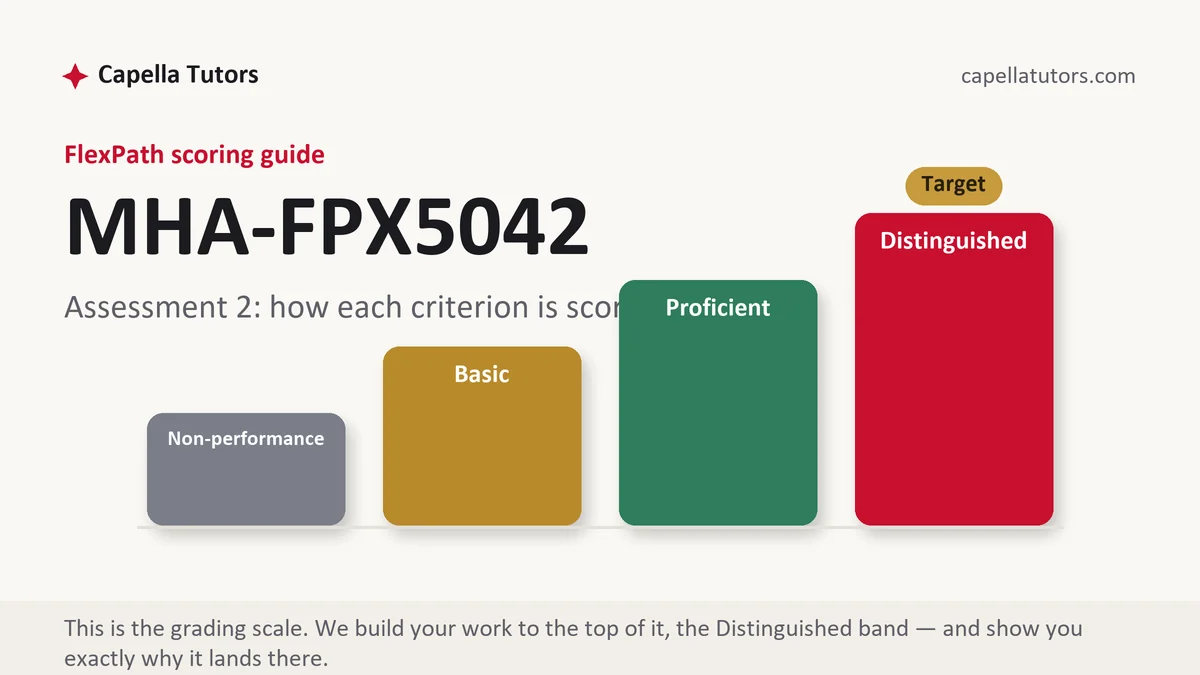
How MHA FPX 5042 Assessment 2 is scored
FlexPath does not use letter grades. Each criterion in the scoring guide lands on one of four levels, and the level descriptions are the real writing brief:
| Level | What it means on a personal development plan |
|---|---|
| Distinguished | Goals carry dated actions, the coaching relationship is specific, coaching strategies are evidence-based and applied to developing talent, trust and equity checks are concrete, and the plan reads as realistic. |
| Proficient | The plan is complete, but coaching strategies and equity checks are general. |
| Basic | The plan lists goals and actions with little about coaching. |
| Non-performance | The actions and timelines, the coaching relationship or the equity checks are missing. |
Carry forward the goals from Assessment 1, revised if feedback asked for it.
The MHA FPX 5042 Assessment 2 method, step by step
-
Restate the goals
Your SMART goals from Assessment 1.
-
Set actions and timelines
Two or three dated actions per goal.
-
Describe the coaching relationship
Who will coach you, how often, and how progress will be reviewed.
-
Apply coaching strategies
Models such as GROW, and how you will use them to develop staff.
-
Build trust and rapport
Practices that make coaching honest, with evidence.
-
Check for equity and honesty
How you will make sure coaching opportunities and feedback are fair across your team.
A structure that maps to the criteria
Word counts are planning targets our tutors use, not Capella rules; follow the length and format your scoring guide states.
| Section | What it must do | Guide |
|---|---|---|
| Introduction | Purpose of the plan. | ~100 words |
| SMART goals, actions and timelines | Goals with dated actions, often as a table. | ~300 words |
| The coaching relationship | Coach, cadence and review. | ~200 words |
| Coaching to build and develop talent | Strategies applied to others. | ~250 words |
| Trust, rapport, equity and honesty | Practices and checks. | ~200 words |
| Conclusion and references | Close, then current APA. | ~100 words |
Annotated sample excerpt
An original model excerpt from our team, written to show the register that reaches the top of the guide. Learn the moves, then write your own version.
To keep coaching fair, I will track who on my team receives development conversations and stretch assignments each quarter, because informal coaching tends to flow to the people who already resemble their managers.1 If the record shows that night-shift staff or newer employees are receiving fewer opportunities, I will schedule coaching time with them first in the next quarter rather than waiting for them to ask.2 I will also ask my own coach to review a sample of my feedback notes twice a year, checking that I am as direct with high performers as with those who are struggling, since honest feedback that is applied unevenly is not honest at all.3
- 1Names a concrete tracking practice and the bias it guards against.
- 2Sets a corrective action tied to the data.
- 3Adds an external check on honesty.
The full premium sample for your exact assessment, written fresh to your scoring guide and topic, is free to request. Study it, revise it into your own voice, and submit work you understand.
The five mistakes that cost Distinguished
- Actions without dates. Give each action a timeline.
- A vague coaching relationship. Name the coach and cadence.
- Coaching only for yourself. Show how you will coach others.
- Equity as a value statement. Describe concrete checks.
- New goals. Build on Assessment 1.
Pre-submission checklist
- Goals from Assessment 1
- Dated actions for each goal
- Coaching relationship described
- Coaching strategies for developing talent
- Trust, equity and honesty checks
- Current APA references
Want the development plan written?
Send the scoring guide and your goals worksheet. Our team returns a premium original plan in 24 to 48 hours, revised free until it meets the guide.