This manual is for MHA FPX 5042 Assessment 1, start to submission. Goal Setting asks you to complete a SMART goals worksheet for your own personal and professional development: usually three goals, each made specific, measurable, attainable, relevant and time-bound, with indicators of success, the resources you will need, and a short reflection on why the goal matters to you as a leader. The grade turns on how well each goal meets the SMART test. "Be a better communicator" earns little; a goal with two indicators, a resource and a date earns the top column. Below is the method our tutors use, a structure that maps to the criteria, and an annotated sample excerpt. Prefer to hand it off? A premium original sample for this exact assessment comes back in 24 to 48 hours, revised free until it meets the guide. Capella's catalog lists the course as MHA-FPX5042, and some courserooms print MHA5042; both point to this same Assessment 1. In current courserooms this assessment typically appears as "Goal Setting".
One honesty note before the manual: Capella revises courses and scoring guides over time, so always write to the exact scoring guide attached to your assessment in the courseroom. The course identity above is verified on capella.edu; the method and structure below are our tutors' approach to it, not Capella's official rubric text.
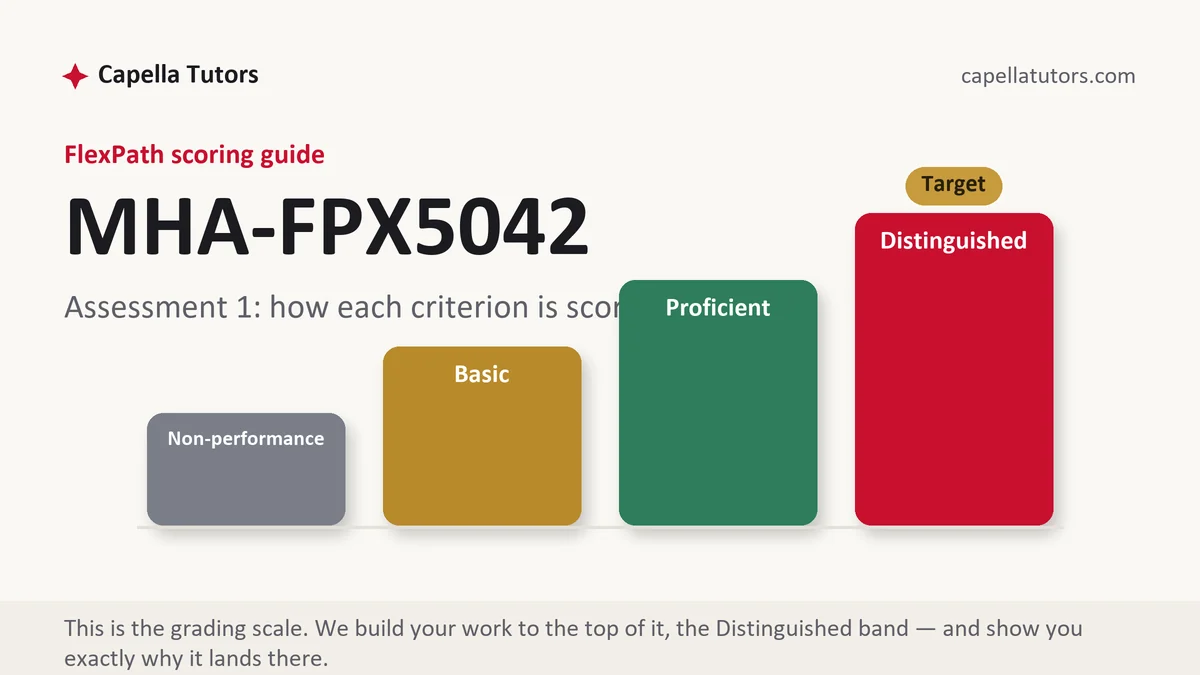
How MHA FPX 5042 Assessment 1 is scored
FlexPath does not use letter grades. Each criterion in the scoring guide lands on one of four levels, and the level descriptions are the real writing brief:
| Level | What it means on a SMART goals worksheet |
|---|---|
| Distinguished | Each goal is specific, has two measurable indicators, names the skills or resources to attain it, explains its relevance to your leadership, sets a realistic deadline, and the reflection shows insight. |
| Proficient | Goals are complete, but indicators or relevance are general. |
| Basic | Goals are broad and some SMART elements are missing. |
| Non-performance | The worksheet is incomplete. |
Use the worksheet in your courseroom. These goals feed the personal development plan in Assessment 2.
The MHA FPX 5042 Assessment 1 method, step by step
-
Choose goals that matter
Areas of growth you can name honestly, drawn from feedback or self-assessment.
-
Make each one specific
What exactly will change, in one sentence.
-
Add two indicators
How you and others will know you succeeded.
-
Name resources
Courses, mentors, practice opportunities, time.
-
Explain relevance
Why the goal matters for your role and career.
-
Set the deadline and reflect
A realistic date and a short reflection on the goal.
A structure that maps to the criteria
Follow the worksheet in your courseroom; the parts below are what the evaluator checks.
| Section | What it must do | Guide |
|---|---|---|
| Goal 1 | Every SMART element and indicators. | worksheet fields |
| Goal 2 | Every SMART element and indicators. | worksheet fields |
| Goal 3 | Every SMART element and indicators. | worksheet fields |
| Reflections | Why each goal matters. | ~75 words each |
Annotated sample excerpt
An original model excerpt from our team, written to show the register that reaches the top of the guide. Learn the moves, then write your own version.
Specific: lead the weekly operations huddle without relying on prepared slides, inviting at least two staff updates each week. Measurable: huddle feedback scores from the team, and the number of issues raised by frontline staff rather than by me.1 Attainable: I will use the facilitation course offered by the organization and ask my director to observe two huddles and give feedback. Relevant: my feedback says I present well but listen less, and the huddle is where staff decide whether to bring problems forward.2 Time-bound: by the end of the next quarter, with a mid-point check after six weeks.3
- 1Writes a specific, observable goal with two indicators.
- 2Names resources and explains relevance from real feedback.
- 3Sets a deadline with a checkpoint.
The full premium sample for your exact assessment, written fresh to your scoring guide and topic, is free to request. Study it, revise it into your own voice, and submit work you understand.
The five mistakes that cost Distinguished
- Vague goals. Make each goal observable.
- One indicator or none. Give two indicators.
- No resources. Say what will help you attain it.
- Relevance skipped. Explain why it matters.
- Unrealistic deadlines. Set dates you can meet.
Pre-submission checklist
- Three goals on the worksheet
- Each goal specific
- Two measurable indicators per goal
- Resources named
- Relevance explained
- Deadline and reflection
Want help shaping your goals?
Send the scoring guide and the worksheet. Our team returns a premium original sample worksheet in 24 to 48 hours, revised free until it meets the guide.