This manual is for MHA FPX 5040 Assessment 3, start to submission. Case Study Analysis: Part 2 continues the case work with a focus on how change happened inside the organization, often using a second case the courseroom supplies, such as a hospital turnaround under a new chief executive: the structures and systems that shaped the change, the powers at play, the effects of the changes on departments and stakeholders, and how communication helped or hindered implementation. The grade turns on organizational analysis. Evaluators look for how structure, power and communication explain the outcome, not a second summary of the case. Below is the method our tutors use, a structure that maps to the criteria, and an annotated sample excerpt. Prefer to hand it off? A premium original sample for this exact assessment comes back in 24 to 48 hours, revised free until it meets the guide. Capella's catalog lists the course as MHA-FPX5040, and some courserooms print MHA5040; both point to this same Assessment 3. In current courserooms this assessment typically appears as "Case Study Analysis: Part 2".
One honesty note before the manual: Capella revises courses and scoring guides over time, so always write to the exact scoring guide attached to your assessment in the courseroom. The course identity above is verified on capella.edu; the method and structure below are our tutors' approach to it, not Capella's official rubric text.
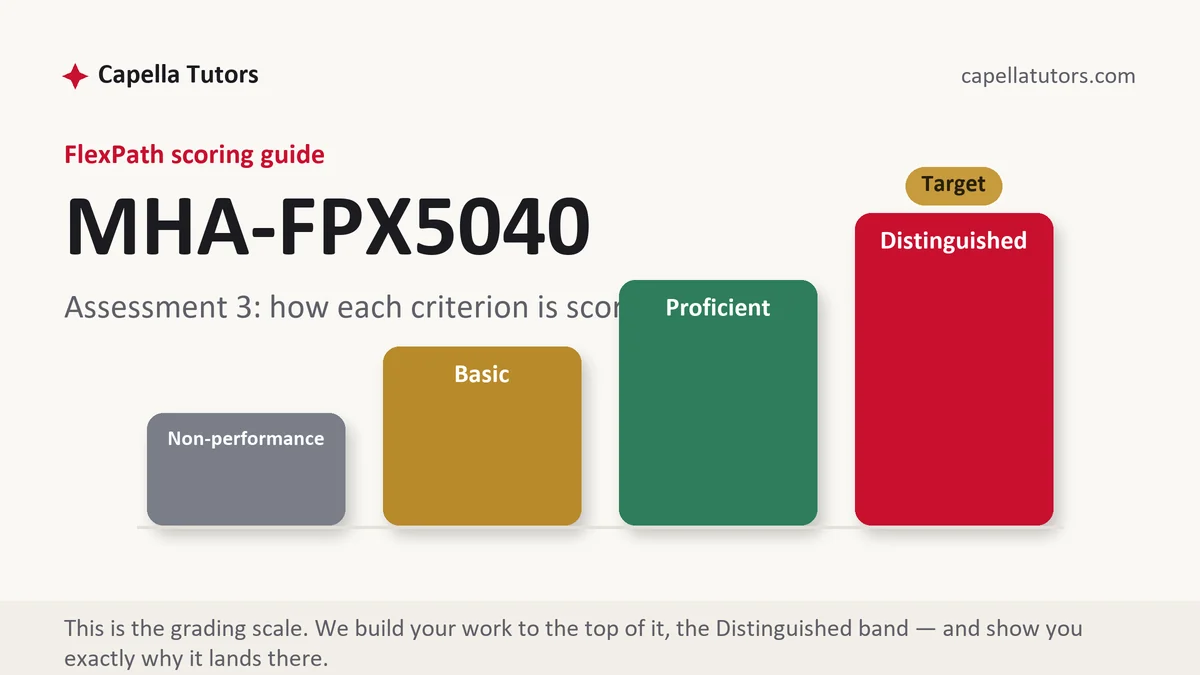
How MHA FPX 5040 Assessment 3 is scored
FlexPath does not use letter grades. Each criterion in the scoring guide lands on one of four levels, and the level descriptions are the real writing brief:
| Level | What it means on the second case analysis |
|---|---|
| Distinguished | Structures and systems are analyzed, sources of power and their use are explained, effects on departments and stakeholders are specific, the role of communication is evaluated, and conclusions are supported with change theory. |
| Proficient | The analysis is accurate, but power and communication are described rather than analyzed. |
| Basic | The paper retells the case. |
| Non-performance | Structures, power, stakeholder effects or communication are missing. |
Check which case your courseroom assigns for Part 2, and connect to Part 1 where the guide asks.
The MHA FPX 5040 Assessment 3 method, step by step
-
Map structures and systems
Reporting lines, governance, financial systems and contracts that shaped the change.
-
Analyze the powers at play
Formal authority, physicians, payers, unions or boards, and how each used influence.
-
Trace effects on departments and stakeholders
Who gained, who lost, and how they responded.
-
Evaluate communication
How leaders explained the change and what that did to adoption.
-
Apply theory
Power and change frameworks that explain the outcome.
-
Conclude
What an administrator should take from the case.
A structure that maps to the criteria
Word counts are planning targets our tutors use, not Capella rules; follow the length and format your scoring guide states.
| Section | What it must do | Guide |
|---|---|---|
| Introduction | The case and the focus of Part 2. | ~100 words |
| Structures and systems | What shaped the change. | ~175 words |
| Powers at play | Who held influence and how they used it. | ~175 words |
| Effects on departments and stakeholders | Specific consequences. | ~150 words |
| Effects of communication | How communication shaped implementation. | ~150 words |
| Conclusion and references | Lessons, then current APA. | ~100 words |
Annotated sample excerpt
An original model excerpt from our team, written to show the register that reaches the top of the guide. Learn the moves, then write your own version.
The new chief executive's formal authority was not enough on its own, because the medical center's finances depended on insurer contracts negotiated at rates below cost, which gave the payers more practical power over its future than its own board had.1 Her first major decision, to renegotiate those contracts and accept the risk of losing one, shifted that balance and signaled to staff that the turnaround was real.2 It also shows the difference between positional power and the power that comes from controlling a critical resource, a distinction that explains why earlier internal reforms had stalled.3
- 1Identifies a non-obvious source of power with evidence from the case.
- 2Shows how a leadership decision shifted the balance.
- 3Uses a power concept to explain the outcome.
The full premium sample for your exact assessment, written fresh to your scoring guide and topic, is free to request. Study it, revise it into your own voice, and submit work you understand.
The five mistakes that cost Distinguished
- A second summary. Analyze structure, power and communication.
- Power treated as job titles only. Look at who controlled critical resources.
- Effects described generally. Name departments and stakeholders.
- Communication ignored. Evaluate its role in adoption.
- No theory. Use frameworks to explain the outcome.
Pre-submission checklist
- Structures and systems analyzed
- Powers at play explained
- Effects on departments and stakeholders
- Communication evaluated
- Theory applied
- Current APA references
Want Part 2 written?
Send the scoring guide and the case. Our team returns a premium original analysis in 24 to 48 hours, revised free until it meets the guide.