This manual is for MHA FPX 5040 Assessment 2, start to submission. Case Study Analysis: Part 1 asks you to analyze a health care change case supplied in the courseroom, for example an organization that transformed its model of care under a new leader: the elements of the problem it faced, the needs of the community it serves, why change was necessary, and how its leaders challenged the status quo. The grade turns on analysis of the case, not retelling. Evaluators look for the causes of the problem, the evidence of need, and an explanation of why the leaders' moves worked or did not. Below is the method our tutors use, a structure that maps to the criteria, and an annotated sample excerpt. Prefer to hand it off? A premium original sample for this exact assessment comes back in 24 to 48 hours, revised free until it meets the guide. Capella's catalog lists the course as MHA-FPX5040, and some courserooms print MHA5040; both point to this same Assessment 2. In current courserooms this assessment typically appears as "Case Study Analysis: Part 1".
One honesty note before the manual: Capella revises courses and scoring guides over time, so always write to the exact scoring guide attached to your assessment in the courseroom. The course identity above is verified on capella.edu; the method and structure below are our tutors' approach to it, not Capella's official rubric text.
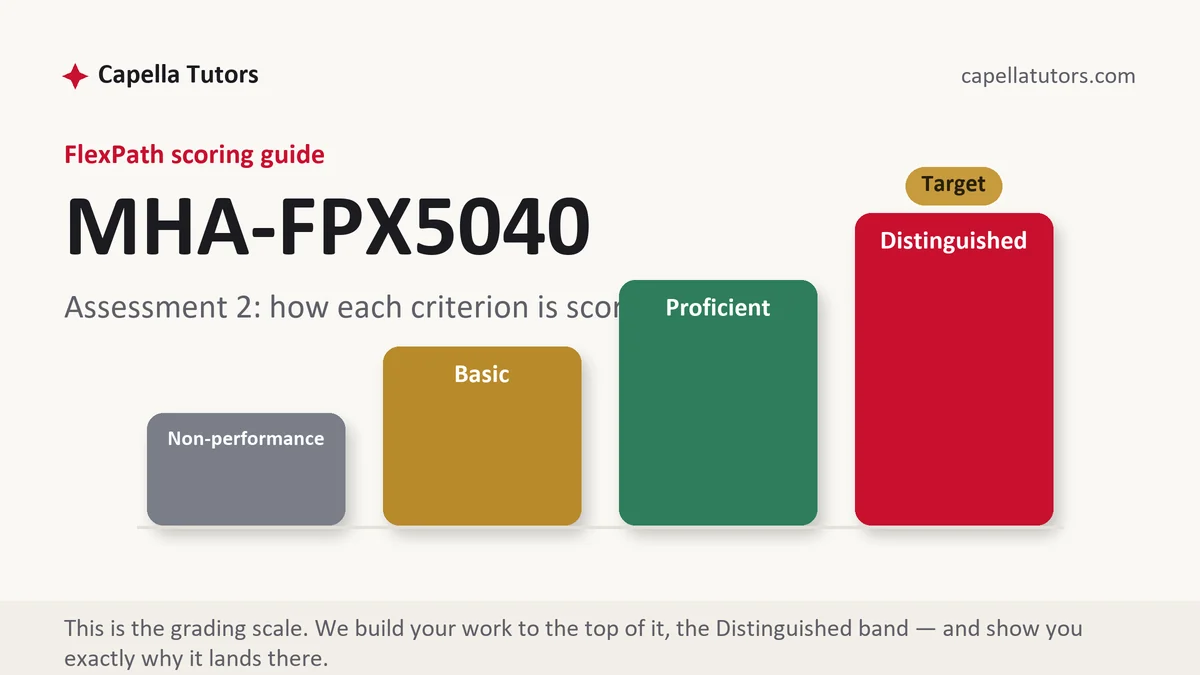
How MHA FPX 5040 Assessment 2 is scored
FlexPath does not use letter grades. Each criterion in the scoring guide lands on one of four levels, and the level descriptions are the real writing brief:
| Level | What it means on a change case analysis |
|---|---|
| Distinguished | The problem is broken into its elements with evidence from the case, community needs are analyzed, the need for change is argued, leadership actions are evaluated with change theory, and conclusions are supported. |
| Proficient | The analysis is accurate, but it summarizes the case more than it explains it. |
| Basic | The paper retells the case. |
| Non-performance | An element of the problem, the community needs or the leadership analysis is missing. |
Read the whole case twice before writing, and mark the facts that show cause, need and leadership action. Part 2 continues the analysis.
The MHA FPX 5040 Assessment 2 method, step by step
-
Identify the elements of the problem
Financial, operational, cultural and community factors, each with case evidence.
-
Analyze community needs
Who the organization serves and what they needed that it was not providing.
-
Argue the need for change
Why staying the same was not an option.
-
Evaluate how leaders challenged the status quo
Specific decisions, how they were communicated, and the resistance they met.
-
Apply change theory
Kotter, Lewin or another model to explain what happened.
-
Conclude
The lessons for health administrators.
A structure that maps to the criteria
Word counts are planning targets our tutors use, not Capella rules; follow the length and format your scoring guide states.
| Section | What it must do | Guide |
|---|---|---|
| Introduction | The case and the purpose of the analysis. | ~100 words |
| Elements of the problem | Causes with case evidence. | ~200 words |
| Needs of the community | What was unmet. | ~150 words |
| Need for change | Why change was necessary. | ~125 words |
| Challenging the status quo | Leadership actions evaluated with theory. | ~200 words |
| Conclusion and references | Lessons, then current APA. | ~100 words |
Annotated sample excerpt
An original model excerpt from our team, written to show the register that reaches the top of the guide. Learn the moves, then write your own version.
The decisive move in the case was not a new building or a new program but a change in who made decisions: the leadership team reorganized care around customer-owners, the people the organization served, and gave them a formal voice in how services were designed.1 That choice challenged a status quo in which clinicians and administrators defined need, and the case describes resistance from staff who saw it as a loss of professional authority.2 Kotter's emphasis on a compelling vision helps explain why the change held: the leaders tied every structural change to a single statement of purpose that staff could repeat and patients could recognize.3
- 1Identifies the leadership move precisely.
- 2Shows how it challenged the status quo and the resistance it met.
- 3Uses change theory to explain why it worked.
The full premium sample for your exact assessment, written fresh to your scoring guide and topic, is free to request. Study it, revise it into your own voice, and submit work you understand.
The five mistakes that cost Distinguished
- Retelling the case. Analyze causes and leadership actions.
- No case evidence. Cite facts from the case.
- Ignoring the community. Analyze whose needs were unmet.
- Theory named but not used. Apply it to the case.
- Going beyond Part 1. Leave implementation details for Part 2.
Pre-submission checklist
- Elements of the problem with evidence
- Community needs analyzed
- Need for change argued
- Leadership actions evaluated
- Change theory applied
- Current APA references
Want the case analysis written?
Send the scoring guide and the case. Our team returns a premium original analysis in 24 to 48 hours, revised free until it meets the guide.