This manual is for MHA FPX 5040 Assessment 1, start to submission. Interview With a Healthcare Leader asks you to interview a leader in a health care organization and write up what you learned: the organizational, community, political, social and global needs the organization faces, how it measures success, the drivers of change it is responding to, and how effective traditional leadership models are in that environment, connected to the literature on change leadership. The grade turns on analysis. A transcript or a list of answers scores lower than a paper that interprets what the leader said against evidence about change leadership. Below is the method our tutors use, a structure that maps to the criteria, and an annotated sample excerpt. Prefer to hand it off? A premium original sample for this exact assessment comes back in 24 to 48 hours, revised free until it meets the guide. Capella's catalog lists the course as MHA-FPX5040, and some courserooms print MHA5040; both point to this same Assessment 1. In current courserooms this assessment typically appears as "Interview With a Healthcare Leader".
One honesty note before the manual: Capella revises courses and scoring guides over time, so always write to the exact scoring guide attached to your assessment in the courseroom. The course identity above is verified on capella.edu; the method and structure below are our tutors' approach to it, not Capella's official rubric text.
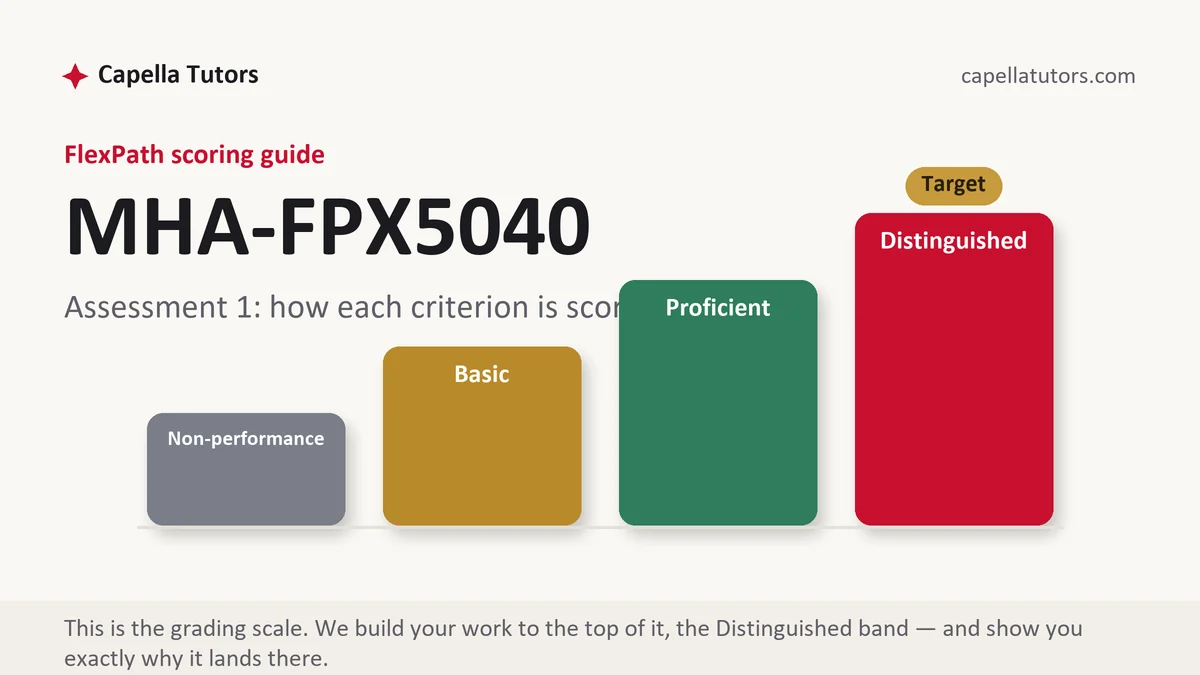
How MHA FPX 5040 Assessment 1 is scored
FlexPath does not use letter grades. Each criterion in the scoring guide lands on one of four levels, and the level descriptions are the real writing brief:
| Level | What it means on a leader interview paper |
|---|---|
| Distinguished | The leader and organization are introduced, each area of need is explored with specific answers, success measures and change drivers are analyzed, leadership models are evaluated with evidence, and the write-up connects the interview to the course's ideas about change. |
| Proficient | All areas are covered accurately, but the write-up reports answers with little interpretation. |
| Basic | The paper reads as a transcript. |
| Non-performance | An area of need, the change drivers or the leadership evaluation is missing. |
Choose a leader with responsibility for change, a director or executive, and plan questions for every area the guide lists. Include contact details if your courseroom asks.
The MHA FPX 5040 Assessment 1 method, step by step
-
Choose and prepare
A leader with real influence over change; questions mapped to every required area.
-
Conduct the interview
Take notes or record with permission; ask for examples, not opinions only.
-
Report the needs
Organizational, community, political, social and global, each with the leader's specifics.
-
Analyze success measures
What the organization tracks and whether those measures capture what matters.
-
Identify drivers of change
Payment reform, workforce, technology, competition, community health.
-
Evaluate leadership models
Whether command-and-control or other traditional models work in this setting, with evidence.
A structure that maps to the criteria
Word counts are planning targets our tutors use, not Capella rules; follow the length and format your scoring guide states.
| Section | What it must do | Guide |
|---|---|---|
| Introduction | The leader, role and organization. | ~125 words |
| Organizational, community, political, social and global needs | What the interview revealed. | ~300 words |
| Success measurements | Measures and their adequacy. | ~150 words |
| Drivers of change | Forces the organization faces. | ~150 words |
| Effectiveness of traditional leadership models | Evaluated with evidence. | ~175 words |
| Conclusion and references | Lessons, then current APA. | ~100 words |
Annotated sample excerpt
An original model excerpt from our team, written to show the register that reaches the top of the guide. Learn the moves, then write your own version.
The chief operating officer named value-based payment as the change driver that reshaped her organization fastest: when two of its largest payers moved to shared savings contracts, readmissions became a financial measure rather than only a quality one.1 She described the response as a shift from department-by-department targets to cross-department teams accountable for one patient population, which matches the literature's argument that complex change needs distributed rather than top-down leadership.2 Her point that the old structure was not wrong but too slow for the new contracts is the clearest statement in the interview of why traditional models struggle in a changing payment environment.3
- 1Reports a specific driver with the leader's example.
- 2Connects the response to the literature on change leadership.
- 3Uses the leader's words to support the evaluation of traditional models.
The full premium sample for your exact assessment, written fresh to your scoring guide and topic, is free to request. Study it, revise it into your own voice, and submit work you understand.
The five mistakes that cost Distinguished
- A transcript. Interpret the answers.
- Skipping an area of need. Cover every area the guide lists.
- Opinions without examples. Ask for specific cases.
- No literature. Connect the interview to evidence.
- Identifying details without permission. Follow the courseroom guidance on naming the leader.
Pre-submission checklist
- Leader and organization introduced
- All areas of need explored
- Success measures analyzed
- Drivers of change identified
- Traditional leadership models evaluated with evidence
- Current APA references
Want the interview paper written up?
Send the scoring guide and your interview notes. Our team returns a premium original paper in 24 to 48 hours, revised free until it meets the guide.