This manual is for MHA FPX 5028 Assessment 3, start to submission. By the third deliverable the course wants the argument rather than the description: something observed in another national system, proposed for a domestic one, priced, located in law, and defended against the interest that will fight it. Your scoring guide decides whether it lands as a policy brief, a report to a board or a narrated presentation, and in every version the criterion rewards a mechanism rather than an admiration. Below is our tutors' method for building that argument, a structure keyed to the criteria, and an annotated sample excerpt. Rather have it built? A premium original sample lands in 24 to 48 hours and is revised at no charge until each criterion clears. Capella's catalog lists the course as MHA-FPX5028, and some courserooms print MHA5028; both point to this same Assessment 3.
One honesty note before the manual: Capella revises courses and scoring guides over time, so always write to the exact scoring guide attached to your assessment in the courseroom. The course identity above is verified on capella.edu; the method and structure below are our tutors' approach to it, not Capella's official rubric text.
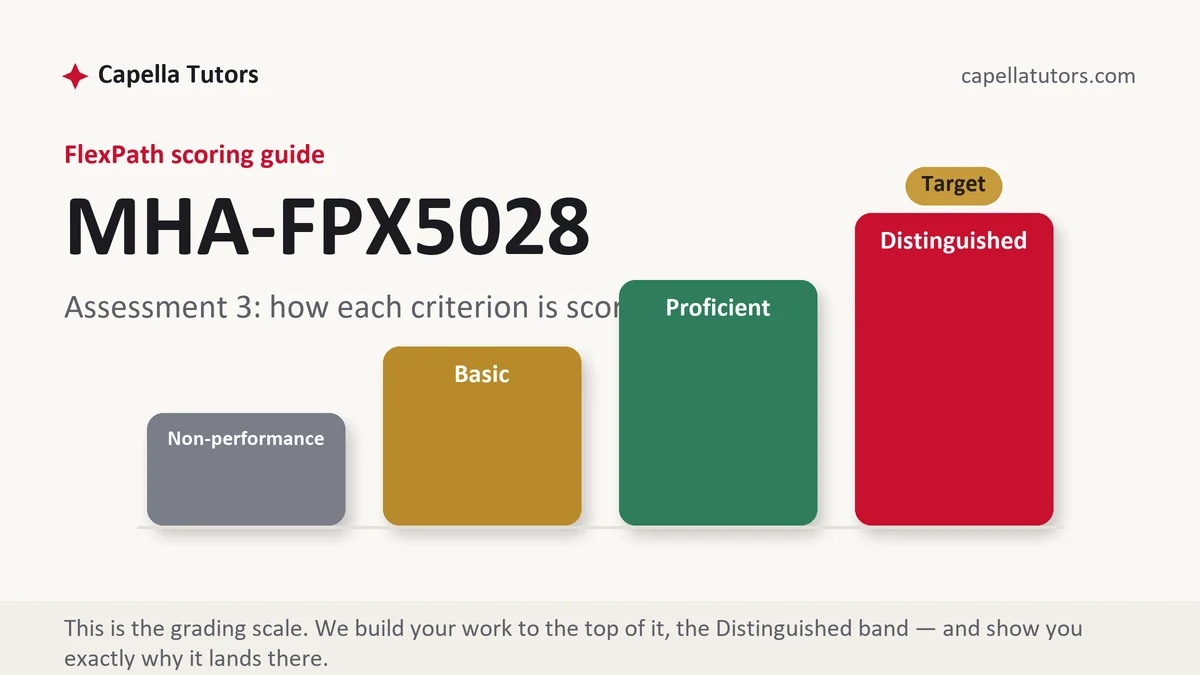
How MHA FPX 5028 Assessment 3 is scored
The same four levels apply, and on a transfer recommendation the columns describe how far the proposal has been pushed:
| Level | What it means on a transfer recommendation |
|---|---|
| Distinguished | One instrument is proposed, its legal home and its cost are named, the arrangement it displaces is identified, the opposition is anticipated, and a sensitivity line shows the case surviving a wrong central figure. |
| Proficient | A specific mechanism is recommended and justified from the comparison. The implementation obstacles are acknowledged rather than priced, which is the gap between the two top columns. |
| Basic | A country held up as a model and a suggestion that the domestic system should be more like it. Sincere, unimplementable, and the most common shape a first draft takes. |
| Non-performance | No recommendation at all, or one with no connection to the comparison that preceded it. A conclusion that could have been written without the analysis scores as if it had been. |
This is the deliverable that decides whether the course read as a tour of foreign systems or as preparation for a job. Administrators are not paid to admire other countries; they are paid to say which instrument could survive here and what it would cost to install.
The MHA FPX 5028 Assessment 3 method, step by step
-
Extract the instrument from the system around it
Write down the specific device you admire, not the country that houses it: a global operating budget for a hospital, a negotiated national fee schedule, a statutory minimum benefit package, a reference price for a therapeutic class, a single claims clearing point. One instrument, named in one line, is the whole recommendation. Everything after that is defence.
-
Explain the mechanism, not the result
Say how the instrument changes behaviour, which actor faces the new incentive, and what that actor is expected to do differently. An instrument imported without its causal story is a slogan, and the criterion written about analysis is looking exactly here for the sentence that connects the device to the outcome you want.
-
Locate the legal authority before you cost anything
Say whether the change needs an act of Congress, a state legislature, a federal agency rule, a state plan amendment or nothing more than a payer's own contracting decision. Structure decides feasibility, and a proposal that has already found the desk it belongs on is worth several proposals that have not.
-
Price the administration, then price the displacement
Two costs, not one. What running the instrument costs, in staff, systems and enforcement, and what it takes away from whoever currently holds the money or the discretion. The second is the political price, and it is the one students skip. Name the group that loses, quantify what it loses, and say how the proposal answers them.
-
Test the recommendation against its weakest number
Find the figure your case leans on hardest, move it by ten percent in the unhelpful direction, and report what happens. If the recommendation survives, you have written a robustness paragraph; if it does not, you have found out before your evaluator did and can narrow the claim accordingly.
-
Read the draft as the opposition, then self-score
Take one pass through the paper wearing the hat of the association that will lobby against it, marking every sentence they could refute. Answer the three strongest. Then score each criterion yourself, lift anything below the top column, and submit early in the week rather than at the weekend.
A structure that maps to the criteria
Word targets our tutors plan against for a transfer argument; adjust to whatever your own guide weights heaviest.
| Section | What it must do | Guide |
|---|---|---|
| The problem, restated as a decision | What the domestic system is failing to do, sized in numbers, framed as a choice somebody must make. | ~200 words |
| The instrument observed abroad | The device itself, how it works, the actor whose behaviour it changes, and the evidence that it does. | ~300 words |
| Structural fit | What in the domestic arrangement helps or blocks it, and what has to be true for it to function here. | ~250 words |
| Legal home and cost | The authority required, who holds it, the administrative cost, and the arrangement being displaced. | ~250 words |
| Opposition and sensitivity | Who loses and by how much, their strongest objection answered, and the test on the central figure. | ~250 words |
| Recommendation and references | The decision in one paragraph, a first step with an owner, sources in current APA both ways. | as needed |
Annotated sample excerpt
Original model work from our writers, showing the difference between proposing a country and proposing a device. Study the shape, then argue your own instrument.
The recommendation is not to copy the comparator's remote care programme but to adopt one instrument from it, a single payment rate that pays a remote consultation at the same level as the equivalent in-person visit code, with a stated review date attached.1 Authority for that sits with the state Medicaid agency for its own enrolled population and with the legislature for the commercial market, and the arrangement it displaces is the current schedule paying remote visits at 74 percent of the office rate.2 At 38,000 remote consultations a year the change adds roughly 1.1 million dollars of payment, and if remote visits substitute for in-person visits at the sixty percent rate the comparator actually observed rather than the eighty percent assumed here, the case still holds, because avoided facility cost stays above the added payment at both rates.3
- 1Refuses the country and names the device in the first sentence, which is the move the top column of a transfer criterion is describing.
- 2Puts the legal home and the displaced arrangement together, so feasibility and cost are argued in the same breath.
- 3Runs the case at a worse assumption and reports that it survives. A recommendation that has already tested its own weakest number reads as executive work.
The full premium sample for your exact assessment, written fresh to your scoring guide and issue, is free to request. Study it, revise it into your own voice, and submit work you understand.
The five mistakes that cost Distinguished
- Importing a country. A proposal to adopt another nation's system reads as unserious no matter how good the description that preceded it.
- No legal address. A mechanism recommended with no statement of who would have to authorise it, which leaves the reader unable to act on any of it.
- Cost without displacement. The administrative price calculated while the money being taken from somebody else goes unmentioned.
- The opposition erased. No named interest group, no objection, no answer, so the political feasibility criterion goes unearned.
- A conclusion detached from the data. A recommendation that never cites a figure from the comparison, which makes the earlier analysis decorative.
Pre-submission checklist
- One instrument named in a single sentence, with the causal mechanism stated
- The legal authority identified, and the body that holds it named
- Administrative cost estimated and the displaced arrangement quantified
- The losing interest group named, its strongest objection answered in the text
- A sensitivity line moving the central figure and reporting the result
- Every recommendation traceable to a figure in your own comparison, self-scored D, submitted early in the week
Recommendation due and it still reads like praise?
Send the guide, the comparison you have already built, and the instrument you are drawn to. Eight people, analyst through double proofread, return a premium original sample in 24 to 48 hours with the authority located, the cost priced and the objection answered on the page.