This manual is for MHA FPX 5028 Assessment 1, start to submission. In current courserooms, Assessment 1 of Comparative Models of Global Health Systems is an executive summary for leaders: you profile major global health organizations, such as the World Health Organization and nongovernmental bodies like the International Rescue Committee, explain their missions and roles, give an overview of the main health care system models, and identify the key performance indicators used to compare health systems. The grade turns on accuracy and comparison. Organization profiles copied from websites score lower than a summary that explains what each organization does that matters to health system performance. Below is the method our tutors use, a structure that maps to the criteria, and an annotated sample excerpt. Prefer to hand it off? A premium original sample for this exact assessment comes back in 24 to 48 hours, revised free until it meets the guide. Capella's catalog lists the course as MHA-FPX5028, and some courserooms print MHA5028; both point to this same Assessment 1. In current courserooms this assessment typically appears as "Executive Summary".
One honesty note before the manual: Capella revises courses and scoring guides over time, so always write to the exact scoring guide attached to your assessment in the courseroom. The course identity above is verified on capella.edu; the method and structure below are our tutors' approach to it, not Capella's official rubric text.
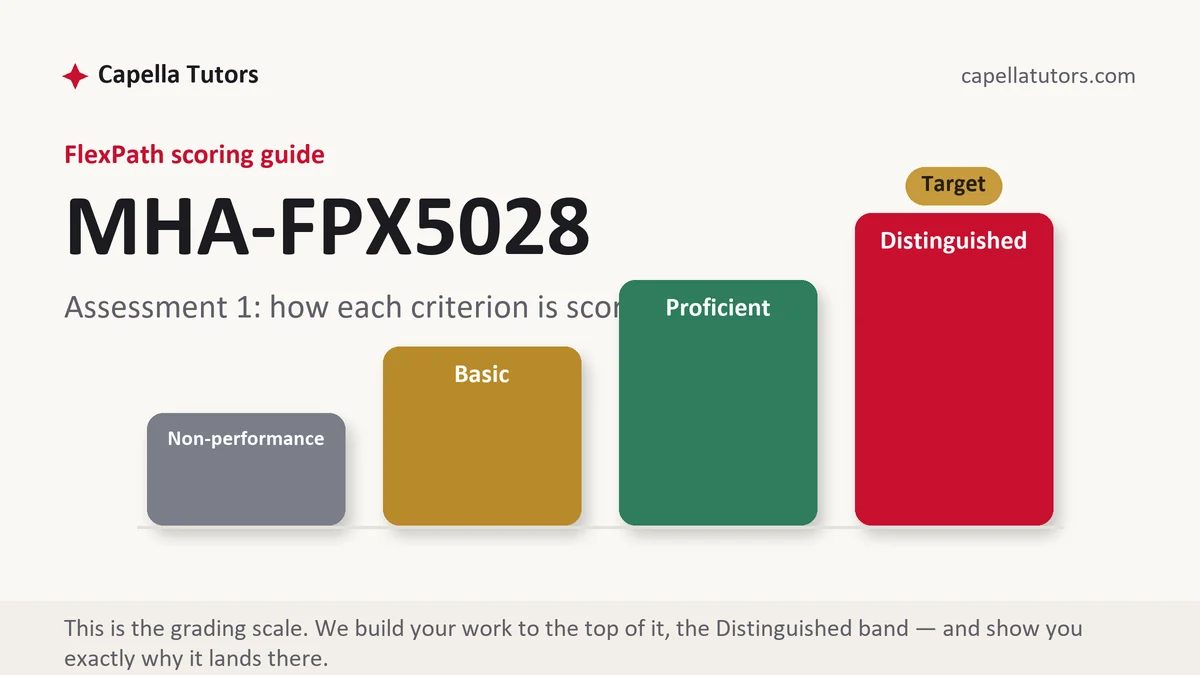
How MHA FPX 5028 Assessment 1 is scored
FlexPath does not use letter grades. Each criterion in the scoring guide lands on one of four levels, and the level descriptions are the real writing brief:
| Level | What it means on a global health executive summary |
|---|---|
| Distinguished | Each organization is profiled accurately with its mission, structure and role, the health care models are explained with examples, KPIs are defined and sourced, and the summary is concise and useful for leaders. |
| Proficient | The summary is accurate and complete, but comparisons are thin and KPIs are listed rather than explained. |
| Basic | The organizations are described from their websites with little analysis. |
| Non-performance | An organization, the models overview or the KPIs are missing. |
Check which organizations your courseroom names. Write in executive summary style: short sections, the important facts first.
The MHA FPX 5028 Assessment 1 method, step by step
-
Profile each organization
Founding, mission, funding, structure and main programs, from official sources.
-
Explain their role in global health
What each contributes to health system performance, such as standards, emergency response or advocacy.
-
Outline the health care models
The Beveridge, Bismarck, national health insurance and out-of-pocket models, with a country example for each.
-
Define the KPIs
Life expectancy, infant and maternal mortality, health spending per capita, access measures, with sources such as WHO and OECD.
-
Compare briefly
Show how the models tend to perform on the KPIs.
-
Keep it executive
Concise headings and a closing paragraph with the main takeaways.
A structure that maps to the criteria
Word counts are planning targets our tutors use, not Capella rules; follow the length and format your scoring guide states.
| Section | What it must do | Guide |
|---|---|---|
| Organization profiles | Mission, structure and role for each. | ~300 words |
| Overview of health care models | The main models with examples. | ~200 words |
| Key performance indicators | KPIs defined and sourced. | ~150 words |
| Conclusion and references | Main takeaways, then current APA. | ~100 words |
Annotated sample excerpt
An original model excerpt from our team, written to show the register that reaches the top of the guide. Learn the moves, then write your own version.
The most useful indicators for comparing health systems are the ones that capture both outcomes and access: life expectancy at birth, infant and maternal mortality, the share of the population covered by insurance, and health spending per person as a share of national income.1 WHO's Global Health Observatory and OECD Health Statistics publish these consistently across countries, which makes them comparable in a way that national reports often are not.2 Read together, they show why the United States, with the highest spending per person among wealthy countries, still trails peers on life expectancy, which is the kind of contrast the later assessments in this course examine.3
- 1Names indicators that cover outcomes, access and cost.
- 2Identifies comparable data sources.
- 3Shows how the indicators reveal a meaningful contrast.
The full premium sample for your exact assessment, written fresh to your scoring guide and topic, is free to request. Study it, revise it into your own voice, and submit work you understand.
The five mistakes that cost Distinguished
- Copied profiles. Explain each organization's role in your own words.
- Models without examples. Give a country for each model.
- KPIs without sources. Cite WHO, OECD or similar.
- Too long. Keep it an executive summary.
- No comparison. Show what the KPIs reveal.
Pre-submission checklist
- Organizations profiled accurately
- Roles in global health explained
- Health care models with examples
- KPIs defined and sourced
- Concise executive format
- Current APA references
Want the executive summary written?
Send the scoring guide and the organizations named in your courseroom. Our team returns a premium original summary in 24 to 48 hours, revised free until it meets the guide.