This manual is for MHA FPX 5020 Assessment 3, start to submission. Assessment 3 turns the project into something an organization could actually run, and the assessment usually asks for the operating plan: staffing derived from volume, the workflow end to end, the sequence and its dependencies, a measurement plan with real definitions, and the governance that decides who approves what. The test the criteria apply is reconciliation, because an operating plan whose volumes do not match the financial model tells an evaluator the project was assembled rather than built. What comes next is the method, a criterion-mapped structure and an annotated sample excerpt from a plan of this kind. Rather not build it alone? A premium original sample for this assessment lands inside 24 to 48 hours and is revised at no cost until every criterion clears. Capella's catalog lists the course as MHA-FPX5020, and some courserooms print MHA5020; both point to this same Assessment 3.
One honesty note before the manual: Capella revises courses and scoring guides over time, so always write to the exact scoring guide attached to your assessment in the courseroom. The course identity above is verified on capella.edu; the method and structure below are our tutors' approach to it, not Capella's official rubric text.
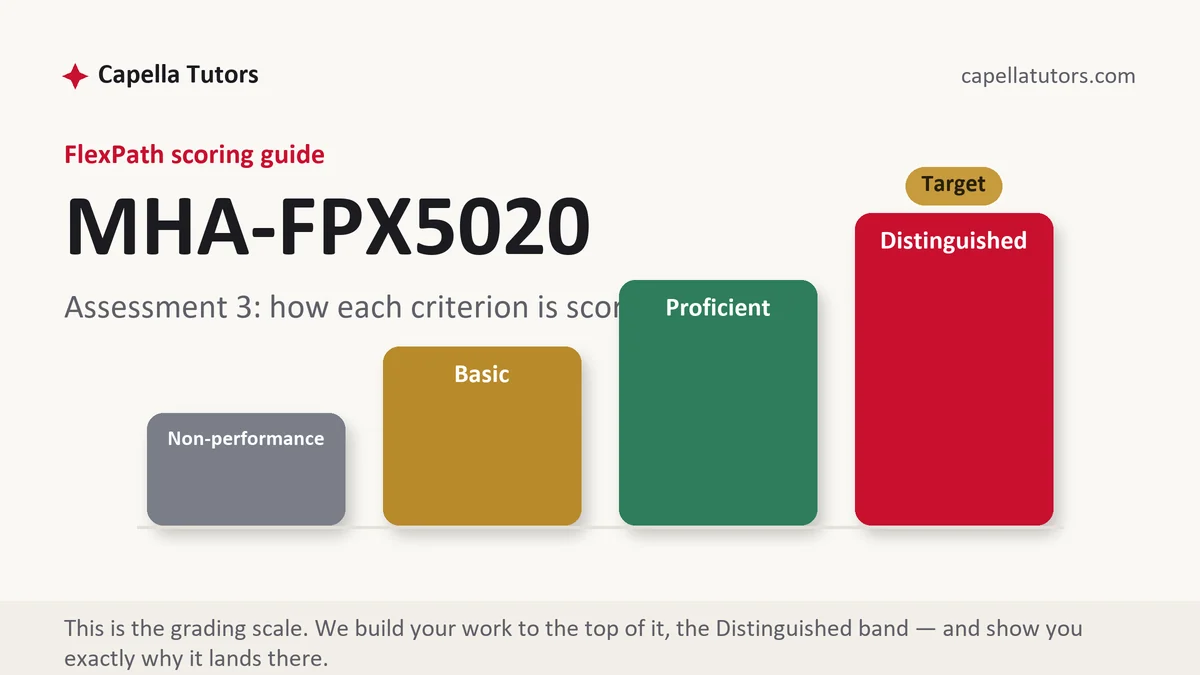
How MHA FPX 5020 Assessment 3 is scored
Four levels again, applied to a plan rather than to an argument. The wording in each cell is what a reviewer holds your document against:
| Level | What it means on an implementation and measurement plan |
|---|---|
| Distinguished | Volumes and hours reconcile with the financial model line for line, every measure could be recomputed by a stranger, and the plan names who does the work on which shift. Compare the two top descriptions word by word and write to the difference. |
| Proficient | The plan is complete and workable and the measures are defined. Workable, and never tested against the numbers in the rest of the project. |
| Basic | A timeline with phases and no staffing arithmetic, and measures named without numerators, denominators or windows. |
| Non-performance | A required part of the plan is absent, most often the measurement section or the governance path. Nothing there means nothing to score. |
Reconciliation is the whole examination at this stage. Walk every number that appears in two places and confirm it appears identically in both, because a volume that changes between the pro forma and the staffing plan is the defect a capstone evaluator is most reliably hunting for.
The MHA FPX 5020 Assessment 3 method, step by step
-
Convert volume into hours before you convert hours into people
Take the case volume from the assumptions table, multiply by the time each case consumes, add travel, documentation and handoff, and only then divide into positions. Working the other way round produces a staffing model that matches your intuition and nothing else in the document.
-
Staff the schedule, not the average
Demand is not flat, so a plan built on an average day will be short every weekday afternoon and idle every Sunday morning. Show coverage by shift and by day, name who covers the gap when somebody is sick, and say what the model does when volume runs 20 percent above plan.
-
Sequence by dependency
List what must be true before each element can start: the contract, the equipment, the credentialing, the build in the record system, the training. A phase plan with no dependencies is a wish list with dates attached, and the first dependency to slip usually decides the whole timeline.
-
Define every measure so a stranger could recompute it
Numerator, denominator, window, exclusions, source system, reporting cadence and the person who receives the report. Print the count beside the rate. Where the outcome is rare, put a process measure underneath it so somebody sees movement before the year is over.
-
Write the governance as decisions rather than as a chart
Which committee approves the workflow, which approves the spend, what the board sees rather than approves, who can stop the program and on what evidence. Then state the review cadence and what happens at the first review if the measures have not moved.
-
Reconcile, then submit early
Set this plan beside the analysis and check the volume, the rates, the period and the unit costs one at a time. Fix the assumptions table wherever the plan taught you something new, and push the correction backwards through the earlier stage. Then submit early, because evaluation can take two business days and the correction cycle is where reconciliation actually happens.
A structure that maps to the criteria
The figures below are planning targets our tutors use for a typical 5020 operating plan, not Capella requirements; give the heaviest criterion the most room.
| Section | What it must do | Guide |
|---|---|---|
| What is being implemented | The intervention as agreed, with the volume and period carried straight from the assumptions table. | ~150 words |
| Workflow | The process end to end, including handoffs, escalation and what happens outside posted hours. | ~300 words |
| Staffing and coverage | Hours derived from volume, then roles, shifts, coverage gaps and the surge case. | ~300 words |
| Sequence and dependencies | What has to be true before each element starts, with the critical dependency named. | ~250 words |
| Measurement plan | Every measure defined so it could be recomputed, with cadence, owner and threshold. | ~300 words |
| Governance, risks and references | Approval path, who can stop it, the review cycle, current APA matched both ways. | ~200 words |
Annotated sample excerpt
A worked paragraph from our writers, included to show how staffing arithmetic should appear on the page. Follow the derivation, then run it on your own volumes.
At a steady state census of 22 patients the hospital-at-home service generates 22 daily nursing visits averaging 74 minutes of contact plus 38 minutes of travel and documentation, which is 41.1 hours a day, or 5.1 nursing full time equivalents once a 1.19 factor for leave, training and non-productive time is applied.1 Physician oversight runs on daily virtual rounds at 9 minutes a patient, 3.3 hours a day, and the paramedic response line is staffed for 14 hours because 91 percent of urgent home responses over two years at the comparison program fell inside that window.2 All three figures use the same 22 patient census as the pro forma in the analysis stage, and the census, the visit length and the leave factor are the three inputs the surge scenario moves.3
- 1Hours are derived from volume and then converted into positions, with the leave factor visible on the page rather than buried in a spreadsheet.
- 2Coverage hours are justified by observed demand rather than by convenience, and the source of that observation is named.
- 3The plan states that it uses the same census as the financial model, which is the reconciliation sentence a capstone evaluator looks for. Figures here are constructed to show the arithmetic.
The full premium sample for your exact assessment, written fresh to your scoring guide and issue, is free to request. Study it, revise it into your own voice, and submit work you understand.
The five mistakes that cost Distinguished
- Positions estimated rather than derived. A staffing number that never passes through hours, so nothing in the plan can be checked against the volume.
- The average day staffed. A model with no shift detail, short every weekday afternoon and unable to say who covers a sick call.
- Phases with no dependencies. Dates attached to activities that cannot start until something else finishes, none of which the plan mentions.
- Measures without definitions. A quality measure named but never specified, so nobody could recompute it and nobody ever will.
- Governance drawn instead of decided. An organization chart where the criterion asked who approves the spend and who has authority to stop the program.
Pre-submission checklist
- Volume converted into hours, then hours into positions, with the leave factor printed
- Coverage shown by shift and by day, with the surge case and the sick call answered
- Dependencies listed, with the one that decides the timeline named
- Every measure carrying a numerator, denominator, window, exclusion rule and owner
- Approval path, stop authority and review cadence written as decisions
- Every shared number reconciled against the analysis stage, current APA both ways
Operating plan stage due?
Send the guide, the analysis and the assumptions table. We derive the staffing from the volume, sequence the dependencies, define every measure so a stranger could recompute it, and reconcile the whole plan against the earlier stage, back inside 24 to 48 hours with free revisions until the criteria clear.