This manual is for MHA FPX 5020 Assessment 2, start to submission. Assessment 2 is where the capstone turns into arithmetic, and the assessment usually asks for the analysis behind the proposal: the evidence read with its designs attached, the cost of the intervention loaded properly, the benefit streams separated so that none is counted twice, and a break-even a committee could argue with. This is the stage where capstones inflate, and the criteria were written by people who know it. Below is the method, a structure that answers the criteria in sequence, and an annotated sample excerpt. Prefer the arithmetic done for you? A premium original sample for this assessment comes back within 24 to 48 hours with free revisions until the guide is met. Capella's catalog lists the course as MHA-FPX5020, and some courserooms print MHA5020; both point to this same Assessment 2.
One honesty note before the manual: Capella revises courses and scoring guides over time, so always write to the exact scoring guide attached to your assessment in the courseroom. The course identity above is verified on capella.edu; the method and structure below are our tutors' approach to it, not Capella's official rubric text.
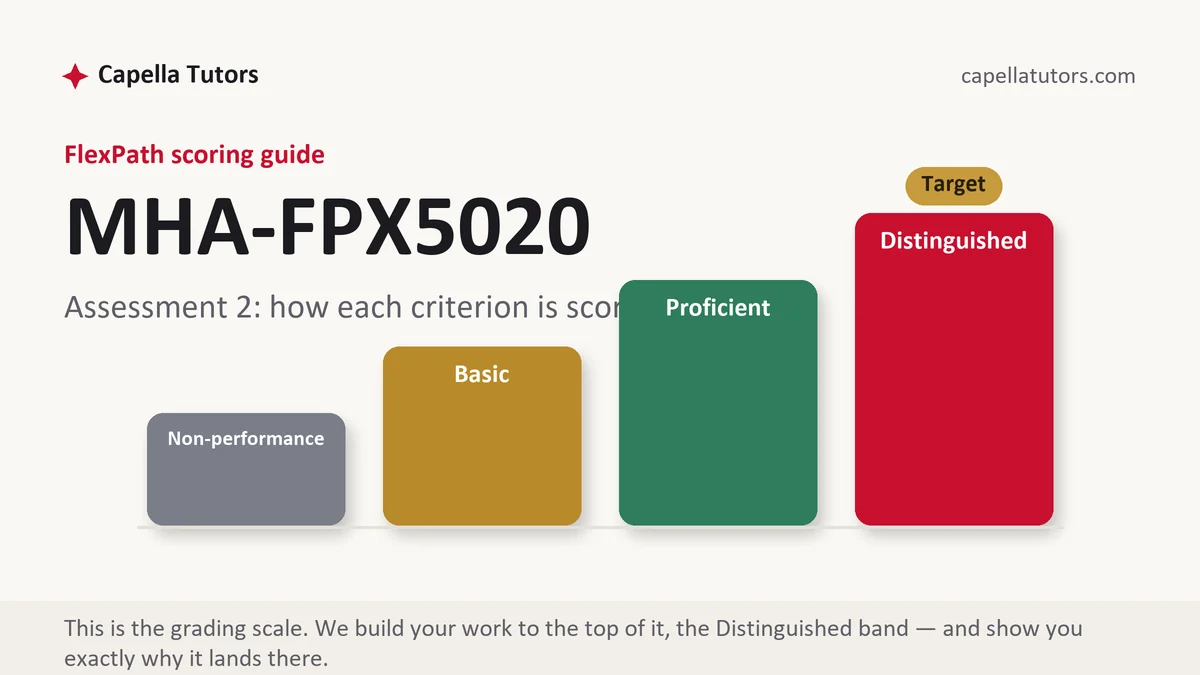
How MHA FPX 5020 Assessment 2 is scored
The scale is the same set of four levels the rest of the program uses, and on a financial and evidentiary analysis they land like this:
| Level | What it means on a capstone analysis |
|---|---|
| Distinguished | Benefit streams that cannot coexist are kept apart, borrowed effect sizes are discounted with the discount explained, and the weakest assumption is tested and reported. Whatever the Distinguished text names that Proficient does not is the paragraph you have not written yet. |
| Proficient | The analysis is complete, the model adds up and the evidence supports the direction. Correct, and quietly optimistic in a way nobody has been asked to check. |
| Basic | A cost saving built from the most favorable published result, with every stream counted and nothing tested. |
| Non-performance | A required component is missing, usually the cost side or the sensitivity. An analysis that is not there cannot be scored. |
The strongest capstone analyzes often conclude that the project roughly breaks even on money and earns its approval on measured performance instead. That paper outscores a fabricated three to one return every time, because a reviewer with operating experience can tell the difference in about a minute.
The MHA FPX 5020 Assessment 2 method, step by step
-
Separate the streams before you add anything up
Avoided variable cost, contribution from a backfilled bed, avoided penalty exposure, new revenue and released staff time are five different things, and at least two of them usually cannot both be true. Put them on separate lines, then say in the text which combination the model is claiming and why that combination is the honest one.
-
Discount the borrowed effect
Every effect size you cite was measured somewhere else with a different payer mix and different staffing, and the literature in most of these areas includes well run studies that found nothing at all. Quote the spread rather than the best arm, apply a discount, say how large it is, and name the local condition that would have to hold for even the discounted figure to appear.
-
Cost the thing fully
Salaries fully loaded, the space, the equipment, the software, the time the change takes out of production, and the first year ramp during which nothing works properly yet. A model that omits the ramp overstates year one benefit and shortens the payback period, and both errors are visible to a reader who has run a program.
-
Run the break-even in the reader's units
Give the number of cases, days or encounters at which the project pays for itself, then say whether the organization can plausibly reach it. A break-even the volume cannot support is one of the most useful findings a capstone analysis can produce, and reporting it honestly scores well.
-
Test the assumption most likely to be wrong
Halve the effect size and print what happens: the benefit, the net position, and the cost per unit of outcome achieved. That figure is the one a committee should be asked to approve or refuse, and putting it on the page is what the top of the guide is describing.
-
Reconcile against the proposal, then submit early
Every volume, rate and period in this analysis has to match the assumptions table you opened at the start. Walk them one at a time. Then submit early in the week, because evaluation takes up to two business days and the next stage depends on these numbers being settled.
A structure that maps to the criteria
Treat the targets below as our tutors' planning figures for a typical 5020 analysis stage, not as Capella limits; the criterion carrying the most weight should get the most words.
| Section | What it must do | Guide |
|---|---|---|
| Analytical question | What this analysis has to establish before the recommendation could be defensible. | ~150 words |
| Evidence review | Effect sizes with their designs, the spread of published results, and the discount you apply. | ~300 words |
| Cost of the intervention | Staffing, space, equipment, software and ramp, each fully loaded and either sourced or labeled. | ~300 words |
| Benefit streams | Each stream on its own line, with the streams that cannot coexist explicitly separated. | ~300 words |
| Break-even and sensitivity | The volume at which it pays for itself, and what happens at half the assumed effect. | ~250 words |
| What the analysis cannot settle, and references | The unresolved question, the measure that would settle it, current APA both ways. | ~150 words |
Annotated sample excerpt
An original worked paragraph from our team, showing how a benefit case reads when the writer has refused the easy addition. Study the logic, then run it on your own project.
Diverting 1,150 behavioral health presentations a year from the emergency department to a 16 chair crisis stabilization unit releases 6,440 boarding hours, and there are two ways to value those hours which cannot both be counted.1 Treated as avoided cost, 6,440 hours at $92 of variable departmental cost is $592,000; treated as released capacity, the same hours accommodate roughly 1,600 additional lower acuity visits at $148 of contribution each, or $237,000, and this model reports the second figure because the department runs at 94 percent occupancy and the space will refill.2 Against that, the unit costs $1.94 million a year fully loaded, so the project does not pay for itself on throughput, and its case rests instead on the 41 percent of diverted patients who currently wait more than twelve hours for a psychiatric bed.3
- 1The double counting trap is named before either figure is quoted, which is exactly the sentence the criteria reward.
- 2The model chooses between the two streams and gives an operational reason for the choice rather than simply taking the larger one.
- 3The analysis reaches an unfavorable conclusion and keeps going, which is stronger than a favorable one nobody believes. Every amount here is constructed to show the method.
The full premium sample for your exact assessment, written fresh to your scoring guide and issue, is free to request. Study it, revise it into your own voice, and submit work you understand.
The five mistakes that cost Distinguished
- Both streams counted. Selling the same released capacity as a cost saving and as room for growth, which an experienced reader spots immediately.
- The best published arm. A borrowed effect applied at full strength, with no discount and no mention of the studies that found nothing.
- Salaries without loading. Base pay used where fully loaded cost belongs, understating the program by roughly a quarter before anything else goes wrong.
- No ramp in the first year. A model assuming full performance from the opening month, which shortens the payback period artificially.
- A sensitivity nobody ran. A single point estimate presented as the answer, leaving a committee with no idea which assumption it is really approving.
Pre-submission checklist
- Benefit streams listed separately, with incompatible ones explicitly separated
- Every borrowed effect discounted, with the size of the discount and the reason printed
- Costs fully loaded, the ramp included, each line sourced or labeled as an assumption
- A break-even stated in units the organization can compare against its own volume
- One sensitivity run at half the assumed effect, with the cost per unit of outcome printed
- Every figure reconciled against the assumptions table, current APA matched both ways
Capstone analysis stage due?
Send the guide, the assumptions table and whatever the earlier stage established. We build the cost model, separate the benefit streams, discount the borrowed effect and run the sensitivity, back as a premium original sample inside 24 to 48 hours. Revisions are free and unmetered until every criterion clears.