This manual is for MHA FPX 5020 Assessment 1, start to submission. Assessment 1 opens the Health Administration Capstone, and the assessment usually asks you to define the project itself: the organization, the population, the gap with a magnitude and a boundary around it, and the decision a committee would eventually be asked to make. There is no placement to arrange and no preceptor to find, since the program carries no practicum requirement, so the whole weight of this stage falls on making the problem worth an executive's attention. What follows is the method our tutors use at this stage, a structure that maps onto the criteria, and an annotated sample excerpt. Would you rather hand the stage over? A premium original sample for this assessment returns in 24 to 48 hours, revised free until the criteria clear. Capella's catalog lists the course as MHA-FPX5020, and some courserooms print MHA5020; both point to this same Assessment 1.
One honesty note before the manual: Capella revises courses and scoring guides over time, so always write to the exact scoring guide attached to your assessment in the courseroom. The course identity above is verified on capella.edu; the method and structure below are our tutors' approach to it, not Capella's official rubric text.
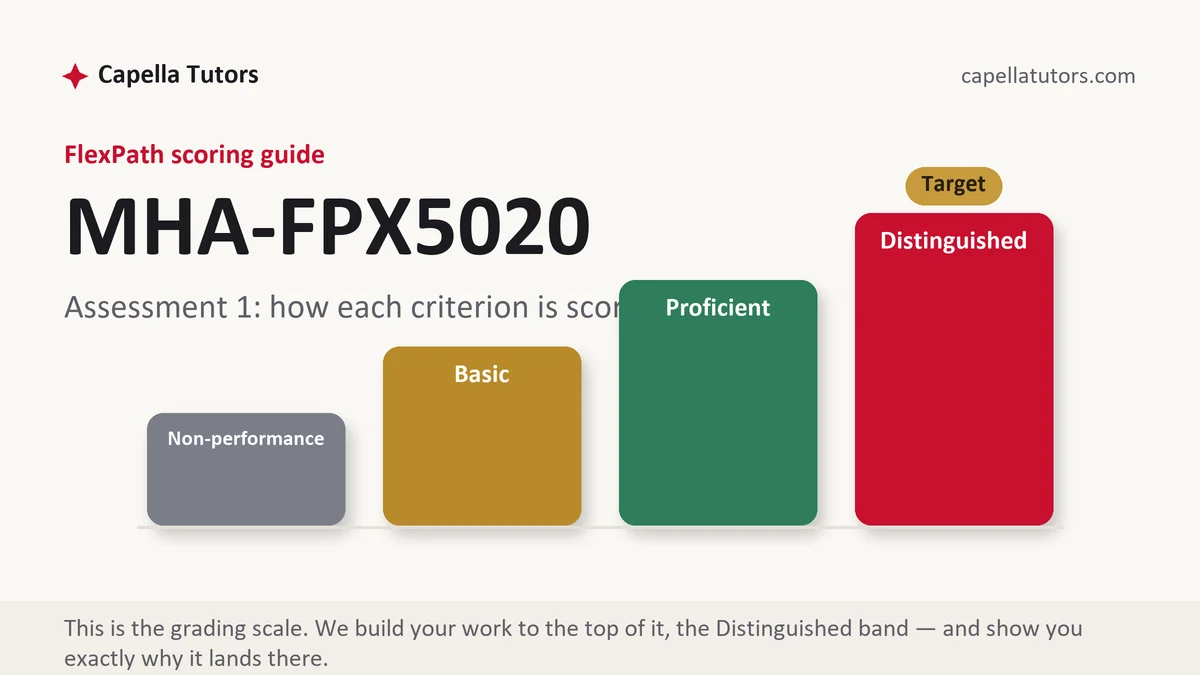
How MHA FPX 5020 Assessment 1 is scored
Capstone criteria use the same four levels as every other FlexPath course, and they are read the same way, one row at a time, with the level text serving as the brief:
| Level | What it means on a capstone proposal |
|---|---|
| Distinguished | The gap has a magnitude, a boundary and a comparison somebody could dispute, the baseline period is fixed for the whole project, and the proposal says what would make this project not worth doing. The clause the top row adds is the one to answer in a sentence of its own. |
| Proficient | The problem is defined, the organization described and the project scoped. Solid, and easy to inflate later because nothing has been pinned to a number yet. |
| Basic | A topic rather than a problem, described sympathetically, with no measured gap and no boundary around who is affected. |
| Non-performance | A required element never appears, most often the baseline or the comparison. A criterion with no material underneath it cannot rise. |
Whatever you fix here you inherit for the rest of the project. A vague population or an unstated baseline period will still be producing contradictions two stages later, when the financial model and the measurement plan quietly stop describing the same organization.
The MHA FPX 5020 Assessment 1 method, step by step
-
Read the later criteria before drafting the early ones
A capstone's closing work usually needs a figure the opening work was supposed to have produced. Read the whole guide first, note every number a later criterion will demand, then build this stage so those numbers exist and are defined in one place.
-
Open the assumptions table on day one
One table holding the volume, the baseline rates, the unit costs, the period and the source or basis for each. Everything the project ever says about itself is quoted from it. That single habit is what separates an integrated capstone from four assignments in a folder.
-
Give the gap a magnitude and an edge
State the size of the problem, the population it belongs to, the period it was measured over, and the comparison you are calling a gap. A problem nobody can dispute is a problem nobody has stated precisely, and precision here is what makes the rest of the project possible.
-
Choose an organization you can source
Where an employer will release figures, ask permission before using anything not already public and keep patient level detail out of the document entirely. Where it will not, build the project on a comparable public system and say so in the text, which is legitimate and often produces a cleaner paper because every number in it is citable.
-
Name the decision and the decider
Say which committee would approve this, what the board would see rather than approve, and what the organization does if nothing changes. A capstone with no named approval path reads as an essay about a hospital rather than as a proposal to one.
-
Sanity check the scope, then submit early
A capstone that changes its subject later cannot be reconciled afterwards, so test now whether the project can carry a financial model, an operating plan and a measurement plan. Then submit early in the week, since evaluation takes up to two business days and each stage feeds the next.
A structure that maps to the criteria
The word targets below are our tutors' planning figures for a typical 5020 proposal, not Capella rules; expand whichever section your scoring guide loads with criteria.
| Section | What it must do | Guide |
|---|---|---|
| Organization and context | Structure, ownership, payer environment, the service in question and the population it serves. | ~250 words |
| The problem | The gap, its magnitude, its boundary, the period and the comparison being used against it. | ~300 words |
| Why it matters now | The financial, operational, regulatory and reputational consequences of leaving it alone. | ~250 words |
| Preliminary evidence | What the literature and the benchmarks suggest is achievable, with the designs named. | ~250 words |
| Scope, assumptions and data plan | What the project will and will not cover, the assumptions table, and where each figure will come from. | ~250 words |
| Approval path and references | Who decides, what the board sees, the project timeline, current APA matched both ways. | ~150 words |
Annotated sample excerpt
A model paragraph our writers produced to show what a defined problem looks like on the page. Take the structure and rebuild it around your own organization.
The employed multispecialty group has 214 physicians paid almost entirely on work relative value units, and in the last complete fiscal year 61 percent of the group's revenue arrived through contracts holding the organization accountable for total cost and quality, so the group is paid one way and rewarded another.1 The gap is measurable rather than philosophical: 9 percent of compensation is tied to anything other than volume, against a 22 percent median for comparable employed groups in the published survey used throughout this project, and closing two thirds of that distance would move roughly $14.8 million of a $73 million compensation pool onto different terms.2 The project is bounded to the seven primary care and medical specialties inside those contracts, uses the last complete fiscal year as the baseline for every figure in every later stage, and excludes the hospital-based specialties whose contracts are negotiated separately.3
- 1The problem is a contradiction between two facts about the same organization, which opens far more strongly than a paragraph about alignment.
- 2The gap carries a size, a comparison and a consequence in dollars, so a committee can argue with it. Amounts here are constructed to demonstrate the structure.
- 3Boundary and baseline period are fixed inside the proposal, which is what makes the later stages reconcilable at all.
The full premium sample for your exact assessment, written fresh to your scoring guide and issue, is free to request. Study it, revise it into your own voice, and submit work you understand.
The five mistakes that cost Distinguished
- A mood instead of a problem. Improving alignment or enhancing engagement cannot be measured, so nothing built on top of it can be reconciled later.
- No baseline period. A project whose figures come from whichever year happened to be available will contradict itself by the third stage.
- A population with soft edges. If a reader cannot tell who is in and who is out, no denominator anywhere in the project can be trusted.
- An organization nobody can source. Choosing a setting whose numbers are neither public nor releasable leaves every later stage resting on invention.
- No approval path. A proposal that never names who could say yes is an essay, and the governance criterion is left with nothing to grade.
Pre-submission checklist
- The gap stated with a magnitude, a boundary, a period and a comparison
- One assumptions table opened, with a source or a basis beside every figure
- The organization sourceable, with permission settled or a public substitute named
- Later criteria read, and every figure they will demand identified now
- The approval path named, including what the board sees rather than approves
- Self-scored on every criterion, current APA both ways, submitted early in the week
Capstone proposal due?
Send the guide and the organization, and the assumptions table comes back with the draft so nothing drifts between stages. An eight person pipeline returns a premium original sample inside 24 to 48 hours, with a reviewer assigned to nothing except checking that a number appearing twice appears identically. Revisions are free until the criteria clear.