This manual is for MHA FPX 5014 Assessment 3, start to submission. In current courserooms, Assessment 3 of Healthcare Quality, Risk, and Regulatory Compliance is a cost-benefit analysis of a quality improvement program, for example a transitional care management program that follows patients from discharge into the community: the stakeholders and what they care about, the value proposition for the change, strategies to make the change happen, the costs and benefits over several years with stated assumptions and discounting, and internal and external benchmarks. The grade turns on the numbers and their assumptions. A spreadsheet without assumptions, or benefits that are asserted rather than calculated, caps the analysis at Proficient. Below is the method our tutors use, a structure that maps to the criteria, and an annotated sample excerpt. Prefer to hand it off? A premium original sample for this exact assessment comes back in 24 to 48 hours, revised free until it meets the guide. Capella's catalog lists the course as MHA-FPX5014, and some courserooms print MHA5014; both point to this same Assessment 3.
One honesty note before the manual: Capella revises courses and scoring guides over time, so always write to the exact scoring guide attached to your assessment in the courseroom. The course identity above is verified on capella.edu; the method and structure below are our tutors' approach to it, not Capella's official rubric text.
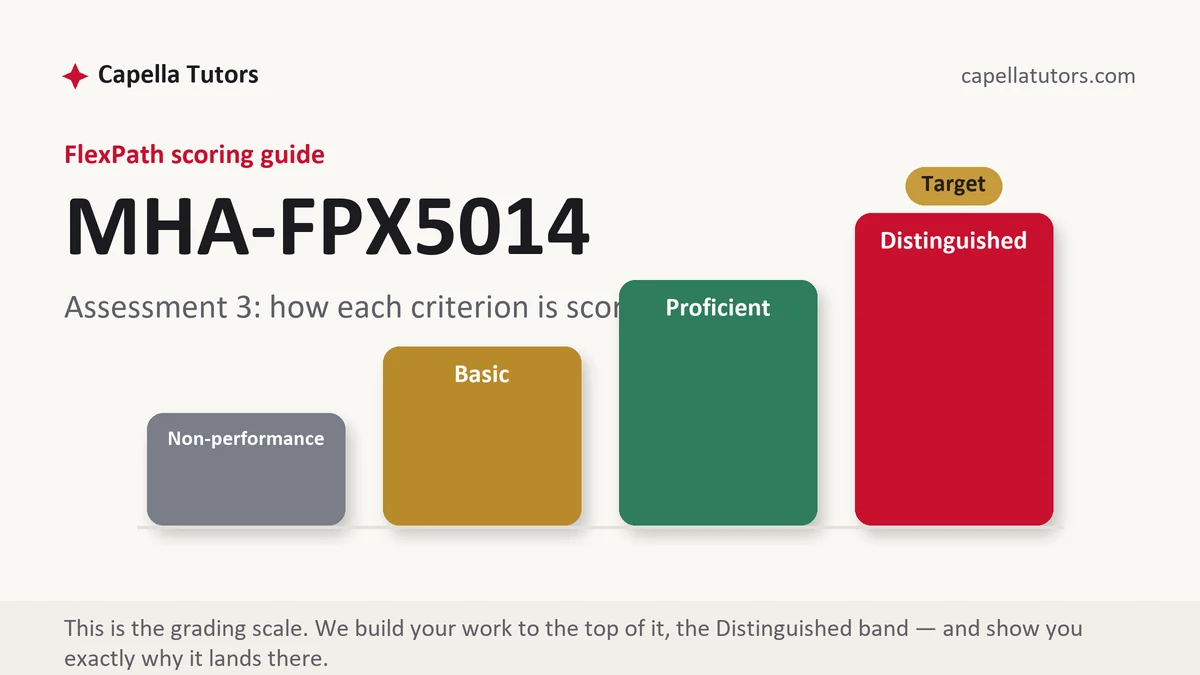
How MHA FPX 5014 Assessment 3 is scored
FlexPath does not use letter grades. Each criterion in the scoring guide lands on one of four levels, and the level descriptions are the real writing brief:
| Level | What it means on a cost-benefit analysis |
|---|---|
| Distinguished | Stakeholder interests are identified, the value proposition is clear, costs and benefits are itemized over the time horizon with assumptions and present value, benchmarks support the estimates, and the conclusion follows from the numbers. |
| Proficient | The analysis is complete and correct, but assumptions are thin or benchmarks are missing. |
| Basic | Costs and benefits are described without calculation. |
| Non-performance | The cost-benefit table, the assumptions or the stakeholder analysis is missing. |
Build the table first, then write around it. The narrative should explain every number a reader might question.
The MHA FPX 5014 Assessment 3 method, step by step
-
Define the program
What the program does, for whom, and the outcome it targets, such as thirty-day readmissions.
-
Identify stakeholders
Patients, clinicians, finance, payers and community partners, with what each values.
-
State the value proposition
Why the change is worth making, in quality and financial terms.
-
Itemize costs and benefits
Staff, technology and training costs; avoided readmissions, penalties and reimbursement gains, by year.
-
State assumptions and discount
Volumes, rates and costs used, and the discount rate for present value.
-
Benchmark and conclude
Compare with published results and internal data, then give the benefit-cost ratio and recommendation.
A structure that maps to the criteria
Word counts are planning targets our tutors use, not Capella rules; follow the length and format your scoring guide states.
| Section | What it must do | Guide |
|---|---|---|
| Abstract or introduction | The program and the purpose of the analysis. | ~125 words |
| Stakeholders | Who is affected and what they value. | ~150 words |
| Value proposition and change strategies | Why and how to make the change. | ~200 words |
| Cost-benefit analysis and assumptions | Itemized table with assumptions and present value. | ~200 words plus table |
| Benchmarks | Internal and external comparisons. | ~125 words |
| Conclusion and references | Ratio, recommendation, then current APA. | ~100 words |
Annotated sample excerpt
An original model excerpt from our team, written to show the register that reaches the top of the guide. Learn the moves, then write your own version.
The analysis assumes 1,200 eligible discharges a year, a baseline thirty-day readmission rate of 18 percent, and a 20 percent relative reduction once the program is running, which is within the range reported in published evaluations of transitional care programs.1 Each avoided readmission is valued at the hospital's average variable cost of 9,800 dollars, and benefits are discounted at 3 percent over five years so they can be compared with the up-front cost of two transition nurses and the scheduling software.2 If the reduction were only half as large, the program would still return slightly more than it costs, which is the sensitivity result that matters most to the finance committee.3
- 1States the key assumptions with their sources.
- 2Explains how benefits are valued and discounted.
- 3Adds a sensitivity check that addresses the obvious objection.
The full premium sample for your exact assessment, written fresh to your scoring guide and topic, is free to request. Study it, revise it into your own voice, and submit work you understand.
The five mistakes that cost Distinguished
- Benefits asserted, not calculated. Put numbers on each benefit.
- Hidden assumptions. State every assumption and its source.
- No discounting. Use present value over the time horizon.
- No benchmarks. Compare with published and internal results.
- A conclusion that ignores the numbers. Let the ratio drive the recommendation.
Pre-submission checklist
- Program and outcome defined
- Stakeholders and their interests
- Value proposition and change strategies
- Itemized multi-year costs and benefits with present value
- Assumptions and benchmarks stated
- Conclusion and current APA references
Want the cost-benefit analysis built?
Send the scoring guide and the program you chose. Our team returns a premium original analysis with its table in 24 to 48 hours, revised free until it meets the guide.