This manual is for MHA FPX 5014 Assessment 2, start to submission. This assessment is an internal memo to the organization's risk management team about risk financing: a patient safety issue with the metrics and key performance indicators that show the risk, strategies for identifying risk financing issues, recommendations for how the organization should finance that risk, such as insurance, self-insurance or reserves, and the legal and ethical financial obligations involved. The grade turns on connecting safety to money. A memo that links a measured safety risk to a specific financing approach, with its trade-offs, scores above one that describes risk management in general. Below is the method our tutors use, a structure that maps to the criteria, and an annotated sample excerpt. Prefer to hand it off? A premium original sample for this exact assessment comes back in 24 to 48 hours, revised free until it meets the guide. Capella's catalog lists the course as MHA-FPX5014, and some courserooms print MHA5014; both point to this same Assessment 2. In current courserooms this assessment typically appears as "Internal Memo: Risk Financing".
One honesty note before the manual: Capella revises courses and scoring guides over time, so always write to the exact scoring guide attached to your assessment in the courseroom. The course identity above is verified on capella.edu; the method and structure below are our tutors' approach to it, not Capella's official rubric text.
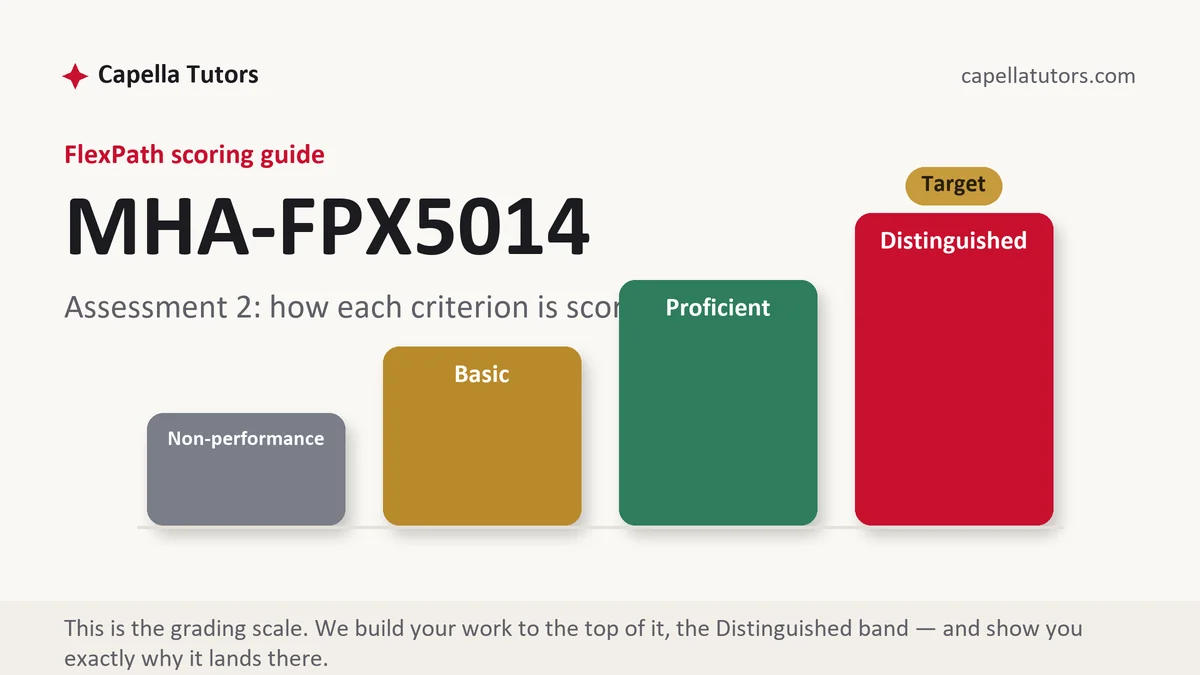
How MHA FPX 5014 Assessment 2 is scored
FlexPath does not use letter grades. Each criterion in the scoring guide lands on one of four levels, and the level descriptions are the real writing brief:
| Level | What it means on a risk financing memo |
|---|---|
| Distinguished | The safety issue is quantified with KPIs, risk identification strategies are specific, financing options are compared with trade-offs, recommendations are justified, legal and ethical obligations are accurate, and the memo format is professional. |
| Proficient | The memo is complete and accurate, but financing options are not compared and KPIs are general. |
| Basic | The memo discusses the safety issue with little about financing. |
| Non-performance | The KPIs, the financing recommendations or the legal and ethical section is missing. |
Use memo format: to, from, date and subject, then short headed sections. Evaluators read it as a professional document.
The MHA FPX 5014 Assessment 2 method, step by step
-
State the safety issue with data
For example falls with injury or medication errors, with the organization's figures.
-
Choose KPIs
Rates, claims frequency and severity, and cost per event, each defined.
-
Explain how risk financing issues are identified
Claims analysis, incident reporting trends, actuarial review and benchmarking.
-
Compare financing options
Commercial insurance, self-insurance, captives, reserves or risk transfer, with costs and trade-offs.
-
Recommend
The approach that fits the organization's size, risk profile and finances.
-
Address legal and ethical obligations
Duty to compensate injured patients, reporting requirements and transparency.
A structure that maps to the criteria
Word counts are planning targets our tutors use, not Capella rules; follow the length and format your scoring guide states.
| Section | What it must do | Guide |
|---|---|---|
| Memo heading and purpose | To, from, date, subject and purpose. | ~50 words |
| Patient safety issue and metrics | The issue with data. | ~150 words |
| Key performance indicators | KPIs defined, often as a table. | ~100 words plus table |
| Identifying risk financing issues | Strategies to identify them. | ~150 words |
| Recommendations for risk financing | Options compared and the recommendation. | ~200 words |
| Legal and ethical obligations and references | Duties, then current APA. | ~125 words |
Annotated sample excerpt
An original model excerpt from our team, written to show the register that reaches the top of the guide. Learn the moves, then write your own version.
Falls with injury produced eleven claims over the past three years, most of them small but two above 250,000 dollars, a pattern of frequent low-cost events with occasional severe ones.1 For that pattern, a combination works better than either option alone: self-insure the predictable layer through a funded reserve sized from the last three years of claims, and keep commercial excess coverage for the rare large loss.2 The reserve also gives the hospital a direct financial reason to invest in prevention, because every avoided fall is money that stays in the fund, which is the link between safety and financing this memo is meant to make.3
- 1Describes the claims pattern that drives the financing choice.
- 2Recommends a combined approach and explains why it fits.
- 3Connects the financing decision back to prevention.
The full premium sample for your exact assessment, written fresh to your scoring guide and topic, is free to request. Study it, revise it into your own voice, and submit work you understand.
The five mistakes that cost Distinguished
- Risk management in general. Focus on how the risk is financed.
- Undefined KPIs. Define each indicator.
- One option only. Compare financing approaches.
- Ignoring legal duties. Address obligations to patients and regulators.
- Essay format. Write it as a memo.
Pre-submission checklist
- Memo format
- Safety issue quantified
- KPIs defined
- Risk financing identification strategies
- Financing options compared and recommended
- Legal and ethical obligations, current APA
Want the risk financing memo written?
Send the scoring guide and the safety issue. Our team returns a premium original memo in 24 to 48 hours, revised free until it meets the guide.