This manual is for MHA FPX 5014 Assessment 1, start to submission. The Regulatory Environment Executive Summary asks you to brief leadership on one quality or patient safety issue, such as health care-associated infections or hospital-acquired conditions: the regulatory and accreditation requirements that apply, the risk-management implications of falling short, the resources needed, a culture statement, how the issue will be measured and monitored, the improvement it supports, and the ethical considerations, often with an executive summary table. The grade turns on precision about the rules. Naming the specific requirement, the agency that enforces it and the consequence of non-compliance scores far above general statements about safety. Below is the method our tutors use, a structure that maps to the criteria, and an annotated sample excerpt. Prefer to hand it off? A premium original sample for this exact assessment comes back in 24 to 48 hours, revised free until it meets the guide. Capella's catalog lists the course as MHA-FPX5014, and some courserooms print MHA5014; both point to this same Assessment 1. In current courserooms this assessment typically appears as "Regulatory Environment Executive Summary".
One honesty note before the manual: Capella revises courses and scoring guides over time, so always write to the exact scoring guide attached to your assessment in the courseroom. The course identity above is verified on capella.edu; the method and structure below are our tutors' approach to it, not Capella's official rubric text.
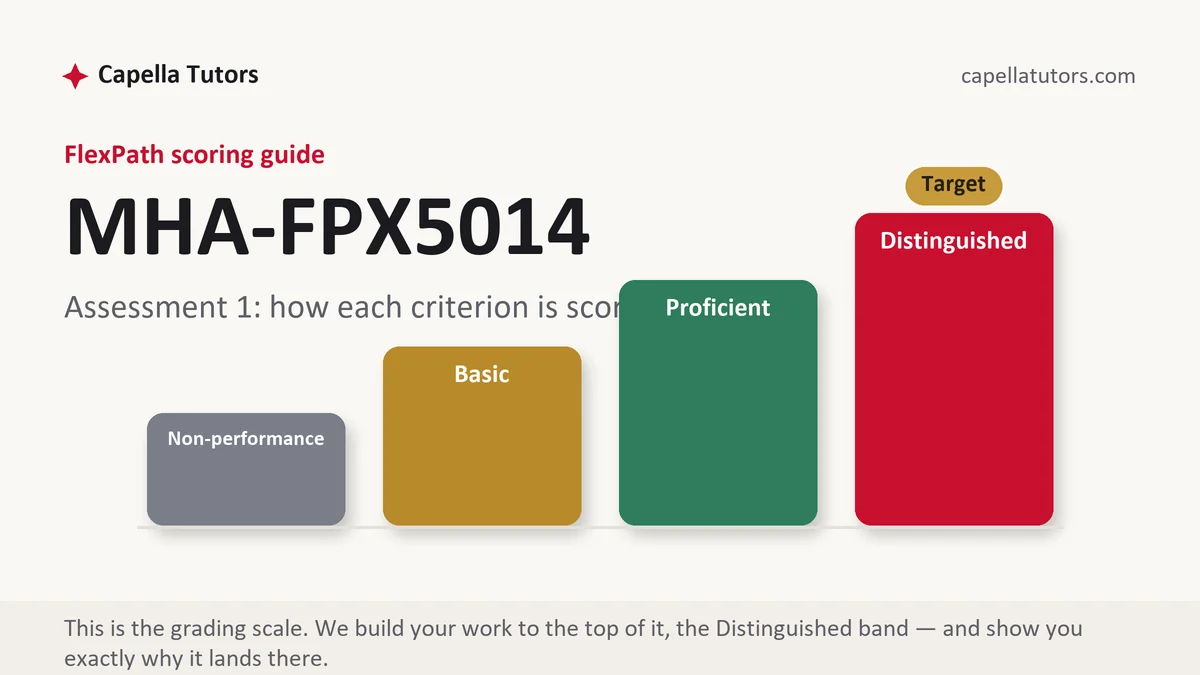
How MHA FPX 5014 Assessment 1 is scored
FlexPath does not use letter grades. Each criterion in the scoring guide lands on one of four levels, and the level descriptions are the real writing brief:
| Level | What it means on a regulatory executive summary |
|---|---|
| Distinguished | The issue is sized with data, specific regulations and standards are cited accurately, risk implications are concrete, resources and monitoring are practical, ethics are addressed, and the summary reads well for executives. |
| Proficient | All parts are present and accurate, but regulations are named generally and monitoring is thin. |
| Basic | The summary discusses the issue with little reference to specific requirements. |
| Non-performance | The regulatory requirements, risk implications or monitoring plan are missing. |
Write for executives: short sections, the key facts first, and the summary table completed if your courseroom supplies one.
The MHA FPX 5014 Assessment 1 method, step by step
-
Choose and size the issue
One issue with organizational or national data, such as catheter-associated urinary tract infection rates.
-
Cite the requirements
CMS Conditions of Participation, CMS hospital-acquired condition and value-based programs, The Joint Commission standards, state rules, as they apply.
-
Explain risk-management implications
Penalties, reimbursement loss, accreditation findings, liability and reputation.
-
Name resources
Staff, training, technology and budget needed to address the issue.
-
Set measurement and monitoring
The metrics, data sources, frequency and who reviews them.
-
Address culture and ethics
A short culture statement and the ethical duties, such as transparency with patients.
A structure that maps to the criteria
Word counts are planning targets our tutors use, not Capella rules; follow the length and format your scoring guide states.
| Section | What it must do | Guide |
|---|---|---|
| Healthcare issue | The issue and its size. | ~100 words |
| Regulatory requirements | Specific rules and standards. | ~150 words |
| Risk-management implications | Consequences of non-compliance. | ~100 words |
| Resources and culture statement | What is needed and the commitment. | ~100 words |
| Measuring, monitoring and improvement | Metrics and review. | ~100 words |
| Ethics, references and summary table | Ethical duties, current APA, the table if required. | ~75 words plus table |
Annotated sample excerpt
An original model excerpt from our team, written to show the register that reaches the top of the guide. Learn the moves, then write your own version.
Catheter-associated urinary tract infections fall under two sets of requirements at once: CMS treats them as a hospital-acquired condition, which affects payment, and The Joint Commission's National Patient Safety Goals require hospitals to implement evidence-based practices to prevent them.1 Our current rate of 1.9 infections per 1,000 catheter days is above the national benchmark the hospital reports against, which exposes us to payment reductions under the HAC Reduction Program if our overall score falls in the worst-performing quartile.2 The risk is therefore financial and accreditation-related at the same time, which is why this summary asks for a prevention bundle and monthly reporting to the quality committee.3
- 1Names the specific requirements and the agencies behind them.
- 2Connects the organization's data to a concrete consequence.
- 3Turns the risk into a clear request for leadership.
The full premium sample for your exact assessment, written fresh to your scoring guide and topic, is free to request. Study it, revise it into your own voice, and submit work you understand.
The five mistakes that cost Distinguished
- General statements about safety. Cite the specific requirement.
- No data. Size the issue with figures.
- Risk without consequence. Say what non-compliance costs.
- Monitoring left vague. Name metrics, frequency and owner.
- Long paragraphs. Executives need a scannable summary.
Pre-submission checklist
- Issue sized with data
- Specific regulations and standards cited
- Risk-management implications concrete
- Resources and culture statement
- Measurement and monitoring plan
- Ethics, summary table if required, current APA
Want the executive summary written?
Send the scoring guide and the issue you chose. Our team returns a premium original summary in 24 to 48 hours, revised free until it meets the guide.