This manual is for MHA FPX 5012 Assessment 3, start to submission. The closing deliverable turns the diagnosis into an accountability structure. The assessment usually asks for a change plan in which every recommendation names the body that owns it, the executive answerable for it, the cadence at which it is reviewed and the evidence that will show it worked. The criteria are looking for authority as much as for ideas, so a recommendation landing on a body that cannot carry it out fails whatever its merits. FlexPath marks each criterion once against the guide in your courseroom. Below is the assignment order our tutors use, the sections behind it, and an annotated sample excerpt. Rather hand it over? A premium original sample for this exact assessment comes back in 24 to 48 hours with owners and cadence already in place, revised free until the criteria clear. Capella's catalog lists the course as MHA-FPX5012, and some courserooms print MHA5012; both point to this same Assessment 3.
One honesty note before the manual: Capella revises courses and scoring guides over time, so always write to the exact scoring guide attached to your assessment in the courseroom. The course identity above is verified on capella.edu; the method and structure below are our tutors' approach to it, not Capella's official rubric text.
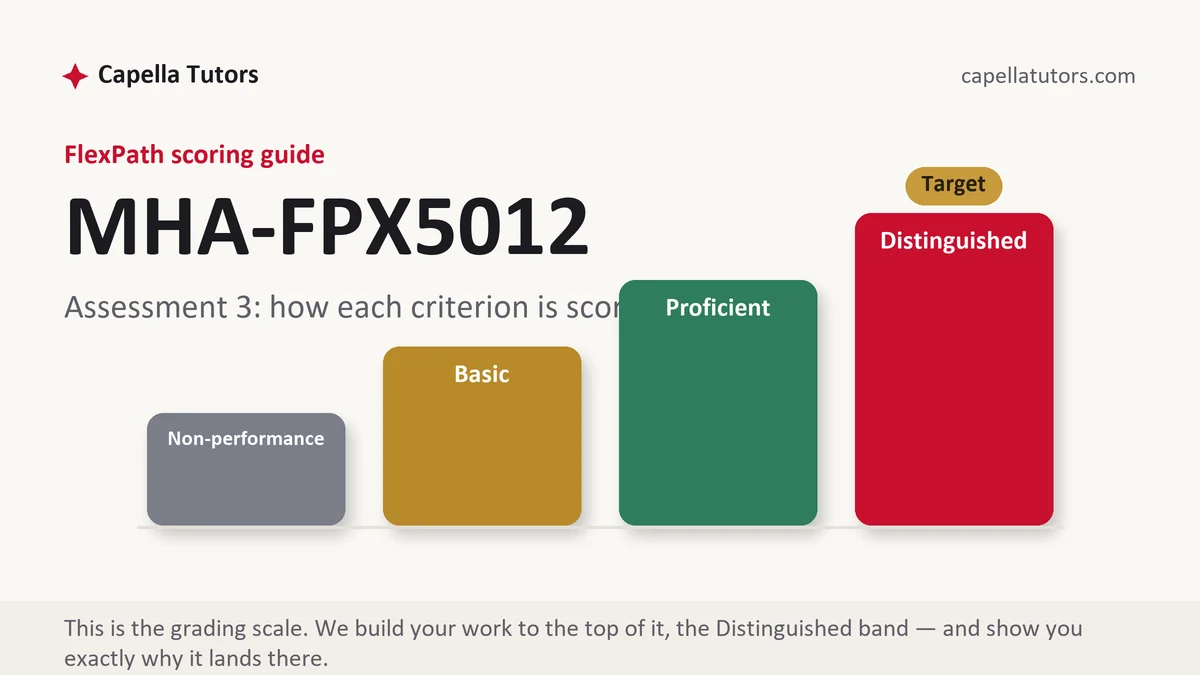
How MHA FPX 5012 Assessment 3 is scored
Each criterion is judged once at one of four levels, and on a change plan the levels are mostly about who is accountable for what:
| Level | What it means on a change and accountability plan |
|---|---|
| Distinguished | Every action has an owning body with the authority to perform it, a review cadence, a threshold that escalates, and evidence of success defined in advance. The final requirement is written into your criterion; put it in the document. |
| Proficient | Actions are sensible, owned and sequenced. What usually holds it below the top is escalation: no threshold, so nothing ever reaches the board. |
| Basic | Recommendations addressed to the organization in general, with leadership should as the owner of record. |
| Non-performance | Owners, measures or the plan itself is absent, and the accountability criteria have nothing to evaluate. |
Draw a line between what the board must approve and what it only needs to see. Both belong in the plan, and confusing them is the fastest way to hand trustees work that belongs to management.
The MHA FPX 5012 Assessment 3 method, step by step
-
Assign every action to a body that can actually perform it
Board, board committee, executive team, medical executive committee, department. Write the owner before the action if it helps, because an action drafted first tends to acquire whichever owner is convenient rather than the one holding the authority.
-
Give the measures denominators, windows and comparisons
A count is not information. A count over a stated volume, across a stated period, against a comparison is. Say who receives the measure, at what threshold it escalates, and what the receiving body does once the threshold trips.
-
Shorten what the board sees
A committee meeting six times a year and receiving forty measures is receiving them, not overseeing them. Recommend a dashboard short enough to be discussed, with thresholds attached, and say which measures move to management review instead.
-
Price the structural changes
A supervisory layer, a new committee, a compliance analyst and a data feed all cost money and somebody's hours. Put the figure beside the recommendation and name the budget it comes from, because unpriced governance advice is the easiest kind to ignore.
-
Respect clinical authority in writing
Anything touching credentialing, practice standards or peer review runs through the medical staff structure. Say so explicitly, describe the route, and do not write a plan that hands administrators decisions the bylaws place elsewhere.
-
Name the recommendation that will stall, then self-score
Say which action is most likely to fail, why, and what the plan does about it. A change plan with no stated failure mode has not been tested by its own author. Then read the draft against each criterion and rewrite anything below the top row.
A structure that maps to the criteria
Planning targets our tutors use on a typical 5012 change plan. The scoring guide attached to your assessment outranks all of them.
| Section | What it must do | Guide |
|---|---|---|
| Problem recap and authority map | The diagnosis in brief, and who holds the authority each action will require. | ~200 words |
| Recommendations | Each action stated plainly, with the owning body and the executive answerable for it. | ~350 words |
| Measures and thresholds | The evidence of success, with denominators, windows, comparisons and escalation points. | ~300 words |
| Board reporting | What reaches the board, in what form, on what cycle, and what stops at management. | ~250 words |
| Resources and clinical route | The cost of each change, and the medical staff route for anything clinical. | ~250 words |
| Failure mode and references | The action most likely to stall, the reason, the response, and APA both ways. | ~200 words |
Annotated sample excerpt
One recommendation from a model plan our team wrote, marked where accountability is actually established rather than implied.
Recommendation 3: the finance committee, not the full board, receives a quarterly service line margin review covering the six lines that account for 71 percent of net revenue, owned by the chief financial officer and prepared from the monthly contribution report finance already produces.1 The escalation threshold is a line falling below a 2 percent contribution margin for two consecutive quarters, or any single quarter below zero, at which point the item moves to the full board with a management response attached rather than as a number on a slide.2 Adding the review costs no new reporting and roughly six analyst hours a quarter, and it deliberately keeps service line decisions with management: the committee's role is to ask why the threshold tripped, not to decide which line closes.3
- 1The owning body, the executive answerable and the source report all appear before any content. An action drafted this way cannot end up with leadership as its owner.
- 2The escalation rule is written in advance with two conditions and a required response, so oversight has a trigger rather than a habit.
- 3The cost is stated and the governance line is defended in the same breath. Saying what the committee will not decide is what keeps the plan on the right side of it.
The full premium sample for your exact assessment, written fresh to your scoring guide and issue, is free to request. Study it, revise it into your own voice, and submit work you understand.
The five mistakes that cost Distinguished
- Leadership as the owner. An action assigned to no named body is an action nobody will be asked about at the next meeting.
- Measures with no trigger. Reporting without a threshold produces attendance rather than oversight, and the criterion notices.
- The forty measure dashboard. A board packet nobody can discuss in the time available guarantees the important number goes past unremarked.
- Administrative capture of clinical decisions. A plan quietly moving credentialing or practice standards under management will be dismissed by any reader who has sat in that room.
- No failure mode. A change plan anticipating nothing going wrong has not been stress tested by the person who wrote it.
Pre-submission checklist
- Every action assigned to a body with the authority to perform it
- An executive named as answerable for each recommendation
- Measures carrying denominators, windows and comparisons
- An escalation threshold with a defined response, written in advance
- The medical staff route stated for anything touching clinical practice
- One named failure mode with the plan's response, APA checked both ways
Change plan due with owners still blank?
Send the diagnosis, the guide and whatever you know about the committee structure. We assign each action to a body that can carry it, attach thresholds and cadence, keep clinical decisions on the clinical route, and name the failure mode. Back inside 24 to 48 hours, revised free until the criteria clear.