This manual is for MHA FPX 5012 Assessment 2, start to submission. The second deliverable asks for leadership applied rather than surveyed. The assessment usually wants you to choose a leadership model, say which behaviors it predicts in the case in front of you, and show what happens when those behaviors meet an independent medical staff, a possibly unionized workforce and a structure nobody entirely controls. Naming a model costs nothing and earns nothing; the criterion is written about what the model explains. Your scoring guide settles the level on each criterion independently of the others. Below is how our tutors choose and apply a model, the sections it fills, and an annotated sample excerpt. Prefer to hand it off? A premium original sample for this exact assessment arrives in 24 to 48 hours with the model already doing work, revised free until the criteria clear. Capella's catalog lists the course as MHA-FPX5012, and some courserooms print MHA5012; both point to this same Assessment 2.
One honesty note before the manual: Capella revises courses and scoring guides over time, so always write to the exact scoring guide attached to your assessment in the courseroom. The course identity above is verified on capella.edu; the method and structure below are our tutors' approach to it, not Capella's official rubric text.
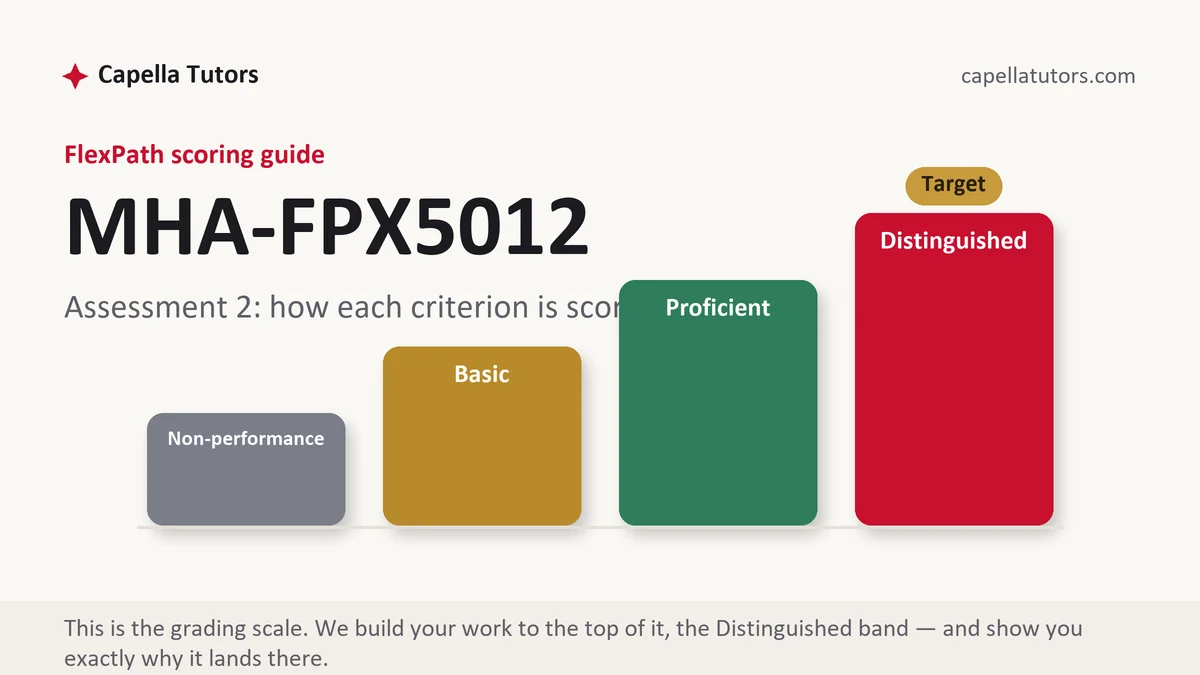
How MHA FPX 5012 Assessment 2 is scored
The guide decides one criterion at a time and rewards application over coverage. On an applied leadership deliverable the levels mean this:
| Level | What it means on an applied leadership analysis |
|---|---|
| Distinguished | One model, chosen before drafting, carried through specific behaviors in a specific setting, and criticized honestly where it stops explaining. The extra move is printed in your criterion; make it word for word. |
| Proficient | The model is applied and the application is coherent. It typically stays a row down for describing behaviors the model predicts without testing them against what the setting allows. |
| Basic | Three models summarized politely, none of them used, with the case restated underneath them. |
| Non-performance | No model, or a model named in the framing and absent from the analysis, which leaves the application criterion with nothing to read. |
One model used precisely outscores three summarized. Cite the original author rather than a leadership textbook, because a model attributed to a survey of models reads as unread to anyone who has taught the course.
The MHA FPX 5012 Assessment 2 method, step by step
-
Pick the model the case demands, before drafting
Transformational where the problem is direction and commitment, situational where one manager faces followers at very different levels of readiness, servant where the argument turns on trust inside a mission driven organization, complexity where the honest description is that nobody controls the system. Choose once and carry it to the last page.
-
Convert the model into behaviors somebody could observe
Not inspires a shared vision. Holds a standing forum where the medical staff sets two agenda items, publishes the decision log within a week, and names the decisions that were never open to consultation. Behaviors are what an evaluator can check the model against.
-
Put the behaviors into this structure
Clinical authority and administrative authority are separate structures in a hospital, and a leadership approach assuming one chain of command will predict the wrong outcome. Say what the medical staff controls, what a collective bargaining agreement constrains, and what the approach can and cannot reach.
-
Attach the numbers the argument needs
Spans of control, meeting frequency, turnover, vacancy days, time to fill. A claim that supervision has become nominal is worth more when the arithmetic of one to one time across a pay period is on the page beside it.
-
Say where the model fails
Every model has a boundary and the criteria reward finding it. Transformational approaches struggle where the constraint is a contract rather than a conviction, situational models assume a diagnostic accuracy managers rarely have, servant models sit awkwardly against a hard budget decision. Name the boundary you actually hit.
-
Weigh the evidence honestly, then self-score
Much of the leadership literature is cross-sectional and self-reported, with the same respondents rating both the leader and the outcome, a design that cannot separate cause from mood. Use it, say what it can support, then mark the draft against each criterion and rewrite anything short.
A structure that maps to the criteria
The section budget our tutors use for a typical 5012 applied leadership deliverable. Your scoring guide overrides it.
| Section | What it must do | Guide |
|---|---|---|
| The case | The situation, the actors, and the authority each of them actually holds. | ~250 words |
| Model and rationale | The model chosen, cited to its original author, and why this case rather than another. | ~200 words |
| Predicted behaviors | What the model says the leader does here, written as observable actions. | ~350 words |
| Structural constraints | Medical staff authority, bargaining agreements, and what the approach cannot reach. | ~300 words |
| Boundary of the model | Where the approach stops explaining, and what would be needed instead. | ~200 words |
| Evidence and references | The empirical support, its design limits, and APA checked both ways. | ~200 words |
Annotated sample excerpt
A model paragraph from our team showing a theory doing work rather than sitting in a background section. Copy the moves onto your own case.
The dyad pairs a physician lead with the network operations director across nine ambulatory sites, and the complexity leadership reading of it is that neither partner controls the system, so their work is to shape the conditions under which the sites adapt rather than to issue decisions downward.1 That reading predicts specific behaviors: publishing the same performance data to all nine sites on the same day, protecting two hours a month in which site leads compare it without an executive in the room, and declining to standardize anything the sites have not first argued about.2 Where the model stops is credentialing and practice standards, which sit with the medical staff structure and are not conditions anyone can shape from the operations side, and a plan quietly assuming otherwise will be dismissed by anybody who has sat on a credentials committee.3
- 1The model is applied in the same sentence that introduces it, and the application is a claim about this structure rather than a definition of the theory.
- 2Three observable behaviors, each of which an evaluator could look for in the case. Specificity here is what the application criterion is measuring.
- 3The boundary is named with the exact authority the model cannot cross. Conceding what an approach cannot do is more persuasive than extending it past its evidence.
The full premium sample for your exact assessment, written fresh to your scoring guide and issue, is free to request. Study it, revise it into your own voice, and submit work you understand.
The five mistakes that cost Distinguished
- The model parked in the background. A theory introduced on page two and never returned to has contributed nothing the criteria can grade.
- Three models, no argument. A polite survey of leadership approaches is a literature review standing where an analysis was requested.
- Textbook attribution. Citing a model to a chapter that summarizes it rather than to the author who wrote it reads as unread.
- One chain of command. Treating physicians as employees of the org chart predicts behavior a hospital will never produce.
- The model that never fails. An approach presented as adequate to every part of the case tells the evaluator the boundary was never looked for.
Pre-submission checklist
- One model, chosen and carried from the framing to the conclusion
- The model cited to its original author, not to a textbook chapter
- At least three behaviors written as actions somebody could observe
- Medical staff authority and any bargaining constraint stated explicitly
- One paragraph naming where the model stops explaining the case
- Empirical support described with its design limits, APA both ways
Leadership paper due and the model still undecided?
Send the scenario, the guide and the setting you are writing about. We pick the model the case actually demands, convert it into observable behaviors, run it against the medical staff and bargaining structures in your setting, and name the boundary honestly. Delivered in 24 to 48 hours, revised free until the criteria are satisfied.