This manual is for MHA FPX 5012 Assessment 1, start to submission. Assessment 1 of MHA FPX 5012, Organizational Leadership and Governance, is where the course establishes the line every later criterion is measured against: governance decides and oversees, management executes. The assessment usually asks you to describe an organization's governance structure accurately and to diagnose a leadership or governance problem inside it, which means putting each decision on the correct side of that line and treating the duties of care, loyalty and obedience as legal obligations rather than as values. The scoring guide judges each criterion on its own, and FlexPath awards nothing in between the levels. Below is the diagnostic order our tutors use, the sections it maps onto, and an annotated sample excerpt. Rather hand it over? A premium original sample for this exact assessment returns in 24 to 48 hours with the structure described accurately, revised free until the criteria clear. Capella's catalog lists the course as MHA-FPX5012, and some courserooms print MHA5012; both point to this same Assessment 1.
One honesty note before the manual: Capella revises courses and scoring guides over time, so always write to the exact scoring guide attached to your assessment in the courseroom. The course identity above is verified on capella.edu; the method and structure below are our tutors' approach to it, not Capella's official rubric text.
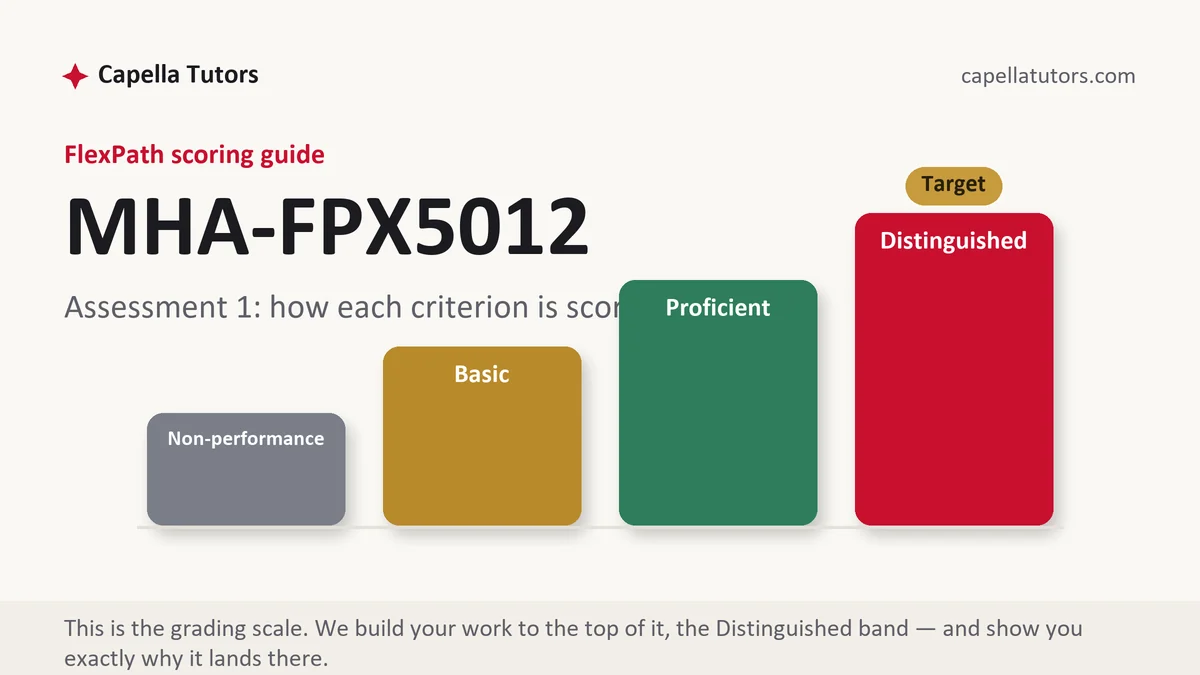
How MHA FPX 5012 Assessment 1 is scored
Four levels per criterion, decided on precision rather than on length. On a governance analysis they read like this:
| Level | What it means on a governance analysis |
|---|---|
| Distinguished | The structure is described specifically, the ownership form carries its obligations into the analysis, and the problem is sized with a number and placed on the correct side of the governance line. The additional requirement sits in your criterion; satisfy it exactly. |
| Proficient | The structure is accurate and the problem is real. What usually keeps it out of the top row is magnitude: a diagnosis with no figure attached to it. |
| Basic | Governance described from a textbook. Boards set direction, management implements, with no reference to the organization actually in front of the writer. |
| Non-performance | The board, the ownership form or the problem itself is missing, and the criterion has no organization to evaluate. |
The working test while you draft is whether an action needs authority over people or authority over direction. The first belongs to management, the second to the board, and where the two genuinely overlap you say who sets the threshold and who acts on it.
The MHA FPX 5012 Assessment 1 method, step by step
-
Sort the criteria by who acts
Some criteria are about the board, some about the executive team, some about a manager on a unit. A document answering all of them in one undifferentiated voice reads as vague to an evaluator who has worked in a health system. Label the actor beside each criterion in your outline before you draft.
-
Describe this board, not a board
Composition, committee structure, terms, who chairs what, and how the organized medical staff connects to it. Bylaws, annual reports, community benefit filings and board rosters are public for a great many organizations, and using them is the difference between a description and a definition.
-
Let the ownership form do analytical work
A tax exempt system answers to a community benefit standard and a set of public filings that an investor owned system does not, and a public district hospital answers to an electorate. Say which one you are writing about, then say what that form obliges the board to do that another form would not.
-
State the problem structurally, then size it
Not a complaint about behavior but a defect in how authority, information or oversight is arranged. Then attach a number: hours, dollars, meetings, measures received, separations. Governance arguments made without arithmetic stay rhetorical and score that way.
-
Check the duties against the facts
Care means informed attention to the decision, loyalty means the organization's interest ahead of a personal one, obedience means acting within the mission and the law. Say which duty the problem touches and why, because a paper that lists the three and never applies them has used a legal obligation as a values statement.
-
Name what your evidence cannot show, then self-score
Much of the governance literature is observational: systems with active quality committees perform better, and better performing systems also attract more engaged trustees. Say which direction your source can and cannot establish, then mark the draft criterion by criterion and fix what falls short.
A structure that maps to the criteria
Section targets our tutors use on a typical 5012 governance analysis. Anything specified in your scoring guide replaces them.
| Section | What it must do | Guide |
|---|---|---|
| Organization and ownership form | The entity, its ownership form, and the obligations that come with that form. | ~200 words |
| Governance structure | Board composition, committees, terms, and the medical staff relationship. | ~300 words |
| The problem | The structural defect, stated with a magnitude and placed on the correct side of the line. | ~300 words |
| Fiduciary analysis | Which duty is engaged, on what facts, and what the duty requires here. | ~250 words |
| Evidence and its limits | What the literature supports, and what the study designs behind it cannot establish. | ~200 words |
| References | Statutes and agency documents by jurisdiction, standards by edition, journals through the library, APA both ways. | as needed |
Annotated sample excerpt
A model diagnosis from our team, annotated at the three moves that lift a governance paragraph off the textbook floor.
Conflict of interest disclosure at Ashfield Regional is collected once at appointment and never refreshed, so four of the eleven current trustees last disclosed in 2019 and two have since joined boards of organizations holding contracts with the hospital.1 The system is a tax exempt corporation, so its conflict policy, the identity of interested persons and the process for reviewing transactions with them are reported annually on a public filing, and that filing currently asserts an annual disclosure process the board does not operate.2 This is a duty of loyalty exposure rather than an administrative oversight, and it sits with the governance committee, which has met twice in the last eighteen months against a bylaw requirement of quarterly.3
- 1The defect is quantified in trustees and years rather than described as a weakness. Four of eleven is a fact a board could act on tonight.
- 2The ownership form is doing work: the obligation named exists because the organization is tax exempt, and the gap between the filing and the practice is the finding.
- 3The problem is assigned to the duty it engages and to the body that owns it, with a second number showing why that body has not caught it.
The full premium sample for your exact assessment, written fresh to your scoring guide and issue, is free to request. Study it, revise it into your own voice, and submit work you understand.
The five mistakes that cost Distinguished
- The board running the department. Recommendations that have trustees approving schedules or hiring managers tell the evaluator the central distinction never landed.
- Governance in the abstract. A structure section that would fit any hospital in the country has described a concept rather than an organization.
- Duties as values. Care, loyalty and obedience listed in a background paragraph and never applied to a fact pattern are decoration on a legal obligation.
- An unmeasured problem. A diagnosis with no hours, dollars, meetings or measures behind it cannot be prioritized against anything else the board is carrying.
- Ownership form ignored. Writing about a tax exempt system as though it were investor owned drops an entire layer of obligation the criteria expect to see.
Pre-submission checklist
- Ownership form named, with at least one obligation it creates carried into the analysis
- Board composition, committees and medical staff relationship described from real documents
- The problem stated structurally and sized with a number
- The fiduciary duty engaged, applied to specific facts rather than defined
- Every claim kept on the correct side of the governance line
- Statutes and standards cited by jurisdiction and edition, APA both ways
Governance analysis due this week?
Send the scenario, the guide and whatever is public about the organization: bylaws, an annual report, a community benefit filing, a board roster. We describe that structure accurately, size the problem, and keep the board and the executive team in their own lanes throughout. Back in 24 to 48 hours with free revisions.