This manual is for MHA FPX 5006 Assessment 3, start to submission. The third deliverable asks you to spend the analysis rather than extend it. The assessment usually wants a financial recommendation addressed to the people who approve money, with the ask quantified, the effect stated in margin or cash, and a monitoring measure that already exists inside the organization. It is graded criterion by criterion against your scoring guide, and the criteria here are unusually unforgiving about vagueness. Below is how our tutors assemble it, the sections it needs, and an annotated sample excerpt. Rather hand it over? A premium original sample for this exact assessment comes back in 24 to 48 hours with the model behind it, revised free until the criteria clear. Capella's catalog lists the course as MHA-FPX5006, and some courserooms print MHA5006; both point to this same Assessment 3. In current courserooms this assessment typically appears as "Cost-Benefit Analysis".
One honesty note before the manual: Capella revises courses and scoring guides over time, so always write to the exact scoring guide attached to your assessment in the courseroom. The course identity above is verified on capella.edu; the method and structure below are our tutors' approach to it, not Capella's official rubric text.
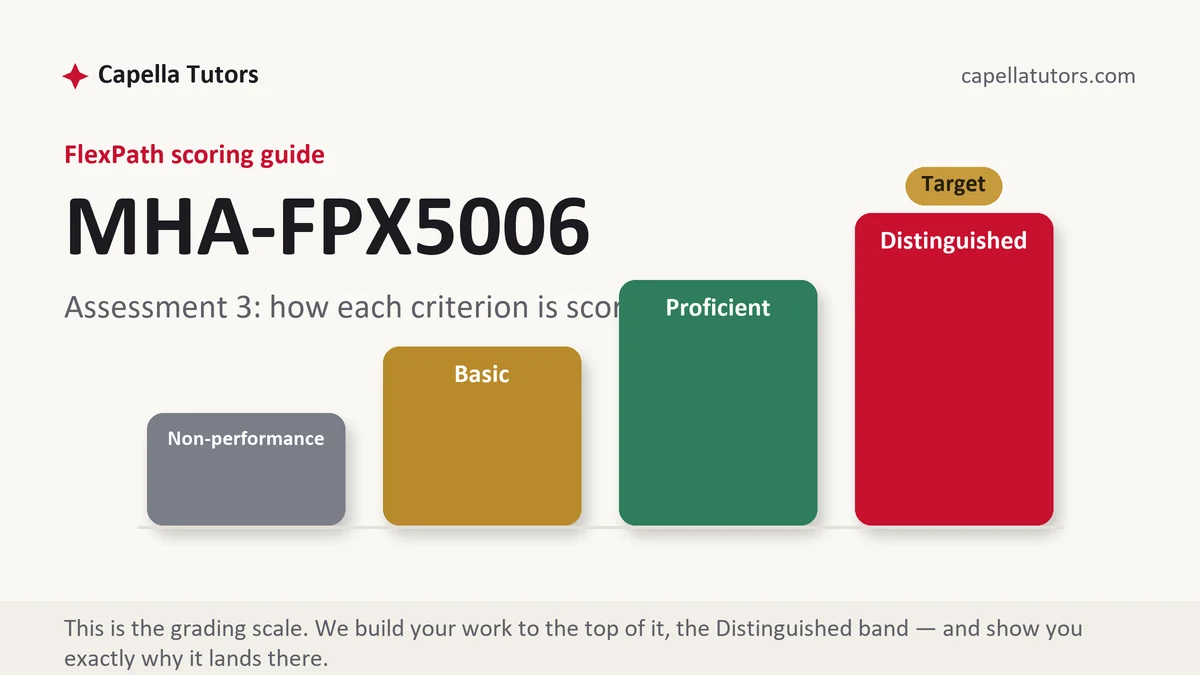
How MHA FPX 5006 Assessment 3 is scored
Four levels, one per criterion, decided on what the document actually contains rather than on how confidently it reads:
| Level | What it means on a financial recommendation |
|---|---|
| Distinguished | One ask, priced, with recurring separated from one time cost, a payback or break-even point, a named risk and a measure finance already produces. The extra requirement is printed in your criterion; satisfy it word for word. |
| Proficient | A sound recommendation supported by the analysis. What holds it down a row is usually timing: an effect stated without a period over which it lands. |
| Basic | Improvement recommended in general terms, with the numbers left back in the analysis section where nobody can approve them. |
| Non-performance | No recommendation, or a recommendation with no financial consequence attached, which leaves the criterion nothing to grade. |
Write for the reader who has to sign. A finance committee needs an amount, a date, an owner and a way to be told later whether it worked, and a document supplying three of those four gets sent back for the fourth.
The MHA FPX 5006 Assessment 3 method, step by step
-
Recommend one thing
Three options analyzed and none chosen is an analysis, not a recommendation, and the criterion usually asks for a choice. Present the alternatives briefly, state which one you are recommending, and say what the others would have cost.
-
Price the ask in two columns
One time cost and recurring cost get approved through different mechanisms and belong on separate lines. Capital, implementation labor, software, training and the hours somebody has to stop doing something else all count, and the last one is the line most students leave out.
-
State the effect in money, over a period
Improved collections is not an effect. Two days off accounts receivable at $49,000 of net revenue a day is $98,000 of cash pulled forward once, and saying whether the gain is recurring or one time is what tells the committee which budget it belongs in.
-
Find the break-even and print it
Divide the investment by the monthly effect and name the month it turns positive. If the payback runs past the contract term or the equipment life, say that too, because a recommendation quietly outliving its own assumptions is the kind evaluators catch.
-
Name the risk and the party who controls it
Most health finance recommendations depend on somebody else behaving as expected: a payer, a physician group, a vendor, a state agency. Name them, say what happens if they do not, and give the plan a decision point rather than a hope.
-
Attach a monitoring measure that already exists, then self-score
A measure finance already produces monthly gets watched; an instrument somebody has to invent does not. Name the report, the owner and the cadence, then score the draft against each criterion and rewrite anything short of the top row.
A structure that maps to the criteria
The section budget our tutors use for a typical 5006 recommendation deliverable, superseded by anything your scoring guide specifies.
| Section | What it must do | Guide |
|---|---|---|
| Situation in one page | The problem restated with the two or three figures the decision turns on, and nothing else. | ~200 words |
| Options considered | The alternatives, each with its cost and the reason it was not chosen. | ~250 words |
| The recommendation | One ask, stated plainly, with the owner and the date it would start. | ~150 words |
| Financial effect | One time and recurring cost against margin or cash effect, with the period the effect lands in. | ~350 words |
| Risk and sensitivity | The assumption most likely to fail, who controls it, and what the plan does then. | ~250 words |
| Monitoring and references | The existing report that will track it, on a named cycle, with every figure traceable in APA. | ~200 words |
Annotated sample excerpt
An original excerpt from our team showing how an ask and its effect belong on the page together. Take the structure, then price your own case.
The recommendation is to accept the payer's quality incentive tier at 2.5 percent of contracted value and to fund the data infrastructure it requires, which is $148,000 in year one, of which $92,000 is one time build and $56,000 recurs as an analyst salary.1 Contracted value with this payer is $14.6 million, so the full tier returns $365,000 a year, but the tier pays on four measures and current performance clears two, which puts $182,500 in reach in year one and leaves the balance behind a two year improvement curve.2 Against $148,000 of cost the year one net is $34,500, and once all four measures clear the recurring net is $309,000, so payback falls inside the first contract year even if the third measure never improves.3
- 1The ask is one sentence and the money splits into one time and recurring on first mention. A committee approves those two through different routes, and separating them saves the reader from asking.
- 2The upside is discounted by current performance rather than quoted at its maximum. Claiming the full incentive would have been the easier sentence and the less credible one.
- 3Payback is stated with the pessimistic case attached, so the recommendation holds even where the improvement curve does not.
The full premium sample for your exact assessment, written fresh to your scoring guide and issue, is free to request. Study it, revise it into your own voice, and submit work you understand.
The five mistakes that cost Distinguished
- The unranked menu. Options laid out with no choice made hands the decision back to the committee, which is the one thing the deliverable was supposed to avoid.
- Effects in adjectives. Significant savings, improved throughput, enhanced position. None of those can be entered in a budget.
- One time and recurring merged. A single annual figure hides which part of the ask returns next year, and that is the first thing a chief financial officer separates.
- A payback with no horizon. An investment turning positive in month 41 of a 36 month contract is a proposal that failed and did not notice.
- An invented measure. Monitoring assigned to a dashboard nobody currently produces means the change goes unwatched from the first quarter onward.
Pre-submission checklist
- Exactly one recommendation, stated in a sentence a reader could quote in a motion
- One time and recurring cost on separate lines, with the labor hours priced
- The effect expressed in margin or cash, over a named period
- A break-even or payback point compared against the term of the underlying agreement
- The party whose behavior the plan depends on named, with a decision point if they deviate
- A monitoring measure the finance department already runs, with an owner and a cadence
Recommendation due to a committee that does not exist yet?
Send the guide and the analysis you have already produced, even if the numbers are half finished. We finish the model, price the ask in two columns, run the payback and write the memo in the register a finance committee reads. Delivered in 24 to 48 hours, revised free until the criteria clear.