This manual is for MHA FPX 5006 Assessment 2, start to submission. The Proposal for Billing Changes asks you to recommend changes to an organization's billing process, usually for a practice or facility described in the courseroom: where the current process loses money or time, the revenue cycle steps you would change, how pricing, insurance contracts, private pay and charity care should be handled, the billing system that would support the changes, and the benefit you expect. The grade turns on the revenue cycle. Proposals that tie each change to a specific failure point, such as denied claims or delayed collections, score above lists of generic improvements. Below is the method our tutors use, a structure that maps to the criteria, and an annotated sample excerpt. Prefer to hand it off? A premium original sample for this exact assessment comes back in 24 to 48 hours, revised free until it meets the guide. Capella's catalog lists the course as MHA-FPX5006, and some courserooms print MHA5006; both point to this same Assessment 2. In current courserooms this assessment typically appears as "Proposal for Billing Changes".
One honesty note before the manual: Capella revises courses and scoring guides over time, so always write to the exact scoring guide attached to your assessment in the courseroom. The course identity above is verified on capella.edu; the method and structure below are our tutors' approach to it, not Capella's official rubric text.
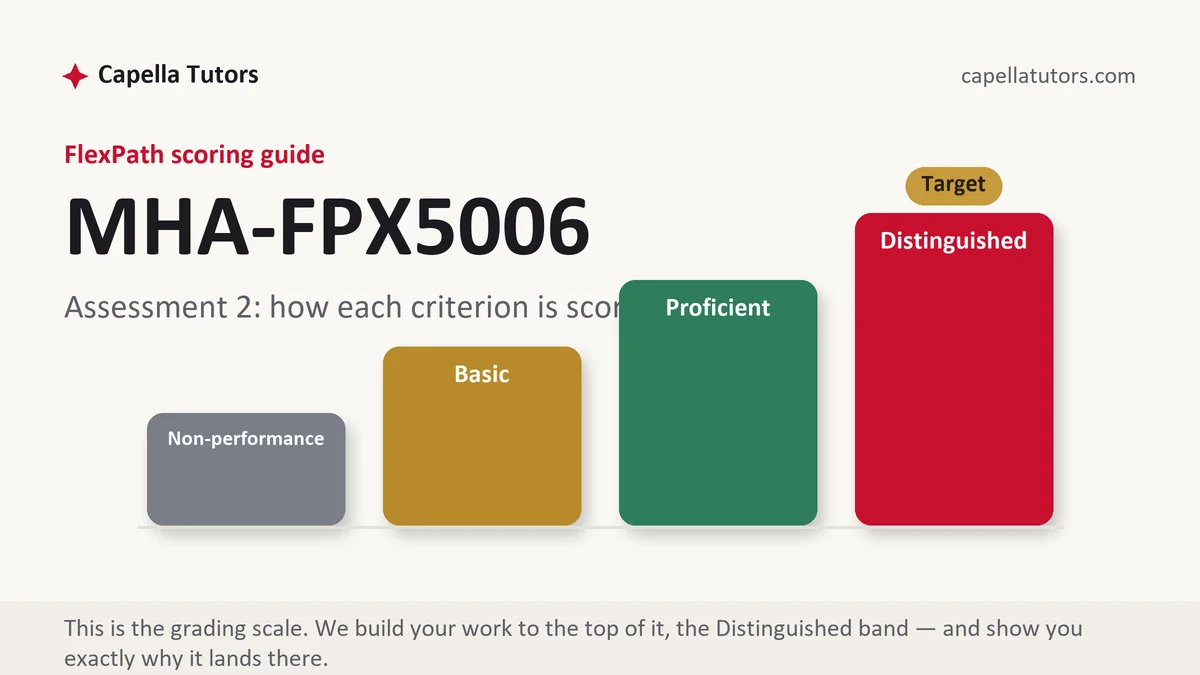
How MHA FPX 5006 Assessment 2 is scored
FlexPath does not use letter grades. Each criterion in the scoring guide lands on one of four levels, and the level descriptions are the real writing brief:
| Level | What it means on a billing change proposal |
|---|---|
| Distinguished | Current problems are identified in revenue cycle terms, each proposed change answers a specific problem, pricing, contracts and charity care are addressed accurately, the system choice is justified, and benefits are quantified where possible. |
| Proficient | The proposal is sound, but some changes are not tied to problems and benefits are general. |
| Basic | The proposal lists billing improvements with little analysis of the current process. |
| Non-performance | The revenue cycle steps, pricing and payer discussion, or the benefits are missing. |
Use the organization and figures your courseroom provides. Evaluators look for the scenario's own problems in the proposal.
The MHA FPX 5006 Assessment 2 method, step by step
-
Map the current process
From registration and eligibility checks to coding, claim submission, denials and patient collections. Mark where it fails.
-
Propose changes step by step
Automation, front-end eligibility checks, denial management, clear patient financial communication, integrated records.
-
Address pricing and contracts
How prices are set, how insurance contracts should be negotiated, and the place of private pay.
-
Handle charity care properly
A clear policy that meets legal obligations and protects patients who cannot pay.
-
Recommend a billing system
The features the organization needs and why, without endorsing a brand you cannot justify.
-
State the benefits
Fewer denials, faster collections, lower cost to collect, with figures where the scenario supports them.
A structure that maps to the criteria
Word counts are planning targets our tutors use, not Capella rules; follow the length and format your scoring guide states.
| Section | What it must do | Guide |
|---|---|---|
| Introduction | The organization and why billing needs to change. | ~100 words |
| Current process and problems | Revenue cycle failure points. | ~150 words |
| Proposed changes | Step-by-step changes to the revenue cycle. | ~200 words |
| Pricing, contracts, private pay and charity care | Policies for each. | ~175 words |
| Billing system | Requirements and justification. | ~100 words |
| Benefits, conclusion and references | Expected gains, then current APA. | ~125 words |
Annotated sample excerpt
An original model excerpt from our team, written to show the register that reaches the top of the guide. Learn the moves, then write your own version.
The largest leak in the current process is at the front: insurance eligibility is checked after the visit, so roughly one claim in eight is denied for coverage problems that a check at scheduling would have caught.1 I propose real-time eligibility verification at scheduling and again at check-in, with any coverage gap explained to the patient before the visit, so the practice either corrects the information or agrees a self-pay estimate in advance.2 Front-end verification is one of the most consistently recommended revenue cycle practices because each denied claim costs staff time to rework and some are never recovered, which makes this the first change in the plan.3
- 1Locates the problem in a specific revenue cycle step with a figure.
- 2Proposes a concrete change that answers it, including patient communication.
- 3Justifies the priority with the cost of denials.
The full premium sample for your exact assessment, written fresh to your scoring guide and topic, is free to request. Study it, revise it into your own voice, and submit work you understand.
The five mistakes that cost Distinguished
- Generic improvements. Tie each change to a specific failure point.
- Ignoring charity care. Address patients who cannot pay.
- A system chosen by brand. Justify it by the features the process needs.
- No benefits. Say what the changes will save or recover.
- Ignoring the scenario. Use the organization your courseroom describes.
Pre-submission checklist
- Current revenue cycle problems identified
- Each change tied to a problem
- Pricing, contracts and private pay addressed
- Charity care policy included
- Billing system justified
- Benefits and current APA references
Want the billing proposal written?
Send the scoring guide and the scenario. Our team returns a premium original proposal in 24 to 48 hours, revised free until it meets the guide.