This manual is for MHA FPX 5006 Assessment 1, start to submission. The first deliverable in MHA FPX 5006, Healthcare Finance and Reimbursement, is the one that sorts students into two groups. The assessment usually hands you an organization or a payer environment and asks you to explain how money actually reaches it, which means holding apart what is billed, what is allowed and what is eventually collected, and carrying that distinction through the whole document without dropping it. FlexPath grades it criterion by criterion, no points, no letter grade. Below is the order our tutors work in, the arithmetic that has to be visible, and an annotated sample excerpt. Rather hand it over? A premium original sample for this exact assessment comes back in 24 to 48 hours with every calculation shown, revised free until the criteria clear. Capella's catalog lists the course as MHA-FPX5006, and some courserooms print MHA5006; both point to this same Assessment 1. In current courserooms this assessment typically appears as "Financial Basics".
One honesty note before the manual: Capella revises courses and scoring guides over time, so always write to the exact scoring guide attached to your assessment in the courseroom. The course identity above is verified on capella.edu; the method and structure below are our tutors' approach to it, not Capella's official rubric text.
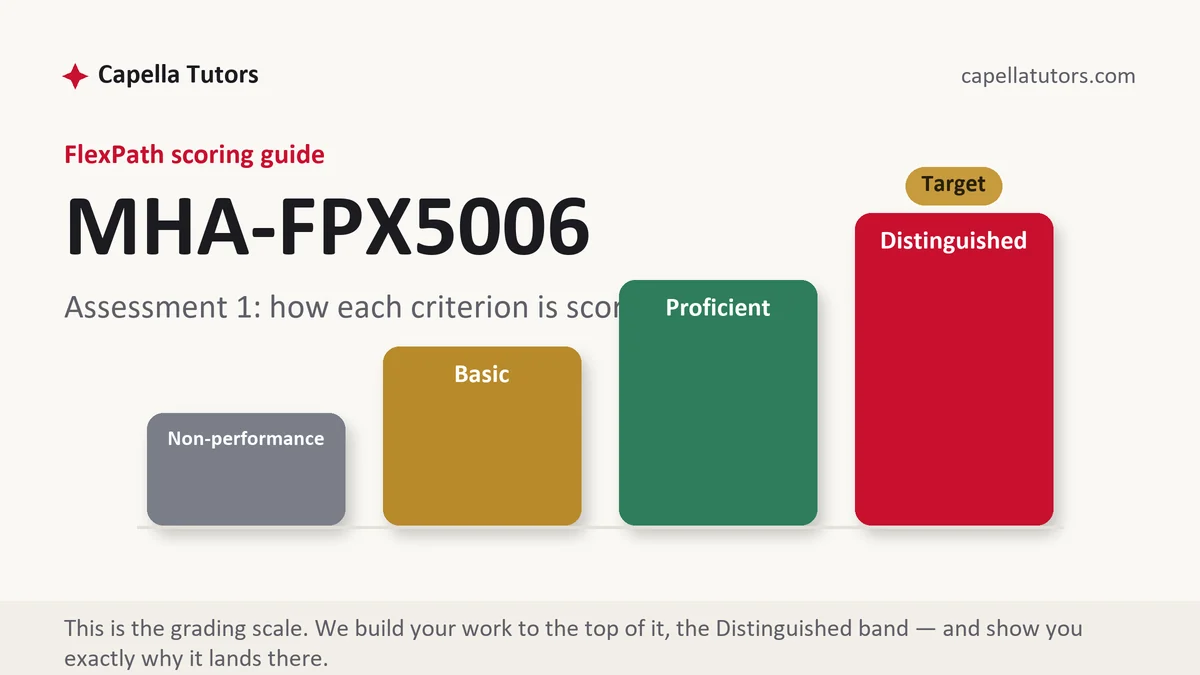
How MHA FPX 5006 Assessment 1 is scored
Every criterion lands on one of four levels and the level text is the specification. On a reimbursement analysis the four read like this:
| Level | What it means on a reimbursement analysis |
|---|---|
| Distinguished | The payment method for each payer is named and reasoned from, every figure has a source or a stated basis, and the analysis says where the financial risk sits. Your criterion spells out the extra move; make it literally. |
| Proficient | The mechanics are described correctly and the numbers reconcile. The usual shortfall is interpretation: rates reported without a verdict attached. |
| Basic | Volume multiplied by gross charges and called revenue, with payment methods listed as vocabulary rather than used as logic. |
| Non-performance | A required component is absent, most often the payer mix itself, without which nothing downstream in the document can be checked. |
The chain this course grades runs charges, contractual allowances, net patient service revenue, then everything that erodes it afterwards. Write the word net where you mean net, because an evaluator reading quickly needs to see that the distinction was deliberate.
The MHA FPX 5006 Assessment 1 method, step by step
-
Split the criteria into numbers and narrative
Two piles, made before you write anything. The criteria that need a figure set your schedule, because sourcing a rate takes a day most students have not planned for. Your scoring guide also decides whether the result is a report, a memo to a finance committee, a workbook with narrative or slides with speaker notes.
-
Build the payer profile before the prose
Percentages that sum to 100, a payment method beside each payer, and a source or a labeled assumption on every line. Public cost reports, state discharge databases, published fee schedules and national coverage surveys will carry the whole profile when your employer's numbers cannot leave the building.
-
Convert charges to net revenue in a visible table
Apply a realization rate per payer, weight the rates by mix, and show the multiplication. A blended realization a reader can recompute is worth more than a precise net figure a reader has to trust, and the criteria are written by people who know the difference.
-
Find the leak and size it
Somewhere between the encounter and the deposit, money goes missing: eligibility, coding, submission, adjudication, patient responsibility, appeal. Pick the stage the case data actually supports, then put a dollar figure on it with the denominator and the time window printed beside the rate.
-
Say where the risk sits under each method
A prospective case rate makes an avoidable day pure cost. A per diem contract pays the day and rewards the opposite behavior. Capitation moves the risk onto the provider entirely. Name the method, then reason from where it parks the risk, because that reasoning is what the mechanics criterion is testing.
-
Reconcile everything, then self-score
Every total in the narrative must match the total in the table it came from, and every rate must carry its period. Read the draft criterion by criterion, mark yourself honestly, and submit early in the week so the two business day evaluation window does not eat your weekend.
A structure that maps to the criteria
Section budgets our tutors use on a typical 5006 reimbursement analysis. The scoring guide in your courseroom overrides them wherever the two differ.
| Section | What it must do | Guide |
|---|---|---|
| Organization and payer profile | The entity, its volumes, and the mix of payers behind them, as percentages that sum with sources attached. | ~250 words |
| Payment methods | How each major payer actually pays, and what that method buys and refuses to buy. | ~300 words |
| Revenue derivation | Charges to allowances to net patient service revenue, with the arithmetic in a table the reader can recompute. | ~300 words |
| Where the money leaks | The revenue cycle stage under examination, sized in dollars with a denominator and a window. | ~250 words |
| Risk and interpretation | Where each method places financial risk, and what the numbers mean for the organization holding it. | ~200 words |
| References | Payment rules by fiscal year, benchmark data by survey year, peer-reviewed work through the library, APA both ways. | as needed |
Annotated sample excerpt
A model paragraph from our finance team, showing how a revenue cycle problem gets sized. Learn the sequence, then run it on your own case.
Registration and eligibility account for 41 percent of first pass denials at Harbor Point Medical Group across the twelve months ending in June, or 1,847 of 4,505 denied claims on 62,300 submissions, which is a 7.2 percent initial denial rate against a 5 percent benchmark for groups of this size.1 Of the eligibility denials, 78 percent are overturned on appeal, so the residual write-off is 406 claims at an average net revenue of $214, or roughly $87,000 a year, while the appeal work itself consumes an estimated 1,100 staff hours at a loaded rate of $34.2 The recommendation therefore has to compete with $37,400 of avoidable labor rather than with the write-off alone, which is the figure a revenue cycle director will ask for first.3
- 1The rate arrives with its numerator, its denominator, its window and a benchmark. All four are needed before a number means anything to a finance reader.
- 2Denial, overturn and write-off are kept as three separate quantities. Collapsing them into one is the error that costs a criterion in this course.
- 3The cost of working the problem is priced beside the loss, so the recommendation that follows has a real hurdle to clear rather than an easy one.
The full premium sample for your exact assessment, written fresh to your scoring guide and issue, is free to request. Study it, revise it into your own voice, and submit work you understand.
The five mistakes that cost Distinguished
- Gross charges as revenue. One substitution at the top of the model invalidates every figure that depends on it, including the margin the paper concludes with.
- Mix left implicit. Without payer mix the analysis cannot explain why the margin moved or say where it goes next quarter.
- Allowance and bad debt merged. The first is a contract term agreed in advance, the second is a collection failure, and one line for both hides which problem you have.
- Rates with no window. A denial rate on a quarter and on a year are different numbers wearing the same name, and neither is checkable without its denominator.
- Description with no verdict. Payment methods explained accurately and never used to explain anything leaves the interpretation criteria untouched.
Pre-submission checklist
- Payer mix stated as percentages that sum, each line sourced or labeled as an assumption
- A payment method named for every major payer, and reasoned from at least once
- Charges, allowances and net revenue shown as separate steps in a visible table
- Every rate printed with its numerator, denominator and time window
- Narrative totals reconciled against table totals, line by line
- Payment rules cited by fiscal year and benchmarks by survey year, APA both ways
Numbers due before the narrative?
Send the case, the guide and whatever figures you are allowed to share, even a rough mix. An analyst builds the model first, a finance writer drafts on top of numbers that already reconcile, and a numbers pass checks the totals against the tables. Back in 24 to 48 hours, and revisions run until the criteria are met.