This manual is for MHA FPX 5001 Assessment 2, start to submission. Leadership and Group Collaboration asks you to respond to a request from a senior leader, often written as a letter or memo, about a diversity and inclusion initiative: why cultural awareness matters in the organization, which leadership approach suits the initiative, who should lead it and why, and which strategies the group should use to collaborate and make progress. The grade turns on fit. Naming leadership styles earns little; matching a leader and an approach to this initiative, with evidence, earns the top column. Below is the method our tutors use, a structure that maps to the criteria, and an annotated sample excerpt. Prefer to hand it off? A premium original sample for this exact assessment comes back in 24 to 48 hours, revised free until it meets the guide. Capella's catalog lists the course as MHA-FPX5001, and some courserooms print MHA5001; both point to this same Assessment 2. In current courserooms this assessment typically appears as "Leadership and Group Collaboration".
One honesty note before the manual: Capella revises courses and scoring guides over time, so always write to the exact scoring guide attached to your assessment in the courseroom. The course identity above is verified on capella.edu; the method and structure below are our tutors' approach to it, not Capella's official rubric text.
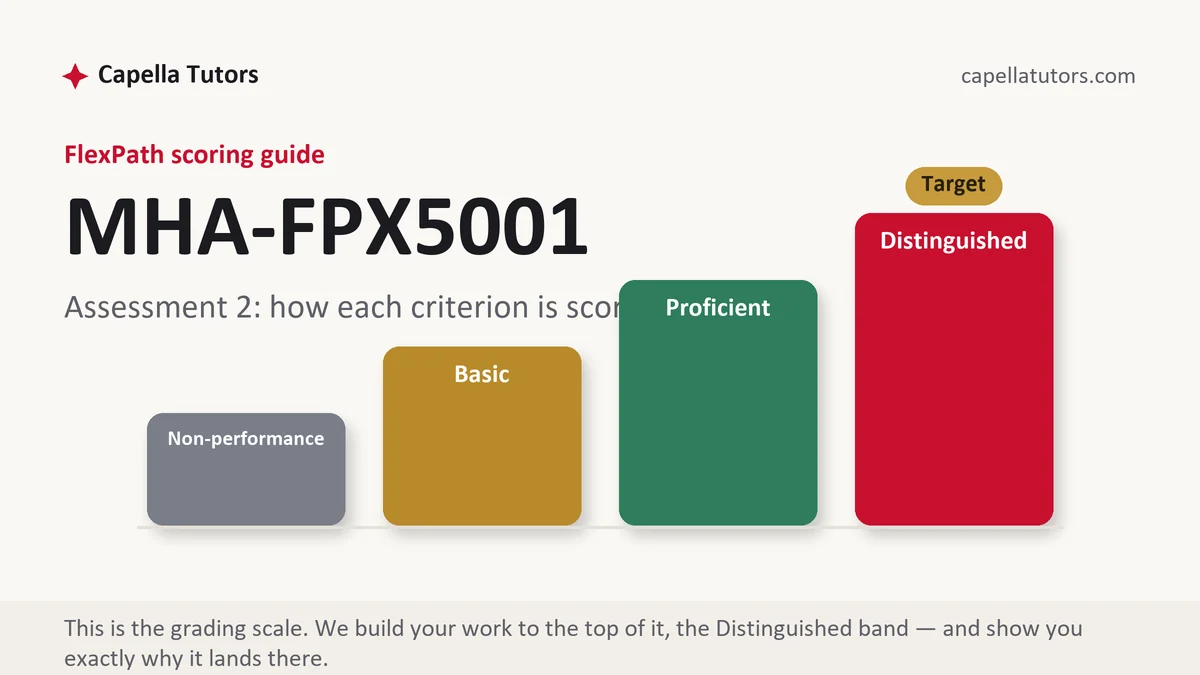
How MHA FPX 5001 Assessment 2 is scored
FlexPath does not use letter grades. Each criterion in the scoring guide lands on one of four levels, and the level descriptions are the real writing brief:
| Level | What it means on a leadership and collaboration response |
|---|---|
| Distinguished | The case for the initiative is supported with evidence, leadership approaches are compared against the initiative's needs, the recommended leader is justified, collaboration strategies are specific, and the tone suits the senior reader. |
| Proficient | All parts are present and accurate, but the comparison of leaders or approaches is thin. |
| Basic | The response describes leadership styles in general and asserts a recommendation. |
| Non-performance | The leadership recommendation or the collaboration strategies are missing. |
Write in the format the courseroom sets, often a reply to a named executive. A professional, direct register is part of the grade in this first master's course.
The MHA FPX 5001 Assessment 2 method, step by step
-
Read the request carefully
Identify what the senior leader is asking you to decide or recommend, and answer that first.
-
Make the case for the initiative
Why diversity, equity and inclusion matter for this organization's patients and staff, with two or three sources.
-
Compare leadership approaches
Transformational, servant, inclusive or situational leadership, each judged against what the initiative needs. A short table helps.
-
Recommend a leader
The candidate or role best placed to lead, with the qualities that make them suitable.
-
Propose collaboration strategies
A steering committee, clear roles, inclusive hiring, confidential support channels, regular reporting. Tie each to evidence.
-
Close and proofread
Restate the recommendation and next step in two sentences, then check APA and tone.
A structure that maps to the criteria
Word counts are planning targets our tutors use, not Capella rules; follow the length and format your scoring guide states.
| Section | What it must do | Guide |
|---|---|---|
| Opening | The request restated and your recommendation in brief. | ~100 words |
| Why the initiative matters | Evidence on cultural awareness and inclusion in health care. | ~200 words |
| Leadership approaches compared | Approaches judged against the initiative, often as a table. | ~250 words |
| Recommended leader | Who should lead and why. | ~150 words |
| Collaboration strategies | Specific strategies with evidence. | ~200 words |
| Closing and references | Next step, then current APA. | ~75 words |
Annotated sample excerpt
An original model excerpt from our team, written to show the register that reaches the top of the guide. Learn the moves, then write your own version.
I recommend that the director of patient experience lead the initiative, because the role already convenes staff from every department and has the trust of the frontline teams the initiative most needs to reach.1 An inclusive leadership approach fits this work better than a directive one: the evidence on diversity programs suggests that participation and psychological safety drive lasting change, while mandates alone tend to produce compliance without commitment.2 To support her, I propose a steering committee with representatives from nursing, environmental services and human resources, meeting monthly with a published progress report, so the initiative is visibly shared rather than assigned to one office.3
- 1Names a leader and grounds the choice in the role's reach.
- 2Justifies the leadership approach with evidence and contrasts it with an alternative.
- 3Adds a concrete collaboration structure with accountability.
The full premium sample for your exact assessment, written fresh to your scoring guide and topic, is free to request. Study it, revise it into your own voice, and submit work you understand.
The five mistakes that cost Distinguished
- Describing styles without choosing. The request asks for a recommendation; make one.
- No evidence for the initiative. Support why it matters with sources.
- A leader chosen by title alone. Explain the qualities that fit the work.
- Vague collaboration. Name the structures and how they work.
- Casual tone. Write for a senior reader.
Pre-submission checklist
- Request answered directly
- Initiative supported with evidence
- Leadership approaches compared against the initiative
- Leader recommended and justified
- Specific collaboration strategies
- Professional tone and current APA
Want the leadership response written?
Send the scoring guide and the request from your courseroom. Our team returns a premium original response in 24 to 48 hours, revised free until it meets the guide.