This manual is for MHA FPX 5001 Assessment 1, start to submission. Assessment 1 of MHA FPX 5001, Foundations of Master's Studies in Healthcare Administration, installs the apparatus every later MHA course assumes you already own. The assessment usually asks for a short piece of health administration writing whose evidence was pulled through a library rather than a search engine, attached to claims inside the sentences that make them, and formatted in current APA. FlexPath scores it criterion by criterion, with no points and no letter grade. Below is the working order our tutors use, a section budget that fits it, and an annotated sample excerpt. Rather hand it over? A premium original sample for this exact assessment comes back in 24 to 48 hours, revised free until the criteria clear. Capella's catalog lists the course as MHA-FPX5001, and some courserooms print MHA5001; both point to this same Assessment 1.
One honesty note before the manual: Capella revises courses and scoring guides over time, so always write to the exact scoring guide attached to your assessment in the courseroom. The course identity above is verified on capella.edu; the method and structure below are our tutors' approach to it, not Capella's official rubric text.
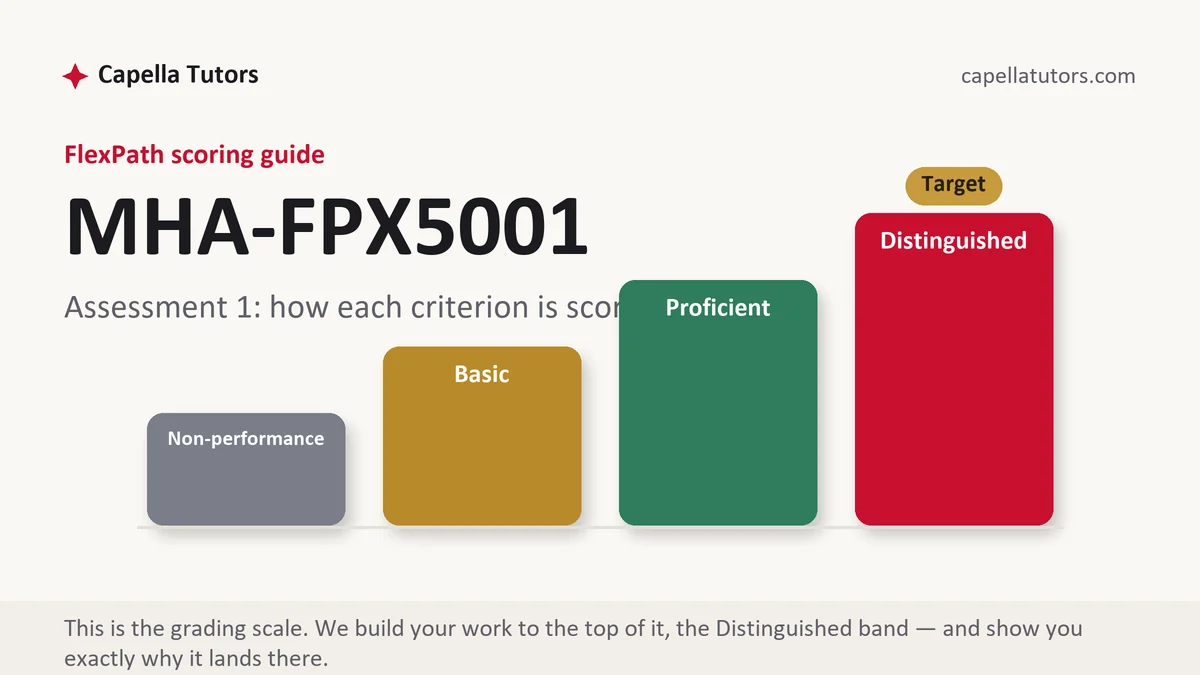
How MHA FPX 5001 Assessment 1 is scored
FlexPath awards no partial credit. Each criterion on the scoring guide lands on one of four levels, and the wording of those levels is the brief you write to:
| Level | What it means on a sourced graduate analysis |
|---|---|
| Distinguished | Every claim carries a source or a labeled assumption, the sources are weighed against each other, and the writing names what the evidence cannot establish. The extra move sits in your criterion text; make it literally. |
| Proficient | Accurate, adequately sourced, complete. What usually keeps it out of the top column is evidence reported rather than weighed. |
| Basic | Judgment asserted from experience with nothing behind it, or literature summarized with no claim in front of it. Where a first attempt by a working administrator normally lands. |
| Non-performance | A required element is absent, most often the source-based support a criterion names outright. Absence, rather than weakness, is what puts a criterion on the bottom row. |
Treat the mechanics criteria as seriously as the analysis ones. In the opening course of the MHA they are checked most closely, and they are the only criteria you can clear before reading a single article.
The MHA FPX 5001 Assessment 1 method, step by step
-
Turn the scoring guide into the outline
The assignment description tells you what to produce; the criteria decide what it is worth. Paste each criterion into an empty document as its own heading, drop the Distinguished wording underneath, and write nothing that sits outside them. Your scoring guide also settles the shape of the deliverable, a paper, a memo or an annotated set of sources, so read it before choosing a format.
-
Narrow the question until it fits the word count
A question about health care in America cannot be answered in a graduate short paper, and trying is how the analysis criterion gets lost. Pick one organization type, one payer environment or one administrative decision, then say in a single sentence what the document will establish. If that sentence names a topic instead of a finding, keep cutting.
-
Search the library first, and log the search
Open the Capella library databases before a browser tab. Note the database, the search terms and the filters, because a criterion about source quality is easiest to answer with a sentence describing how the sources were found. Keep the window to roughly five years unless a document is a framework or a statute, where the current edition is what matters.
-
Give every source a job before you draft
Write the reference list first and put one clause beside each entry naming its job: this one establishes scale, this one supplies the mechanism, this one disagrees. Sources without assigned jobs become a literature tour, and a literature tour reads as Basic however current the articles are.
-
Draft claim first, citation inside the sentence
Open each paragraph with the position it intends to defend, then carry the evidence in the same sentence that makes the claim. A citation stapled on after a period gestures at support; a citation inside the clause supplies it. Cut contractions, cut the passive where an actor exists, and keep first person to where a criterion invites reflection.
-
Self-score, then submit early in the week
Read the draft against the guide one criterion at a time and mark yourself D, P, B or N without generosity. Anything under D earns one more pass. Faculty have two business days to evaluate an attempt, so a Monday upload buys a revision window that a Thursday upload does not.
A structure that maps to the criteria
The word counts below are planning arithmetic our tutors use on a typical 5001 short analysis, not Capella rules. Where your scoring guide asks for more, the guide wins.
| Section | What it must do | Guide |
|---|---|---|
| Introduction and purpose | The issue, the audience, and what the document will establish, purpose sentence last. | ~150 words |
| The issue in context | Who it affects, at what scale, and the payment or workforce background making it live now. | ~250 words |
| Evidence and analysis | The claim carried source by source, with studies put against each other rather than stacked. | ~400 words |
| Limits of the evidence | What the designs behind your sources cannot show, and what would settle the question. | ~200 words |
| Conclusion and implication | The finding restated, plus one implication an administrator could act on this quarter. | ~150 words |
| References | Current APA, reconciled both ways, data year printed on every report and dataset. | as needed |
Annotated sample excerpt
An original model paragraph from our team, showing the register the top column describes. It is study material: take the moves, then run your own evidence.
Between 2021 and 2024 the payer mix at Ridgeline, a 22 bed critical access hospital, moved eleven points, from 38 percent commercial down to 27 percent, with the difference arriving in Medicaid and self-pay.1 Critical access designation pays the federal program's share of inpatient and outpatient services on a cost basis, so that portion of the revenue base is insulated by construction and the commercial minority is what carries the operating margin; an eleven point move is therefore a margin event rather than a coverage story.2 The peer-reviewed work behind that reading is almost entirely cross-sectional and built from filed cost reports, which is enough to describe the association between mix and margin across rural facilities and not enough to establish what caused it at one of them.3
- 1A measured change over a stated window opens the paragraph. A figure with dates on it is precisely what an evidence criterion is written to reward.
- 2The payment mechanism is named and then reasoned from, which turns the number into an argument instead of a fact left on the page.
- 3The design behind the evidence is described and its ceiling stated. Saying what a study cannot show is the sentence most first drafts leave out.
The full premium sample for your exact assessment, written fresh to your scoring guide and issue, is free to request. Study it, revise it into your own voice, and submit work you understand.
The five mistakes that cost Distinguished
- Experience as evidence. A decade running the department is judgment, and a criterion asking for support wants a citation inside the claim sentence.
- Open web sourcing. Trade blogs and consultancy summaries read as Basic on sight, and the library search replacing them takes ten minutes.
- The literature tour. Five studies in five paragraphs with no relationship stated between them is a reading list wearing an analysis heading.
- Frameworks cited from a textbook. Attribute an instrument to the body that publishes it, with its edition year, or the evaluator assumes you never opened it.
- APA left to the end. Reconstructing citations after the draft is how the mechanics criterion gets lost by writers whose analysis was fine.
Pre-submission checklist
- A labeled section standing under every criterion in the guide
- One sentence early on saying what the analysis will establish
- Every source pulled through the library, with the database named
- Each claim carrying its citation inside the sentence, not after the period
- A stated limit on what the evidence can show
- Reference list reconciled both ways, current APA, data year on every report
Starting the MHA with this one?
Send the scoring guide and the prompt. A research analyst pulls the sources, a health administration writer builds the argument, and an APA editor owns the mechanics layer, which is why formatting criteria rarely cost our clients a level in an intake course. Back in 24 to 48 hours, revised free until every criterion clears.