This manual is for MBA FPX 5014 Assessment 3, start to submission. Assessment 3 closes MBA FPX 5014 and asks the whole course to answer one financial question. Valuation, capital structure, cost of capital, and risk stop being topics and become tools aimed at a decision leadership has to make. Your scoring guide sets the case, but the failure mode is predictable: a tour of the syllabus over a company, each technique taking its turn, ending in a recommendation none of the analysis actually required. Papers that reach the top column decide first and compute second. Rather have it built? A premium original sample comes back in 24 to 48 hours, revised free until your scoring guide is satisfied. Capella's catalog lists the course as MBA-FPX5014, and some courserooms print MBA5014; both point to this same Assessment 3. In current courserooms this assessment typically appears as "Financial Engineering to Enhance Shareholder Value".
One honesty note before the manual: Capella revises courses and scoring guides over time, so always write to the exact scoring guide attached to your assessment in the courseroom. The course identity above is verified on capella.edu; the method and structure below are our tutors' approach to it, not Capella's official rubric text.
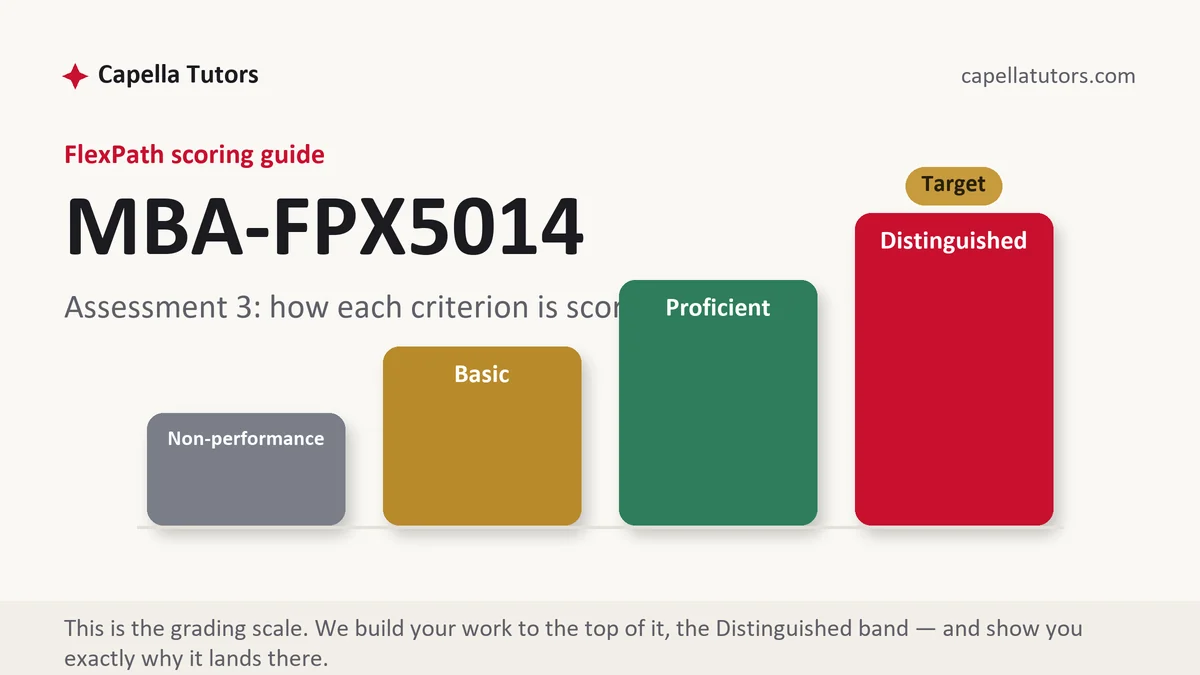
How MBA FPX 5014 Assessment 3 is scored
The same four levels apply, and on the closing deliverable the distinctions get sharper rather than softer:
| Level | What it means on the closing finance synthesis |
|---|---|
| Distinguished | One financial question is answered, with capital structure, valuation, and risk each doing work rather than taking a turn. The recommendation names its conditions, acknowledges what it signals to the market, and commits management beyond the current period. |
| Proficient | Each area handled competently and the recommendation follows, but the tools are surveyed in sequence rather than aimed at the question. Survey work stops in this column however clean the models are. |
| Basic | A tour of the course over a case company, closing with a recommendation the analysis did not force. Coverage in place of argument, which the synthesis criteria are written to detect. |
| Non-performance | A required analysis or the recommendation is absent. A synthesis criterion cannot score what is not on the page, and it does not grade on effort elsewhere. |
Because this closes the course, the evaluator is reading for whether the finance has become usable rather than whether it has been learned. Techniques you already demonstrated can be referenced briefly and applied hard.
The MBA FPX 5014 Assessment 3 method, step by step
-
Reduce the case to one financial question
Write it as a choice with money attached: return the cash or reinvest it, buy the division or partner, take the equity or the debt. Then check that every analysis you plan changes the answer if its result changes. A model that cannot move the decision belongs in an appendix or nowhere, and cutting it makes room for the depth the closing criteria want.
-
Establish what cash is genuinely free
Before allocating anything, work out what the business can release: operating cash flow less maintenance capital expenditure, less committed projects, less a cushion sized from the company's own history of working capital swings rather than a rule of thumb. The number you defend here bounds every recommendation that follows, and inflating it quietly is how a plausible paper becomes a wrong one.
-
Value each use of the cash on the same basis
Whatever the alternatives are, put them in the same units, over the same horizon, discounted at the same rate. Per-share effects belong next to total-value effects, after-tax figures next to after-tax figures. Comparisons that shift basis midway are the most persuasive-looking error in corporate finance writing, and evaluators here are trained to catch them.
-
Weigh the signal against the arithmetic
Financial decisions communicate. A cut dividend, a large buyback, a new leverage target, each tells the market what management believes. Say what the chosen action signals, whether the company can sustain the expectation it creates, and what the alternative would have signaled instead. This paragraph is often the difference between the top two columns.
-
Recommend a policy rather than a transaction
One-time actions are easy to recommend and easy to mark down. Set the rule: the payout the company commits to, the leverage band it will hold, the price below which repurchases proceed and above which they stop. A recommendation with a condition attached survives the follow-up question, which is the standard a board applies and the standard the criteria copy.
-
Read it as the board would, then self-score
Read the draft the way a director reads a paper twenty minutes before the meeting: answer, money, risk, what we are committing to. If any of the four is missing or late, move it forward. Then score yourself criterion by criterion with the guide open, revise anything under the top column, and submit early in the week.
A structure that maps to the criteria
The targets below are our tutors' planning ranges for a typical closing synthesis, not Capella requirements; your scoring guide decides the real scope.
| Section | What it must do | Guide |
|---|---|---|
| Executive summary | The recommended policy, the money it moves, and the condition that governs it. | ~130 words |
| The company and the question | What the business is, what it earns, and the financial choice leadership faces now. | ~180 words |
| Free cash flow and capacity | What cash is genuinely available after maintenance, commitments, and a defended cushion. | ~280 words |
| The alternatives valued | Each use of the cash on the same basis, horizon, and rate, with per-share effects shown. | ~320 words |
| Signal, risk, and recommended policy | What the action tells the market, what could go wrong, and the rule management should adopt. | ~320 words |
| References | Case exhibits, filings and investor materials, rate sources, and finance literature in current APA. | as needed |
Annotated sample excerpt
This excerpt is original model work from our team, included to show a recommendation that commits to a rule instead of an announcement.
Grantley Industrial generated $214 million of operating cash flow against $86 million of maintenance capital expenditure and $31 million of committed growth projects, leaving $97 million discretionary after a $12 million cushion sized from the seasonal working capital swing of the last three years.1 A repurchase at the current $46 share price retires 2.1 million of 74 million shares and lifts earnings per share from $3.12 to $3.21, a gain of 2.9 percent, while an equivalent $0.85 special dividend puts the same cash in holders' hands at a tax cost the repurchase defers rather than removes.2 The repurchase creates value only if $46 sits below intrinsic value, and the valuation above puts the range at $41 to $49, so the recommendation is split: a $0.55 recurring dividend plus a $40 million authorization used only below $44.3
- 1Free cash is defined and defended before a dollar of it is allocated, with the cushion sized from the company's own history. Every later number depends on this one being honest.
- 2The two uses are compared in the same units over the same period, and the tax difference is named as deferral rather than savings. Basis discipline makes the comparison worth reading.
- 3The recommendation is a rule with a price condition attached, not an announcement. Policy that survives the next board meeting is the commitment the closing criteria reward.
The full premium sample for your exact assessment, written fresh to your scoring guide and issue, is free to request. Study it, revise it into your own voice, and submit work you understand.
The five mistakes that cost Distinguished
- Earnings per share accretion read as value creation. A repurchase raises the ratio arithmetically whatever the price paid, so accretion alone proves nothing.
- Free cash flow that is really operating cash flow. Skipping maintenance capital and committed projects produces a recommendation the company cannot fund.
- A repurchase recommended with no view on price. Buying stock above intrinsic value transfers wealth away from continuing holders, and a paper with no valuation range cannot know which side it is on.
- The signal ignored. Payout decisions are read by the market, and a synthesis treating them as pure arithmetic misses the criterion about implications.
- The syllabus tour. Sections demonstrating a technique without changing the answer dilute the criteria the closing assessment weighs most.
Pre-submission checklist
- The financial question written as one choice with money attached, at the top of the draft
- Free cash flow defended after maintenance, commitments, and a cushion sized from company history
- Alternatives valued on the same basis, horizon, and rate, with per-share effects shown
- A valuation range that tells the reader whether the current price is high or low
- What the action signals to the market, and what the rejected option would have signaled
- A policy with a condition attached, draft self-scored on every criterion, submitted early in the week
Want the closing finance paper carried?
Send the scoring guide, the case, and any exhibits or filings the assignment points to. An analyst decodes the criteria, a finance writer aims the models at the actual question, and two QA passes check arithmetic, guide alignment, and APA before delivery inside 24 to 48 hours. Revisions are free until the target column is met.