This manual is for MBA FPX 5014 Assessment 2, start to submission. The middle deliverable in MBA FPX 5014 puts a capital or investment decision in front of you and asks the numbers to settle it. Your scoring guide names the models, usually some combination of net present value, internal rate of return, payback, and a risk treatment, but the graded work is the argument built on top of them. Two papers can carry the same correct NPV and land two columns apart, because one reports a single figure and the other says how far the forecast can slip before the answer changes. Prefer it built for you? A premium original sample returns in 24 to 48 hours with free revisions until your guide is satisfied. Capella's catalog lists the course as MBA-FPX5014, and some courserooms print MBA5014; both point to this same Assessment 2. In current courserooms this assessment typically appears as "Evaluation of Capital Projects".
One honesty note before the manual: Capella revises courses and scoring guides over time, so always write to the exact scoring guide attached to your assessment in the courseroom. The course identity above is verified on capella.edu; the method and structure below are our tutors' approach to it, not Capella's official rubric text.
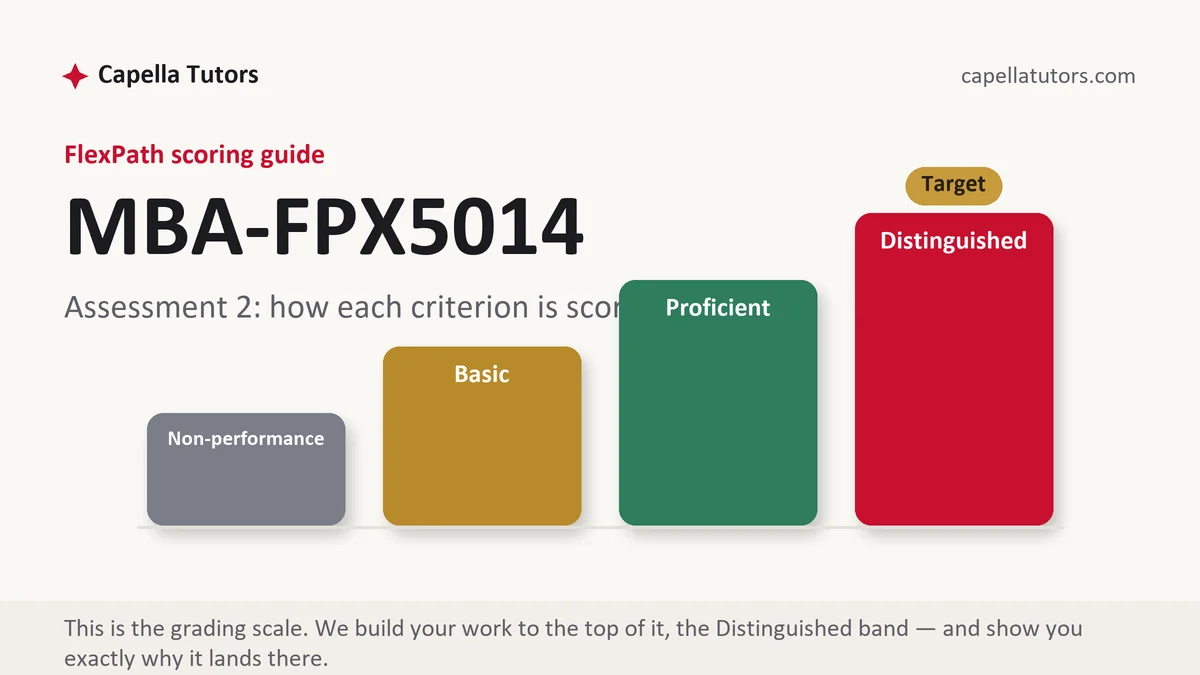
How MBA FPX 5014 Assessment 2 is scored
Four levels, one ladder, applied criterion by criterion. On a capital investment deliverable they read like this:
| Level | What it means on a capital investment deliverable |
|---|---|
| Distinguished | Cash flows are incremental and after tax, the discount rate is defended, the models are weighed against each other where they disagree, and the answer arrives with sensitivity bands and a break-even the reader can check against something the business already measures. |
| Proficient | The models are computed correctly and a decision is stated. Single-point answers, no bands, no threshold. Right and unfinished is the honest description of this column. |
| Basic | Accounting profit discounted as though it were cash, or a hurdle borrowed from the textbook. Method errors live here even when every keystroke of arithmetic is tidy. |
| Non-performance | A model the guide requires, or the recommendation, is missing. The evaluator scores what is on the page and nothing else. |
Assessment 1 built the assumption discipline; this one spends it. The register you wrote there is where the sensitivity analysis comes from, because the inputs worth stressing are the ones whose justification was thinnest.
The MBA FPX 5014 Assessment 2 method, step by step
-
State the decision and the screen it has to clear
One line at the top: fund the automation package or keep the current process, and the test it must pass, a hurdle rate, a payback ceiling, a capital constraint. Cases usually supply that screen and students usually ignore it. An analysis judged against the firm's own threshold reads as management; the same analysis judged against nothing reads as homework.
-
Build cash flows, not accounting profit
Start from the incremental change in operating cash: revenue or cost effects that differ between the alternatives, taxes on them, the depreciation shield added back, working capital movements, any salvage. Net income is an accounting construct with non-cash items inside it, and discounting it is the error that costs the method criterion most often.
-
Defend the discount rate in a sentence
Use the firm's weighted average cost of capital where the case gives the components, and say where each came from. If the project's risk differs from the firm's, say so and adjust with a reason. One sentence of derivation immunizes every present value that follows; its absence undermines all of them at once.
-
Run the models, then argue them against each other
Compute what the guide asks and read the results together. Net present value and internal rate of return usually agree; when scale or timing makes them disagree, say which governs the decision and why, and note that payback ignores everything past its own horizon. Handling a disagreement in the open is the clearest evidence of judgment available here.
-
Band the answer with sensitivity
Take the two or three inputs the answer is most exposed to and move them. Report where the project still clears, where it stops clearing, and what the break-even is in units the operation already tracks, orders a day, occupancy, tons shipped. A band tells a board what it is approving; a point estimate tells it nothing about its own risk.
-
Write the memo answer first, then audit the model
Recommendation in the opening paragraph with the number behind it, then the sections that let a skeptical reader trace that number. Once drafted, recompute the critical figures from raw inputs and confirm every number in the prose matches the model. Self-score against the guide, revise, and submit with the evaluation window in mind.
A structure that maps to the criteria
These ranges are the planning targets our tutors use for a typical investment deliverable, not Capella rules; your scoring guide decides how the weight sits.
| Section | What it must do | Guide |
|---|---|---|
| Executive summary | Fund it or do not, the driving number, and the condition that would change the answer. | ~130 words |
| The investment and the decision screen | What is being bought, why now, and the threshold the firm requires it to clear. | ~180 words |
| Cash flow model | Incremental after-tax cash flows year by year, every line sourced to the case. | ~320 words |
| Net present value, return, and payback | The models computed, compared, and read together, with any disagreement resolved openly. | ~300 words |
| Sensitivity and recommendation | The bands, the break-even in operating units, and the committed call with what to monitor. | ~320 words |
| References | Case exhibits, rate and industry sources, and capital budgeting literature in current APA. | as needed |
Annotated sample excerpt
Below is original model work from our team. It shows a funded recommendation carrying its own uncertainty, which is the shape the risk criteria look for.
Ardmore Distribution's automation package costs $4.7 million installed and produces $1.06 million a year of after-tax operating cash flow: fourteen eliminated pick positions worth $842,000 in fully loaded labor, $180,000 of avoided mispick credits, less $95,000 of added maintenance and power, with depreciation shielding $188,000 at the current federal rate.1 Discounted at Ardmore's 9.4 percent weighted average cost of capital over a ten-year service life, the package returns a net present value of $1.94 million and an internal rate of return of 18.3 percent against the firm's 12 percent hurdle, so both measures agree and the decision is to fund.2 The bands matter more than the point estimate. At 80 percent of forecast labor savings the value falls to $610,000 and still clears; at 65 percent it turns negative, and the break-even is 11,400 lines a day against today's 14,900.3
- 1The cash flow is built line by line, after tax, with the depreciation shield named. Each input can be challenged on its own, which is why the total survives challenge.
- 2Two measures are reported together and read as agreeing, against a hurdle the firm set rather than one the writer chose. When they disagree, saying so and choosing is the graded move.
- 3Sensitivity arrives as bands plus a break-even in units the warehouse already tracks daily. A threshold an operator recognizes turns the analysis into a control.
The full premium sample for your exact assessment, written fresh to your scoring guide and issue, is free to request. Study it, revise it into your own voice, and submit work you understand.
The five mistakes that cost Distinguished
- Net income discounted as cash flow. Depreciation and accruals are not cash, and a model built on profit misstates the answer.
- A hurdle rate with no origin. If the paper cannot say where the rate came from, the evaluator cannot verify a single present value in it.
- Internal rate of return left to settle a question it cannot. On mutually exclusive projects of different scale the higher return can destroy value, and a paper that never mentions the conflict misses the criterion.
- No sensitivity at all. A single number presented as the answer says the writer never asked what would have to be wrong for it to be wrong.
- The memo that buries its answer. A recommendation reached only on the last page leaves an executive guessing through four sections of arithmetic.
Pre-submission checklist
- The decision and the firm's own screen stated in the first paragraph
- Cash flows incremental and after tax, with the depreciation shield and working capital handled
- Discount rate derived in the open, adjusted with a reason if project risk differs
- All required models computed, compared, and any disagreement resolved in writing
- Sensitivity reported as bands plus a break-even in units the business already tracks
- Critical figures recomputed from raw inputs, draft self-scored, submitted early in the week
Want the investment case modeled and written?
Upload the scoring guide and whatever the case supplies, exhibits, a dataset, a project brief. The desk builds the cash flow model, runs the sensitivity, and writes the memo answer first, with scoring-guide QA and an APA and originality pass before it reaches you inside 24 to 48 hours. Revisions stay free until the target column is met.