This manual is for MBA FPX 5014 Assessment 1, start to submission. The opening deliverable in MBA FPX 5014, Applied Managerial Finance, is the financial analysis with its assumptions surfaced the way a diligence memo surfaces them. Your scoring guide names the case and the computations, but the graded shape is consistent: build the model, defend every input that feeds it, and write the result to an executive who wants the answer first. This course runs two gates in order. A wrong model caps the grade however well the memo reads, and a right model still scores mid-ladder if the write-up cannot say what the numbers license. Want it done with backup? A premium original sample returns in 24 to 48 hours, revised free until your guide is met. Capella's catalog lists the course as MBA-FPX5014, and some courserooms print MBA5014; both point to this same Assessment 1. In current courserooms this assessment typically appears as "Financial Condition Analysis".
One honesty note before the manual: Capella revises courses and scoring guides over time, so always write to the exact scoring guide attached to your assessment in the courseroom. The course identity above is verified on capella.edu; the method and structure below are our tutors' approach to it, not Capella's official rubric text.
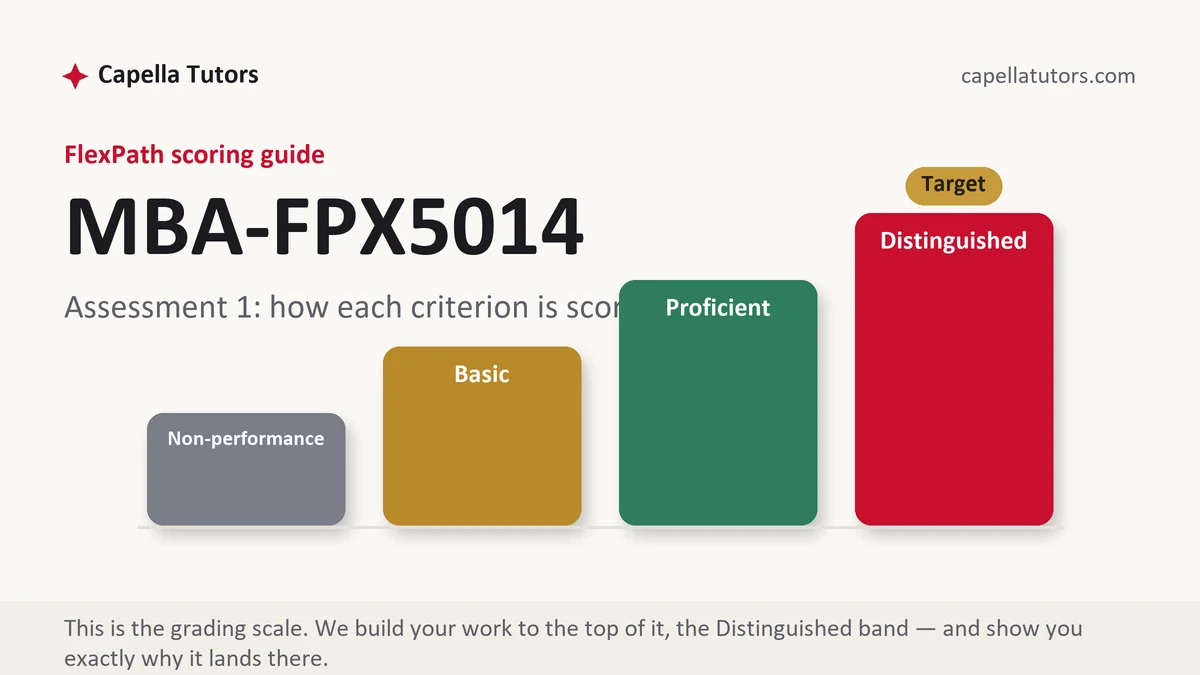
How MBA FPX 5014 Assessment 1 is scored
Each criterion is scored on four levels, and in finance the difference between them is easy to see:
| Level | What it means on a financial analysis deliverable |
|---|---|
| Distinguished | The model is correct and every input is defended in a register a stranger could audit, the analysis ends at a recommendation an executive could act on, and the condition that would reverse the call is stated by the writer rather than discovered by the reader. |
| Proficient | Correct arithmetic and a clear write-up, with assumptions listed but not justified. Listing is the easy half of the job; the defense is what the column above pays for. |
| Basic | Outputs reported without their inputs, ratios and rates appearing from nowhere. A reader who cannot rebuild a number cannot credit it, and most first drafts here are exactly this. |
| Non-performance | A computation the guide names, or the recommendation itself, is missing. In finance one absent model floors its criterion whatever the prose around it does. |
This deliverable sets the discipline the rest of the course assumes. The assumption register you build here is the same one the investment decision will stress and the closing synthesis will inherit, so build it as a real document.
The MBA FPX 5014 Assessment 1 method, step by step
-
Turn the criteria into a model specification
Read the scoring guide and write down what has to be computed before you read the case narrative. Ratios, a cost of capital, a valuation, a coverage test, whatever is named. That list is the model's specification, and building to a specification stops the common failure here, a spreadsheet full of interesting calculations answering criteria nobody set.
-
Build the statements into a live model before you write a sentence
Type the income statement, balance sheet, and any cash flow data into one workbook as formulas. Never paste values you could compute. Every ratio then updates when an input changes, which matters at the sensitivity stage, and every figure in the paper traces back to its statement line in seconds.
-
Set the cost of capital before anything depends on it
The discount rate drives every present value in the paper, so derive it in the open: capital structure weights from the balance sheet, cost of debt from interest expense or the case's quoted rate, cost of equity by whatever method your guide expects, inputs cited. A rate arriving without a derivation makes everything downstream unverifiable.
-
Keep an assumption register as you build
Every time you assume something, write the assumption, its value, its source, and one sentence of justification. Growth rate, horizon, tax treatment, working capital behavior, terminal assumptions. The register becomes a section of the paper, and it is where judgment becomes visible, which is what separates finance writing from arithmetic homework.
-
Argue the analysis to a decision an executive can take
Ratios recommend nothing on their own. Say what the company should do, refinance, hold, raise the price, take the covenant waiver, and put the driving number in the same sentence. Then justify it against the alternative the case makes available. A paper that stops at analysis leaves the heaviest criteria unaddressed while looking finished.
-
Verify the arithmetic twice, then self-score
Recompute the two or three numbers everything rests on from their raw inputs, not by rereading the cell. Check that every figure quoted in the prose matches the model. Then read the draft against the guide, one criterion at a time, and revise anything below the top column. Submit early in the week.
A structure that maps to the criteria
The word targets below are the planning ranges our tutors use on a typical financial analysis, not Capella requirements; your scoring guide decides the real scope.
| Section | What it must do | Guide |
|---|---|---|
| Executive summary | The recommendation and the one number driving it, before any analysis appears. | ~130 words |
| The company and the question | What the business is, what the statements cover, and what decision the numbers must settle. | ~180 words |
| Financial analysis | The computations the guide names, with summary tables in the body and the method choice explained. | ~330 words |
| Assumptions register | Every input listed with its value, its source, and a sentence defending it. | ~280 words |
| Risk and what would reverse the call | The inputs that matter most, how far they can move, and the threshold that flips the answer. | ~280 words |
| References | Case exhibits, filings and investor materials, rate sources, and finance literature in current APA. | as needed |
Annotated sample excerpt
The excerpt below is original model work from our team, written to show what a defended number looks like next to an undefended one.
Lachlan Industrial carries $18.4 million of senior debt at a fixed 8.6 percent maturing in nineteen months, against EBITDA of $6.1 million and interest expense of $1.58 million, giving coverage of 3.9 times and leverage of 3.0 times.1 Refinancing at the 6.4 percent indicative rate the lender quoted, with $340,000 of issuance costs amortized across a new seven-year term, cuts annual interest to $1.18 million and lifts coverage to 5.2 times, worth $400,000 a year pre-tax and $304,000 after tax at the 24 percent effective rate the last three filings support.2 The case, though, is not the saving. Refinancing now converts a nineteen-month maturity wall into a seven-year schedule while coverage still sits comfortably above the 2.5 times covenant, and waiting for a possibly better rate means negotiating from the wrong side of that wall.3
- 1Position is established in ratios built from figures the evaluator can find on the statements. Coverage and leverage stated together frame the question before it is asked.
- 2The saving is computed pre-tax and after tax with the rate named and sourced. A rate borrowed silently from the statutory table is the commonest unforced error here.
- 3The recommendation turns on the risk the numbers imply rather than the largest number in the paragraph. Reframing the decision from price to timing is the judgment the top column rewards.
The full premium sample for your exact assessment, written fresh to your scoring guide and issue, is free to request. Study it, revise it into your own voice, and submit work you understand.
The five mistakes that cost Distinguished
- Outputs without inputs. A ratio quoted with no visible derivation asks the evaluator to trust it, and trust is not one of the four levels.
- A discount rate from nowhere. Ten percent because the textbook used ten percent invalidates every present value in the paper.
- An assumption list that justifies nothing. Bullets naming a growth rate and a horizon without a sentence of defense read as a formality, which is how they get scored.
- Reporting instead of recommending. A paper ending in a summary of findings leaves the decision criteria empty while feeling complete to the writer.
- Precision the data cannot support. Four decimals on a rate derived from a rough estimate signals the writer does not know which numbers are soft.
Pre-submission checklist
- Every computation the scoring guide names is present and labeled
- The whole model built from formulas, with each figure traceable to a statement line
- Cost of capital derived in the open, with weights and component rates sourced
- Assumption register listing value, source, and a defending sentence for every input
- A recommendation stated in the opening paragraph with the number that drives it
- The reversing condition named, arithmetic verified twice, draft self-scored and submitted early
Want the model and the memo handled?
Send the scoring guide and the case exhibits or dataset. A finance-matched writer builds the model, an analyst decodes your guide, and two QA passes check the arithmetic and the APA before delivery inside 24 to 48 hours. The walkthrough explains each calculation, and revisions stay free until the target column is reached.