This manual is for IT FPX 4998 Assessment 3, start to submission. The closing deliverable in IT FPX 4998, Information Technology Capstone 2, is the document you will still be able to show somebody in two years: a variance section separating what was delivered from what changed and what was dropped, lessons tied to decisions rather than to feelings, a handover package a successor could work from, ranked recommendations, and a one-page summary written last. Every criterion collects its own verdict against whichever guide your courseroom attached to this one. Under this sits the sequence our tutors follow, an outline pulled straight from the criteria, and a passage annotated in the margin. Prefer to hand it off? A premium original sample for this exact assessment comes back in 24 to 48 hours layered for both audiences, revised free until the guide is satisfied. Capella's catalog lists the course as IT-FPX4998, and some courserooms print IT4998; both point to this same Assessment 3.
One honesty note before the manual: Capella revises courses and scoring guides over time, so always write to the exact scoring guide attached to your assessment in the courseroom. The course identity above is verified on capella.edu; the method and structure below are our tutors' approach to it, not Capella's official rubric text.
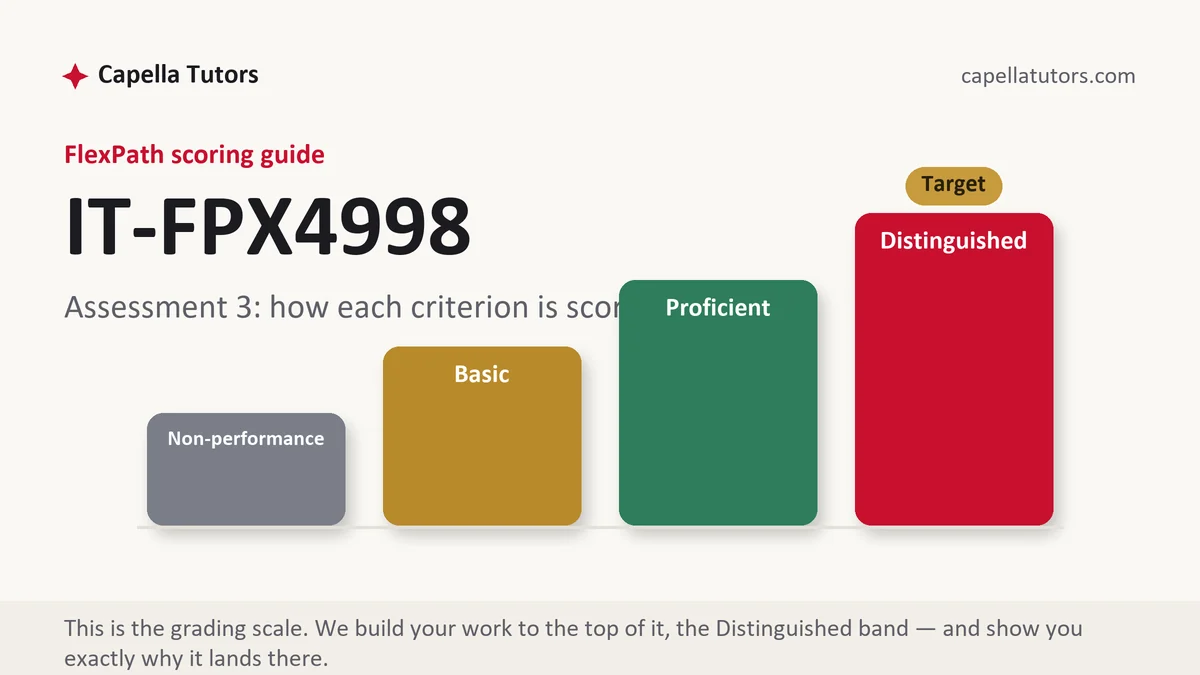
How IT FPX 4998 Assessment 3 is scored
Four levels, one verdict per criterion, and in a final document two of them turn on tone as much as content, because a report that hides a shortfall is placed below one that reports it:
| Level | What it means on a variance and handover deliverable |
|---|---|
| Distinguished | Delivered, changed and dropped items each carry a reason and a date, lessons are stated as decisions you would make differently with the evidence that taught them, and the recommendations carry effort against benefit. The criterion asks for one move past a conclusion, and the move is usually candor. |
| Proficient | The report is complete, layered and honest about the outcome. Strong work one column below the top because the lessons name experiences rather than decisions. |
| Basic | A closing narrative with a paragraph of reflection and a list of next steps. Competent prose with nothing traceable behind it lands here. |
| Non-performance | A required element is absent, most often the variance section or the handover material. The floor belongs to what is not in the document. |
Write the body first and the one-page summary last, so the figures on page one come from tables that have already stopped changing. The test for the summary is whether a reader who stops there could repeat your conclusion accurately to a colleague.
The IT FPX 4998 Assessment 3 method, step by step
-
Write the variance section as three lists
Planned and delivered, planned and changed, planned and dropped, each item with a reason and a date. Something dropped with its cause named and a later phase proposed for it barely costs you anything, while the same absence left for the marker to discover costs the consistency criterion and the trust attached to every claim beside it.
-
Report a shortfall analytically
Assign it a cause: an estimate that was wrong, a dependency that never turned up, a technical ceiling you found, or a requirement that should never have been written. Each of those is a finding, each supports a recommendation, and each is worth more than a sentence apologizing for the gap.
-
Turn each lesson into a decision
A paragraph about the importance of communication names nothing. A sentence saying you underestimated data cleanup by a factor of two, and would in future sample a hundred records before estimating, names a decision and the evidence behind it.
-
Build the handover for the person who inherits it
A runbook somebody could operate from without you, the accounts and access they will need, the known issues with their workarounds, and where the configuration and the source live. Then test it by asking whether somebody who has never seen the system could run it from what you wrote.
-
Rank the recommendations with effort against benefit
Rough figures are fine and no figures are not. A list in priority order with an estimate and an expected outcome beside each item is something a manager can fund, while an unordered list of good ideas is something they will file.
-
Layer the document and write the summary last
One page for a manager with the problem, what was delivered, the measured outcome, the cost and the recommendation. A technical body for the successor. Appendices for raw output, each referenced from the sentence that depends on it, and nothing confidential left anywhere in the file.
A structure that maps to the criteria
Internal planning lengths for a final report, not Capella rules; expand whichever criterion your own guide weights most.
| Section | What it must do | Guide |
|---|---|---|
| Executive summary | Problem, what was delivered, the measured outcome, what it cost and what should happen next, with no jargon and no command lines. | ~250 words |
| Variance against plan | Delivered, changed and dropped, each with a reason, a date and its effect on the requirements. | ~300 words |
| Shortfall analysis | The cause category for each gap, what it teaches, and the recommendation it produces. | ~250 words |
| Lessons learned | Each lesson stated as a decision you would make differently, with the evidence that taught it. | ~250 words |
| Handover package | Runbook, accounts and access, known issues with workarounds, and where configuration and source material live. | ~300 words |
| Recommendations and sources | Ranked items with effort and benefit estimates, appendices referenced from the text, current APA both ways. | ~200 words |
Annotated sample excerpt
A short model paragraph our team wrote at the level a guide's strongest level describes. Take the candor and the structure, then write your own variance section.
Of the eleven knowledge base sections planned for the staffing agency, eight were delivered and populated, two were delivered empty as templates with owners assigned, and one, the client onboarding section, was dropped on 24 June after the compliance manager declined to release the contract templates it depended on.1 That drop is an estimation and dependency failure rather than a build problem: the proposal assumed content access that had never been confirmed in writing, which is the same mistake in a different form as underestimating the tagging effort at 4 hours when the eight delivered sections took 11.2 The recommendation that follows is specific rather than regretful, namely that the section is reinstated in a second phase estimated at 14 hours once a named compliance owner has approved the templates, and the decision I would make differently is to obtain written content access for every dependent section before the plan is submitted rather than after it is approved.3
- 1Counts the three categories rather than describing the project as broadly complete. Eight, two and one is a variance section; substantially delivered is a phrase.
- 2Classifies the cause and links it to a second instance of the same error. A pattern named across two items reads as analysis rather than as excuse.
- 3Ends with a costed recommendation and a decision stated in the first person. That is a lesson the criterion can credit, and it takes one sentence.
The full premium sample for your exact assessment, written fresh to your scoring guide and issue, is free to request. Study it, revise it into your own voice, and submit work you understand.
The five mistakes that cost Distinguished
- A shortfall left for the reader to discover. Markers can separate a project that ran into something from a report working around it, and the second costs far more.
- Lessons learned written as adjectives. A paragraph about communication being valuable names no decision and teaches a reader nothing.
- Recommendations with no effort estimate. An unordered list of good ideas is filed, while a ranked list with rough figures beside it can be funded.
- A handover only its author could use. If the runbook assumes knowledge that exists solely in your head, the system is unmaintainable the day the session ends.
- A final report that quietly departs from the proposal. A change is expected and a change nobody accounts for is not, so every difference earns a sentence and a date.
Pre-submission checklist
- Each criterion in your guide addressed under its own heading
- Variance split into delivered, changed and dropped, each with a reason and a date
- Every shortfall assigned a cause category and a recommendation
- Lessons written as decisions, with the evidence that produced them
- Runbook, access notes and known issues a successor could work from
- Recommendations ranked with effort and benefit, summary written last, current APA both ways
Final report due and the variance section unwritten?
Send the proposal, the results and the criteria for this stage. Variance comes back as three lists with reasons and dates, lessons come back as decisions rather than reflections, and the handover comes back written for the person who inherits the system. The first premium sample is free.