This manual is for IT FPX 4998 Assessment 2, start to submission. The middle deliverable in IT FPX 4998, Information Technology Capstone 2, is where results have to be checkable: test cases numbered back to the acceptance criteria you wrote before, each with input, expected result, actual result, status and date, defects recorded and retested, and an evaluation against the baseline that names its own confounds. Each criterion is decided by itself against the guide that came with your own assessment. Our tutors' working order follows, beside an outline drawn criterion by criterion and a passage with notes against it. Rather delegate it? A premium original sample for this exact assessment lands in 24 to 48 hours with the arithmetic shown and the competing explanations named, revised free until the guide is satisfied. Capella's catalog lists the course as IT-FPX4998, and some courserooms print IT4998; both point to this same Assessment 2.
One honesty note before the manual: Capella revises courses and scoring guides over time, so always write to the exact scoring guide attached to your assessment in the courseroom. The course identity above is verified on capella.edu; the method and structure below are our tutors' approach to it, not Capella's official rubric text.
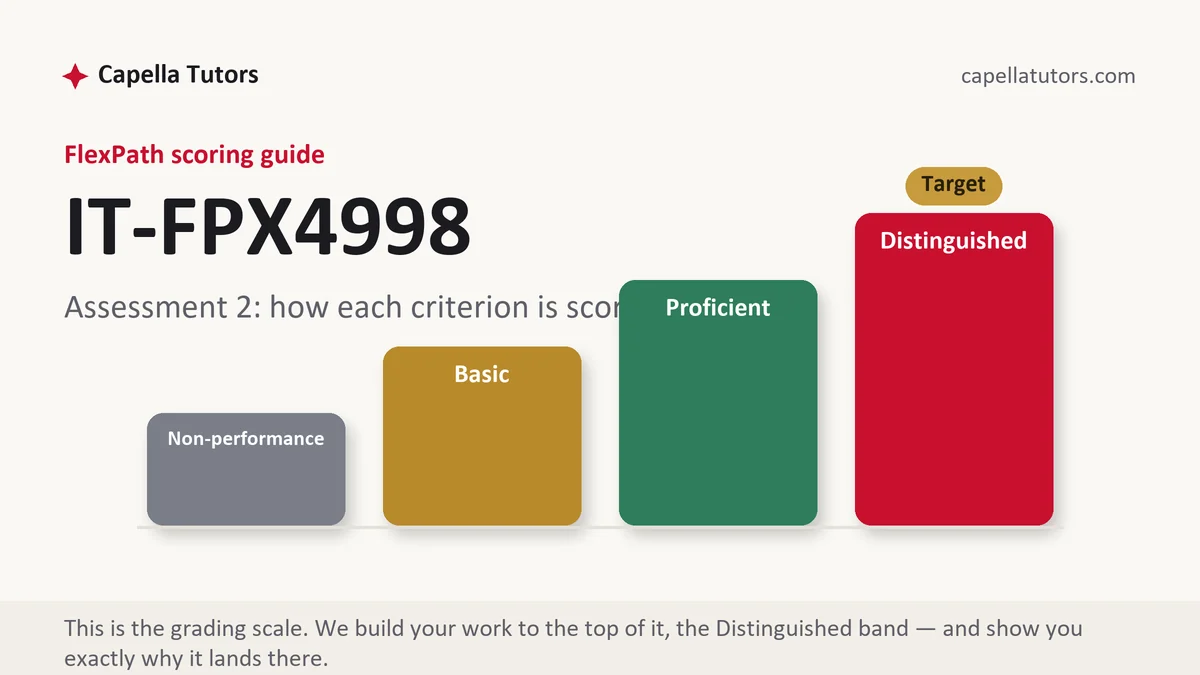
How IT FPX 4998 Assessment 2 is scored
Separate verdicts again, four levels, and this is the deliverable where the middle two separate on one habit, which is whether the report volunteers what weakens it:
| Level | What it means on a testing and evaluation deliverable |
|---|---|
| Distinguished | Cases trace to the acceptance criteria by number, the table contains failures that were fixed and retested, and the measured change carries its arithmetic and its competing explanations. The extra move the criterion wants is the confound you named yourself. |
| Proficient | Testing was performed and results are reported against a baseline. Credible work one column below the top because the comparison is offered without its caveats. |
| Basic | A summary saying the system was tested and works, with a table where every case passed. Confident material with nothing verifiable in it lands here. |
| Non-performance | A required element is absent, most often the baseline figure or the defect records. Absence is punished more sharply than a poor result. |
Volunteering your own confound does not weaken the finding. It is the sentence that shows an evaluator you know where your evidence stops, and it lifts an evaluation criterion more dependably than another decimal place ever will.
The IT FPX 4998 Assessment 2 method, step by step
-
Number the cases from the acceptance criteria
If the earlier course produced requirement R-14, the case that proves it is T-14, and any criterion with no case beside it needs a sentence saying why. Matching numbers are the cheapest traceability you will ever build.
-
Write each case so somebody else could run it
Preconditions, input, the exact steps, the expected result, then the actual result, the status and the date. A case that depends on your interpretation of the outcome is not finished, and the criterion about evidence will treat it as narrative.
-
Test the failure paths, not only the intended ones
The interesting cases are the ones where something is unavailable, a value is out of range, a permission is missing, or two things happen at once. A suite that only proves the design works under ideal conditions is the definition of a suite written afterwards.
-
Record defects, fix them, and show the retest
Each defect gets the case that exposed it, what you changed, and the result of running the same case again. A table where everything passed on the first attempt reads as reconstruction rather than as testing, and evaluators have seen enough of both to tell.
-
Compare against the baseline and show the arithmetic
The before figure, the after figure, the difference in absolute and relative terms, and the collection method for both. A claim of improvement with no before figure is an opinion, and one with no method is unrepeatable.
-
Name every competing explanation you can think of
Seasonality, a change in volume, another project running in the same window, a different sample, or somebody behaving differently because they knew they were measured. Then say which part of the change you are willing to attribute to your work and schedule the measurement that would settle the rest.
A structure that maps to the criteria
Internal targets for a testing deliverable rather than published requirements; whichever criterion your guide leans on hardest earns the extra words.
| Section | What it must do | Guide |
|---|---|---|
| Test approach and coverage | What was tested, how cases were derived from the acceptance criteria, the environment used, and what was deliberately not tested. | ~250 words |
| Test cases and results | Numbered cases with preconditions, input, expected, actual, status and date, including the failures. | ~350 words |
| Defects, fixes and retests | Each defect traced to the case that exposed it, the change made, and the retest result with its date. | ~250 words |
| Baseline and measured outcome | Before and after figures, collection method for each, the arithmetic of the difference, and the period covered. | ~300 words |
| Confounds and attribution | Every competing explanation, what you attribute to the project, and the measurement that would resolve the remainder. | ~250 words |
| Limitations and sources | Coverage gaps, instruments named with versions, benchmarks cited with publication years, current APA both ways. | ~200 words |
Annotated sample excerpt
An excerpt our team wrote where a guide's highest column sits. Study how the measurement, the arithmetic and the confound arrive together, then write your own.
Restore testing was the point of the project, so the measure is the time to recover the electric cooperative's member billing folder from the most recent copy, and the baseline taken on 2 June 2026 before any change was 6 hours 40 minutes, of which 5 hours 15 minutes was locating and loading the correct tape set.1 Three restores after the rebuild, run on 6, 13 and 20 July, took 52, 47 and 61 minutes, a median of 52 against 400, which is an 87 percent reduction, and the collection method was the same in both cases, namely a stopwatch started at the request and stopped when a named clerk confirmed she could open five sample records.2 Two competing explanations belong in the same paragraph: the folder grew from 214 to 240 gigabytes across the period, which works against the improvement rather than for it, but the July restores were run by me while the June baseline was run by the office administrator following the old written procedure, so part of the gain is operator familiarity and the fourth restore in August is scheduled for her to run unaided.3
- 1Names the measure, the date and the decomposition of the baseline. Knowing where five of the six hours went is what makes the later comparison meaningful.
- 2Gives three post-change runs rather than one, states the median, the percentage and the identical collection method. Repetition is what turns a figure into a result.
- 3Volunteers a confound that helps and a confound that hurts, then schedules the test that would settle it. This is the paragraph the evaluation criterion is written for.
The full premium sample for your exact assessment, written fresh to your scoring guide and issue, is free to request. Study it, revise it into your own voice, and submit work you understand.
The five mistakes that cost Distinguished
- A single post-change measurement. One run is an anecdote, and three runs with a median is a result that survives a reader asking whether you got lucky.
- Results reported with no baseline. A single post-change number cannot demonstrate a change, and taking the earlier measurement after the work started does not rescue it.
- Cases drafted once the outcome was already known. A suite where every case passes and matches the result exactly reads as reconstruction, and the pattern is obvious to anybody who has marked a hundred of these.
- Only the intended paths tested. A suite with no unavailable dependency, no out-of-range input and no permission failure has not tested the system, only demonstrated it.
- Confounds omitted because they weaken the claim. An improvement asserted with no competing explanation named is read as an overclaim, and the reader will supply the confound themselves.
Pre-submission checklist
- Every criterion in the guide has a section with a matching name
- Case numbers matching the acceptance criteria they prove
- Cases carrying preconditions, input, expected, actual, status and date
- Failure paths tested, defects recorded, and every retest shown
- Baseline and after figures with the same collection method and the arithmetic shown
- Confounds named with what you attribute to the project, current APA both ways
Testing and evaluation sections due?
Send the acceptance criteria, whatever measurements you have and the criteria for this stage. Cases come back numbered to the requirements they prove, defects come back with retests, and the evaluation comes back with the arithmetic shown and the competing explanations named. First premium sample free.