This manual is for IT FPX 4998 Assessment 1, start to submission. The opening deliverable in IT FPX 4998, Information Technology Capstone 2, is the proof that the work happened: a traceability table carried forward from the earlier course, an implementation record written from your own notes and timestamps, and artifacts that belong to you rather than to a vendor's marketing page. Verdicts are issued one criterion at a time against the guide your courseroom attached. The working order our tutors use appears under this, next to an outline built from the criteria and a marked passage. Prefer to hand it off? A premium original sample for this exact assessment returns in 24 to 48 hours with enough operational detail that a competent reader could repeat the sequence, revised free until the guide is met. Capella's catalog lists the course as IT-FPX4998, and some courserooms print IT4998; both point to this same Assessment 1.
One honesty note before the manual: Capella revises courses and scoring guides over time, so always write to the exact scoring guide attached to your assessment in the courseroom. The course identity above is verified on capella.edu; the method and structure below are our tutors' approach to it, not Capella's official rubric text.
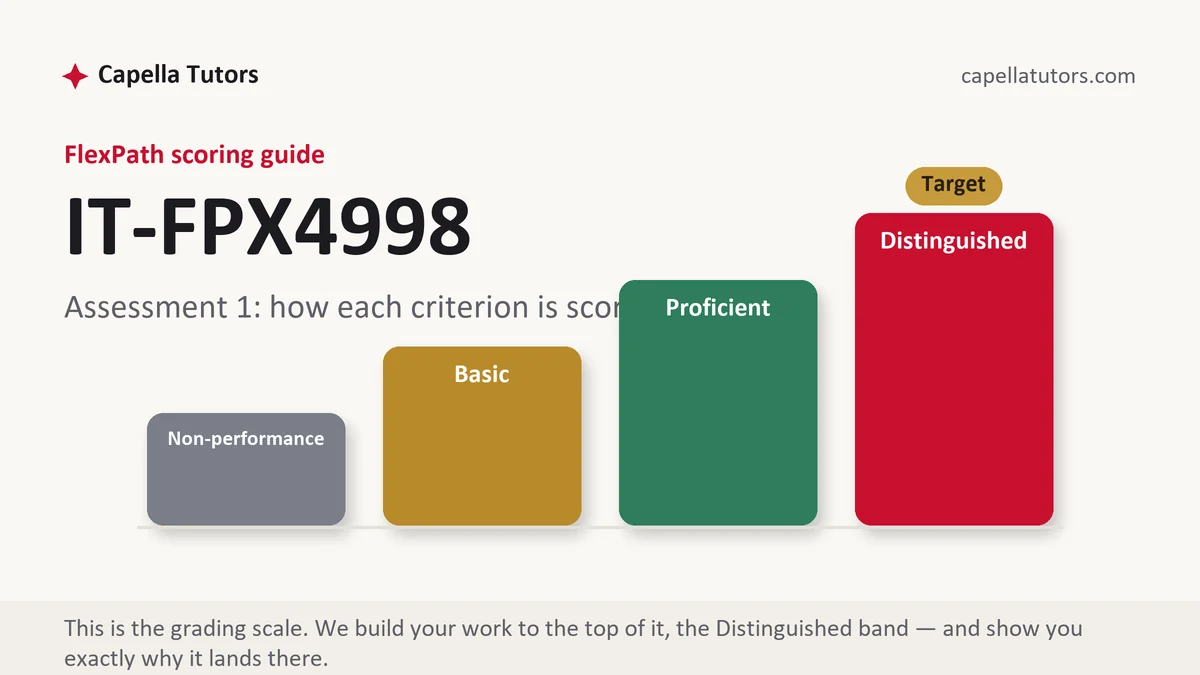
How IT FPX 4998 Assessment 1 is scored
A closing capstone is still assessed one criterion at a time at one of four levels, and the criterion about evidence is unforgiving in a way the earlier course's criteria were not:
| Level | What it means on an implementation record deliverable |
|---|---|
| Distinguished | The traceability map is complete, every empty cell is explained as a declared limitation, and the record carries dates, environments, versions and the deviations from plan in enough detail to reproduce. The criterion asks for one move past a narrative, and that move is reproducibility. |
| Proficient | The work is documented and the map is largely intact. Complete work one column short because the record describes intentions in the past tense rather than actions with timestamps. |
| Basic | A chronological account of a project with screenshots attached. A readable story that nobody could repeat lands here more often than a disorganized one does. |
| Non-performance | A required element is absent, most often the traceability table or any version and environment detail. What is missing costs the criterion whole. |
Rebuild the map in week two rather than week ten. Knowing early which empty cells are work you can still finish and which are limitations you will declare is the whole difference between a controlled ending and a scramble in the last two weeks of the session.
The IT FPX 4998 Assessment 1 method, step by step
-
Rebuild the traceability table first
One row per requirement or acceptance criterion, then four columns: which case proves it, which artifact holds the proof, what the result was, and where in the report it appears. The table tells you what the document has to contain before you write a word of it.
-
Sort the empty cells into two piles
Work still achievable and limitations you will declare. Both are acceptable and only one of them is acceptable late, so make the call while there is still session left to act on it.
-
Write the record from timestamps, not from memory
Ticket times, commit messages, configuration change dates, your own notes. A sequence reconstructed weeks afterwards is where inaccuracies enter, and an evaluator who finds two dates that contradict each other will read the rest of the document more skeptically.
-
Name every environment and every version
Hardware models, firmware, operating system releases, application versions, and where each ran. A behavior a marker cannot reproduce because they do not know which version you used becomes a disputed claim rather than a demonstrated one.
-
Record deviations from plan as they happened
Record the change, the finding that forced it, what it did to the schedule and to the requirement set, and the person who signed it off. A change carried through a written record reads as control, while an unannounced difference between the proposal and the closing report reads as inattention.
-
Caption and date every artifact
An image with nothing written under it shows only that a screen once appeared that way, which no criterion counts as proof. Give each artifact a number, a date, a one-line caption saying what it demonstrates, and a reference from the sentence that depends on it.
A structure that maps to the criteria
Internal planning lengths for the first closing-stage deliverable rather than Capella rules; give the extra words to whichever criterion your guide leans on hardest.
| Section | What it must do | Guide |
|---|---|---|
| Objectives carried forward | The requirements and acceptance criteria from the earlier course, restated with their original identifiers intact. | ~200 words |
| Traceability map | Every criterion against its test case, evidence artifact, result and report section, with each empty cell explained. | ~250 words |
| Implementation record | What was delivered, in what order, with dates, environments, versions and who performed each step. | ~400 words |
| Deviations and change record | Each change with its cause, its evidence, its effect on schedule and requirements, and who agreed to it. | ~250 words |
| Artifact register | Numbered artifacts with dates, captions and the claim each supports, plus where the raw material sits. | ~200 words |
| Limitations and sources | Declared limitations from the empty cells, and vendor and standards documentation cited with versions in current APA. | ~200 words |
Annotated sample excerpt
A paragraph our team wrote as a model for closing-stage work of this shape. Read it for the moves rather than the details, then write yours from your own timestamps.
Access point replacement at the community center ran on 8 and 9 July 2026 in two passes: the eleven units in the main hall and corridor were cut over first between 07:10 and 11:40 on the eighth, and the six units in the annex followed on the ninth between 07:00 and 09:25, each unit recorded with its serial, its mounting position and the firmware release it shipped with.1 Two deviations from the plan are recorded rather than smoothed over: the annex switch had only four ports free instead of the six the survey claimed, so two units ran on a temporary eight-port switch until a module arrived on the fourteenth, and the ceiling in the annex kitchen would not take a mount, so that unit is wall-mounted 2.1 meters up and the coverage figures for that room reflect the changed position.2 Everything in this section is drawn from the change tickets and the controller's own event log rather than from recollection, and the controller export is filed as Artifact 6 with the same timestamps so a reader can check the sequence against a source I did not write.3
- 1Records times, counts and per-unit identifiers. A sequence a reader could follow with a clipboard is what the reproducibility criterion is actually asking for.
- 2Reports two deviations and their consequences instead of describing the plan as executed. Deviations documented cost nothing; deviations discovered cost the consistency criterion.
- 3Names the sources and points at a numbered artifact from the sentence that relies on it. Evidence somebody else generated is the strongest kind available to a student project.
The full premium sample for your exact assessment, written fresh to your scoring guide and issue, is free to request. Study it, revise it into your own voice, and submit work you understand.
The five mistakes that cost Distinguished
- A record written in the past tense of the plan. Describing intentions as though they occurred is the failure this criterion is built to catch, and dates are how it catches it.
- Versions and environments left out. A result a marker cannot reproduce because the release is unknown becomes a disputed claim instead of a demonstrated one.
- Captures filed without a caption or a date. A picture nobody labeled cannot be tied to a claim, a version or a moment, so no criterion can credit it.
- Traceability abandoned after the earlier course. Identifiers that change between the two halves of the sequence break the link the closing criteria are explicitly looking for.
- Deviations smoothed out of the narrative. A project that met an obstacle and handled it reads well, while a project that quietly rewrote its own history reads badly everywhere.
Pre-submission checklist
- Each criterion in your guide addressed under its own heading
- Traceability map complete, with every empty cell explained
- Implementation record carrying dates, order, environments and versions
- Deviations recorded with cause, effect and who agreed
- Every artifact numbered, dated, captioned and cited from the sentence that uses it
- Declared limitations listed, documentation cited by version, current APA both ways
Implementation record due and the notes scattered?
Send the earlier proposal, whatever the project has produced and the criteria for this stage. The traceability map comes back rebuilt with the empty cells sorted, and the record comes back written from timestamps with environments, versions and deviations all in place. Your opening premium sample is free.