This manual is for IT FPX 4997 Assessment 3, start to submission. The closing deliverable in IT FPX 4997, Information Technology Capstone 1, is an approval document: a work breakdown small enough to estimate, dependencies that say what blocks what, a schedule sized against the hours you actually have, a risk register with triggers and owners, a baseline measurement with a collection date, and a request for a decision at the end. Each criterion earns a verdict of its own against whichever guide your courseroom supplied. Below sits the order our tutors follow, an outline mapped from the criteria, and a worked passage with margin notes. Prefer to hand it off? A premium original sample for this exact assessment comes back in 24 to 48 hours with the sizing arithmetic shown, revised free until the guide is satisfied. Capella's catalog lists the course as IT-FPX4997, and some courserooms print IT4997; both point to this same Assessment 3.
One honesty note before the manual: Capella revises courses and scoring guides over time, so always write to the exact scoring guide attached to your assessment in the courseroom. The course identity above is verified on capella.edu; the method and structure below are our tutors' approach to it, not Capella's official rubric text.
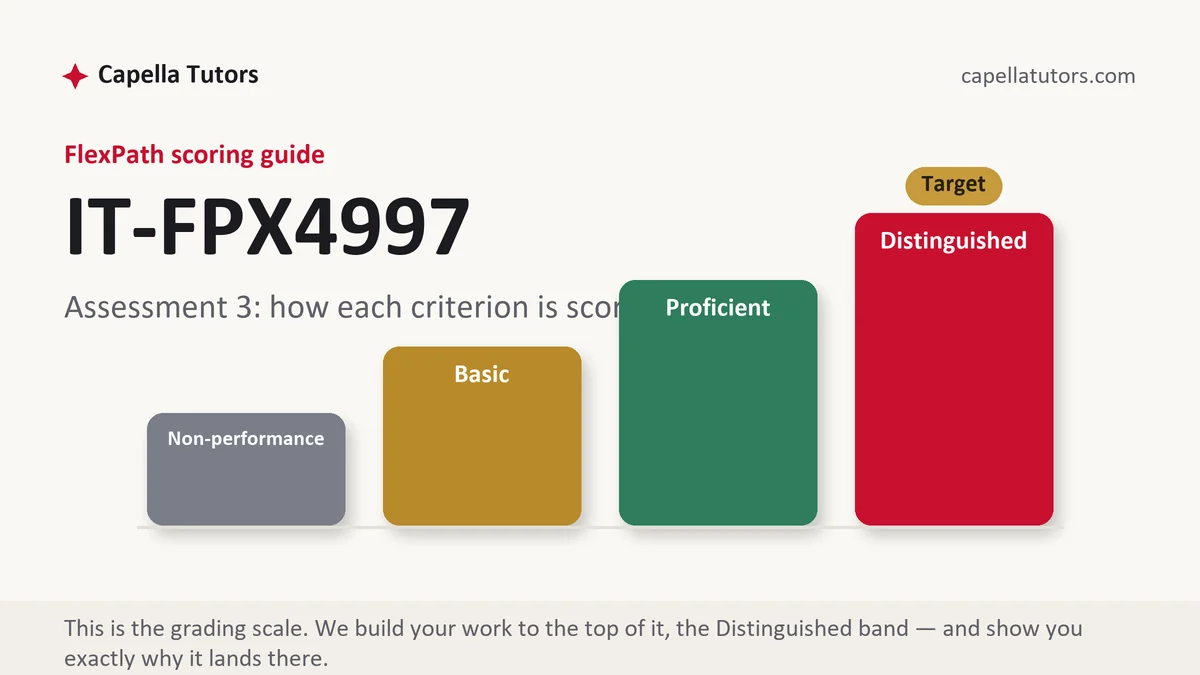
How IT FPX 4997 Assessment 3 is scored
Four levels, one verdict per criterion, decided on their own merits. In a planning deliverable the highest level is nearly always earned by showing a calculation somebody else could repeat:
| Level | What it means on a project plan and approval deliverable |
|---|---|
| Distinguished | The schedule is sized by estimated hours against available hours with the arithmetic on the page, every risk carries a trigger somebody could observe and a response decided in advance, and the baseline has a named measure and a collection date. The criterion asks for one move past a plan, and the move is a decision request. |
| Proficient | The plan, the risks and the evaluation approach are all present and coherent. Complete work one column short because the schedule was asserted rather than calculated. |
| Basic | A task list in date order with a table of things that might go wrong. A plan that looks organized and cannot survive one slipped week lands here. |
| Non-performance | A required element is absent, most often the baseline measurement or the dependencies. The floor is reserved for what is not in the document. |
One structural point worth making inside the plan itself: hold the outcomes, the acceptance tests and the submission dates steady, since those are the commitments you will be measured against, then say which parts of the sequence and the internal design stay open on purpose and name the review point at which each one closes.
The IT FPX 4997 Assessment 3 method, step by step
-
Break the work down until every task can be estimated
If you cannot put a number of hours on a task, it is still two tasks. Keep splitting until each line has an hour figure you would defend, because the schedule that follows is only as honest as its smallest unit.
-
Size the project with arithmetic instead of optimism
Total the estimated hours, then count the hours you actually have in the session, subtract the share that goes to writing the assessments rather than doing the project, and compare. A scope decision shown as a calculation reads as professional judgment, while the same decision offered as a preference reads as reluctance.
-
Draw the dependencies before the dates
Say what cannot start until something else finishes, and mark the longest chain. Tasks listed in date order with no dependencies will reorder themselves the first week anything slips, and the plan will not survive the reorder.
-
Give every risk a trigger, an owner and a decided response
A register that lists dangers and nothing about noticing or responding changes no behavior. The trigger has to be something a person could observe, the owner is a role, and the response is chosen now rather than improvised later.
-
Name the decisions you need and by when
A plan resting on a sign-off nobody has requested has already lost time it will not get back. List each decision, who makes it, what it blocks, and the date after which the schedule changes if it has not arrived.
-
Fix the baseline and its collection date
The closing course cannot prove anything improved without a before figure, and a measurement collected after the work has begun is not a baseline. Name the measure, the method, the period and the exact date it will be taken, then end the document by asking for the decision rather than trailing into a summary.
A structure that maps to the criteria
Internal planning lengths for an approval document, not Capella instructions; expand whichever criterion your own guide weights hardest.
| Section | What it must do | Guide |
|---|---|---|
| Scope confirmation | In-scope and out-of-scope items restated from the requirements set, with anything dropped since then flagged and dated. | ~150 words |
| Work breakdown and estimates | Tasks small enough to estimate, each with an hour figure, grouped into phases with deliverables named. | ~300 words |
| Dependencies and schedule | What blocks what, the longest chain, the session calendar, and the sizing arithmetic that shows the plan fits. | ~300 words |
| Resources and decisions needed | People, access, licenses and environments required, plus each decision requested, its owner and its deadline. | ~200 words |
| Risk register | Each risk with likelihood, impact, an observable trigger, an owner by role and a response decided in advance. | ~300 words |
| Evaluation, baseline and sources | The measure, the method, the collection date, the decision being requested, and method sources cited by edition in current APA. | ~250 words |
Annotated sample excerpt
A short model paragraph our team wrote at the level a guide's top column describes. Take the arithmetic and the honesty, then run both on your own estimates.
Standing up self-service password reset for the charter network's 700 students estimates at 71 hours: discovery and policy agreement 9, directory and attribute cleanup 16, configuration and connector work 14, pilot with two homerooms 11, cutover 6, documentation and a help desk script 9, and staff training 6.1 Against that, the session offers ten hours a week for twelve weeks, which is 120 hours, and roughly a quarter of that goes to writing the assessments rather than performing the work, leaving about 90 hours of project time, so 71 fits with a margin of 19 hours or two slipped weeks.2 The second initiative the sponsor asked about, extending the same reset flow to the 84 staff accounts, estimates at a further 28 hours and does not fit, so it appears in the plan as a phase two recommendation with its estimate attached rather than as a commitment I would have to abandon in week nine.3
- 1Publishes the estimate task by task so a reader can dispute a line rather than the total. Seven numbers invite scrutiny, which is exactly what makes them credible.
- 2Shows available hours net of the writing overhead and states the margin in weeks. A margin expressed as time you could lose is more useful than a percentage.
- 3Declines the second initiative with its estimate published. A refusal backed by arithmetic reads as planning; the same refusal without it reads as reluctance.
The full premium sample for your exact assessment, written fresh to your scoring guide and issue, is free to request. Study it, revise it into your own voice, and submit work you understand.
The five mistakes that cost Distinguished
- A schedule with no dependencies. Tasks in date order and nothing about what blocks what will reorder themselves the first week something slips.
- Estimates offered as a total. A single figure for a whole phase cannot be checked, and a reader who cannot check it will not approve it.
- Risks with no trigger and no owner. A list of what might go wrong, with nothing about noticing or responding, changes no behavior and earns nothing.
- No baseline measurement planned. Without a before figure collected before the work starts, the closing course has nothing to compare against.
- A proposal that trails off into a summary. This is an approval document, so it ends by asking for a specific decision from a specific person by a specific date.
Pre-submission checklist
- Each criterion in your guide addressed under its own heading
- Every task small enough to carry an hour estimate you would defend
- Sizing arithmetic showing estimated hours against available hours
- Dependencies drawn, with the longest chain identified
- Each risk carrying likelihood, impact, an observable trigger, an owner and a response
- Baseline measure, method and collection date named, and a decision requested at the end
Plan due and the hours not adding up?
Send the requirements set, your available hours and the criteria for this stage. The work breakdown comes back estimated line by line, the schedule comes back sized with the arithmetic shown, and the register comes back with triggers, owners and responses decided in advance. The first premium sample is free.