This manual is for IT FPX 4997 Assessment 2, start to submission. The middle deliverable in IT FPX 4997, Information Technology Capstone 1, is where the columns separate most visibly: functional requirements saying what the system does, non-functional requirements saying how well, and an acceptance criterion beside each one that a third party could apply without asking what you meant. Verdicts land on each criterion separately against the guide you were issued. Our tutors' order of work sits below, beside an outline taken criterion by criterion and a passage carrying notes. Rather delegate it? A premium original sample for this exact assessment lands in 24 to 48 hours with every requirement testable and every priority genuinely differentiated, revised free until the guide is satisfied. Capella's catalog lists the course as IT-FPX4997, and some courserooms print IT4997; both point to this same Assessment 2.
One honesty note before the manual: Capella revises courses and scoring guides over time, so always write to the exact scoring guide attached to your assessment in the courseroom. The course identity above is verified on capella.edu; the method and structure below are our tutors' approach to it, not Capella's official rubric text.
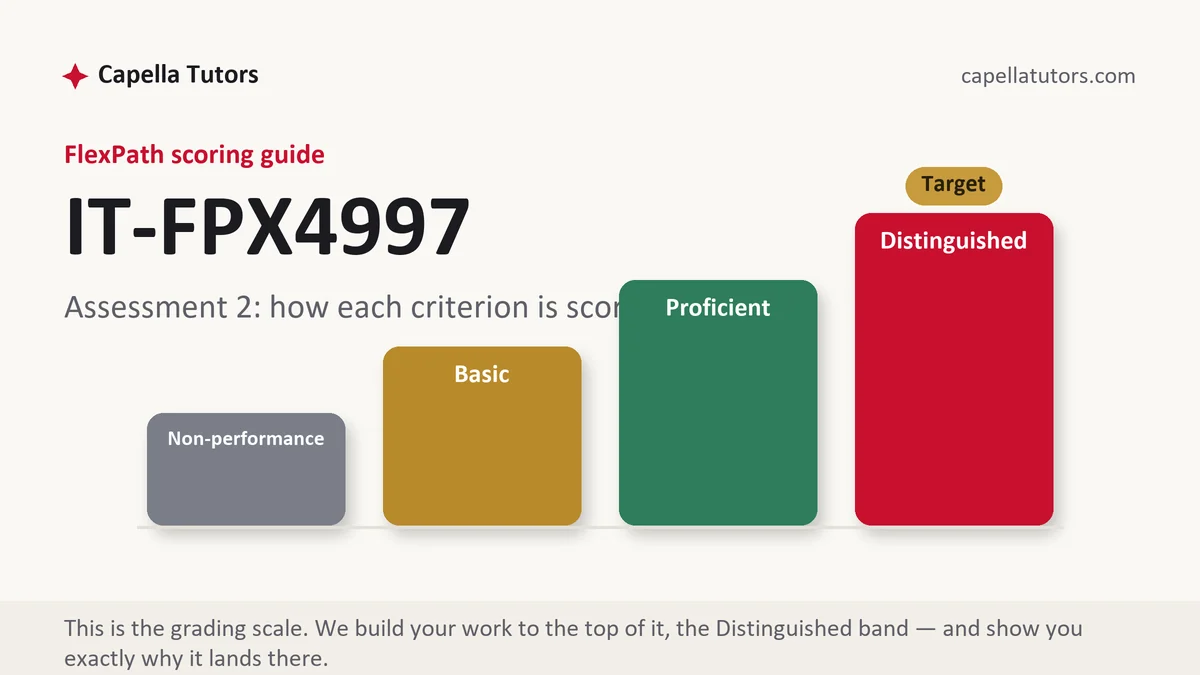
How IT FPX 4997 Assessment 2 is scored
Criteria are placed at one of four levels independently, so a strong functional list does not carry a vague non-functional one. Read all four before writing a single row:
| Level | What it means on a requirements deliverable |
|---|---|
| Distinguished | Every requirement carries an identifier, a source, a priority and an acceptance test a stranger could run, and the non-functional set is as specific as the functional one. The criterion asks for one move past a list, which is usually a measured threshold. |
| Proficient | Requirements are complete and traceable to the problem. Solid work one column below the top because the non-functional items describe qualities rather than thresholds. |
| Basic | A feature list with priorities that are all high. Requirements that read well and cannot be accepted or rejected land here almost every time. |
| Non-performance | A required element is absent, most often the acceptance criteria or the non-functional group entirely. Missing costs more than vague. |
Write these rows as though somebody else will have to prove them, because in the closing course somebody will, and it will be you. A requirement with no threshold produces a test case you cannot design and a result you cannot report.
The IT FPX 4997 Assessment 2 method, step by step
-
Build the table before you write any prose
Identifier, requirement, functional or not, source, priority, acceptance test. Prose written before the table exists drifts into description, while prose written after it becomes the boundary around the table, the plan to satisfy it, and the evaluation read back in order.
-
Trace every requirement to something outside your own head
A stakeholder by role and date, a counted pain point from the current-state work, a regulation, or a constraint. Requirements with no source look invented, and the criterion asking for derivation cannot credit what it cannot follow.
-
Give the non-functional group real numbers
Performance, availability, security, maintainability and accessibility each need a threshold and a method. A system that will be responsive is not a requirement. A search across a stated record count returning its first page inside a stated time, measured a stated number of times, is one.
-
Write acceptance criteria a stranger could apply
Given a starting condition, when this is done, then this observable thing is true. If the test needs you standing beside it to interpret the result, it is not an acceptance criterion yet.
-
Make the priorities mean something
If every row is marked mandatory, no prioritization has happened yet. Force an order, state what that order is based on, and accept that two features will end up recorded as desirable rather than required inside this session.
-
Check the set against the integration reality
Where the project joins two systems, add the requirements nobody remembers: what happens when one side is unavailable, which side owns each field, how a failed transfer is retried, and what a reconciliation report has to show at the end of a period.
A structure that maps to the criteria
Internal targets for a requirements deliverable rather than published rules; whichever criterion your own guide leans on deserves the extra length.
| Section | What it must do | Guide |
|---|---|---|
| Scope of the requirement set | What the requirements cover, what is explicitly out, and the version and date of the set itself. | ~150 words |
| Functional requirements | Numbered rows with source, priority and acceptance test, covering the primary flows and the exceptions. | ~400 words |
| Non-functional requirements | Performance, availability, security, maintainability and accessibility, each with a threshold and a measurement method. | ~350 words |
| Integration and data ownership | Which system owns each field, the direction of each transfer, failure behavior, retries and the reconciliation report. | ~250 words |
| Prioritization | The ranking basis, the mandatory set, the desirable set, and what would be dropped first if the session tightened. | ~150 words |
| Traceability and sources | Each requirement back to its origin, plus vendor and standards documentation cited with versions and dates in current APA. | ~200 words |
Annotated sample excerpt
An excerpt our team pitched at the level a guide's strongest column occupies. Study how one row carries a threshold, a method and an owner, then write the rest of yours the same way.
R-14: when a surveyor closes a time entry in the field application, the entry appears against the matching project in the invoicing system within fifteen minutes, and the invoicing system is the owner of the billing rate while the field application is the owner of the hours, so neither writes the other's field.1 Acceptance: given a project that exists in both systems, when twelve entries totaling 47.5 hours are closed across three devices, then all twelve appear in the invoicing system inside fifteen minutes with hours matching to two decimal places and no rate altered, verified twice on separate days by the office manager rather than by me.2 The failure case is written as its own row because it is where this class of project actually breaks: if the invoicing system is unavailable the entry is queued locally, retried on a rising interval for up to twenty-four hours, and anything still unsent after that appears on a daily exception report that names the project, the surveyor and the timestamp.3
- 1States the behavior, the time bound and the field ownership in one row. Ownership is the requirement most integration documents omit and the one that prevents the worst defects.
- 2Writes acceptance as a runnable procedure with a count, a tolerance and an independent verifier. A test somebody else performs is the strongest form of this criterion.
- 3Promotes the failure case to a requirement of its own rather than a note. Queue, retry interval and exception report are three answers a marker can check.
The full premium sample for your exact assessment, written fresh to your scoring guide and issue, is free to request. Study it, revise it into your own voice, and submit work you understand.
The five mistakes that cost Distinguished
- Requirements written as wishes. Fast, secure and user-friendly cannot be accepted or rejected, so they cannot be tested later or credited now.
- Non-functional items left as one paragraph. Performance, availability, security and accessibility are separate requirements with separate thresholds and separate tests.
- Acceptance criteria that need the author present. If a result requires your interpretation, the criterion is not yet a criterion and the closing course cannot use it.
- No owner declared for a shared field. When two systems both write the same value, the last one to run wins and nobody can explain the discrepancy afterwards.
- Every priority set to high. Undifferentiated priorities mean the first schedule pressure will make the ranking decision for you, badly.
Pre-submission checklist
- Every criterion in the guide has a section with a matching name
- Each requirement carrying identifier, source, priority and acceptance test
- Non-functional group with thresholds and measurement methods, not qualities
- Field ownership declared for every value two systems both touch
- Failure, retry and reconciliation written as requirements rather than notes
- Priorities differentiated with the basis stated, current APA reconciled both ways
Requirements table due and everything still marked high?
Send the problem definition and the criteria for this stage. Requirements come back numbered, sourced and prioritized, non-functional items come back with thresholds and methods, and every acceptance criterion comes back written so somebody other than you could run it. First premium sample free.