This manual is for IT FPX 4997 Assessment 1, start to submission. The opening deliverable in IT FPX 4997, Information Technology Capstone 1, is definition work and is graded as such: a problem written as a problem rather than as a solution in disguise, the stakeholders and what they actually want, a current-state description built from observation, and the constraints you are working inside. Each criterion is settled on its own against the guide your courseroom attached to this assessment. The order our tutors work in is laid out under this, with an outline drawn from the criteria and a marked passage. Prefer to hand it off? A premium original sample for this exact assessment returns in 24 to 48 hours with the pain points quantified wherever a count exists, revised free until the guide is met. Capella's catalog lists the course as IT-FPX4997, and some courserooms print IT4997; both point to this same Assessment 1.
One honesty note before the manual: Capella revises courses and scoring guides over time, so always write to the exact scoring guide attached to your assessment in the courseroom. The course identity above is verified on capella.edu; the method and structure below are our tutors' approach to it, not Capella's official rubric text.
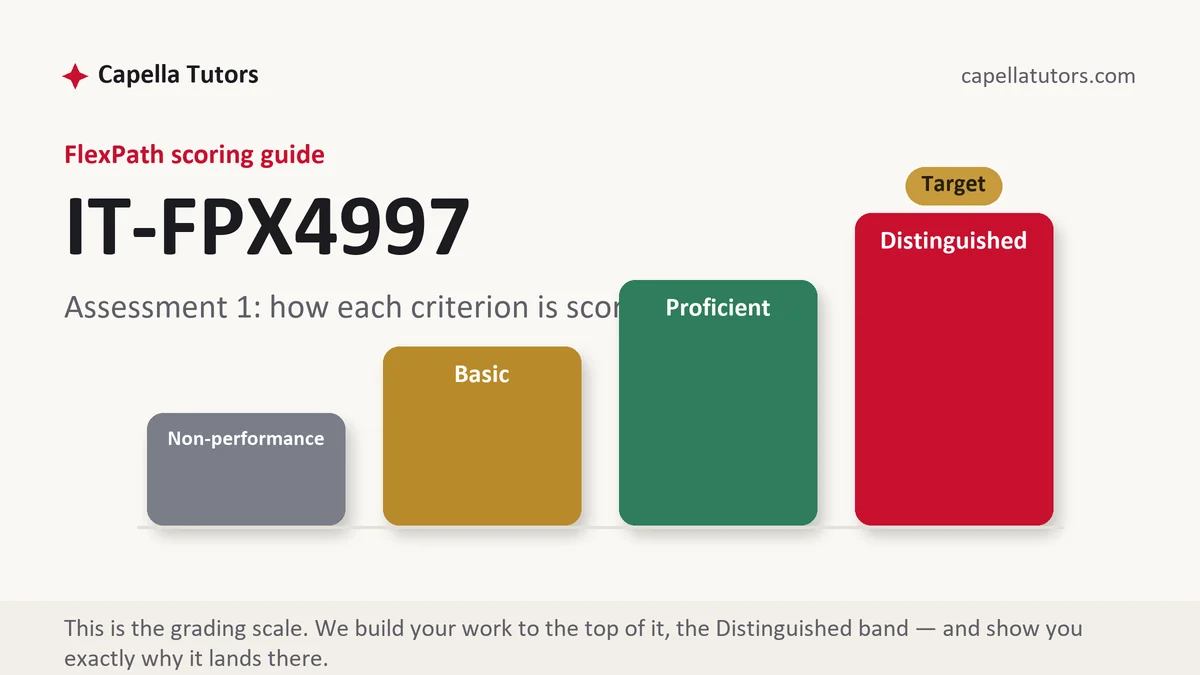
How IT FPX 4997 Assessment 1 is scored
Definition work collects the same treatment as everything else in FlexPath, one verdict per criterion at one of four levels. The wording of the highest level is the sentence to write toward:
| Level | What it means on a problem definition deliverable |
|---|---|
| Distinguished | The problem statement conceals no solution, the current state is described from evidence rather than assumption, and every pain point that can be counted has been counted. The criterion asks for one move past a description, and the move is usually a number. |
| Proficient | Problem, stakeholders and current state are all documented and consistent. Full work one column short because the description rests on what people said rather than on what was observed. |
| Basic | A situation summarized in general terms with a product implied throughout. Readable material with no measurement in it lands here more often than a confusing draft does. |
| Non-performance | A required element is not present, most often the constraint set or the current-state description. What is absent costs the criterion whole. |
This deliverable decides how much room the rest of the sequence has. A problem with a product name inside it removes the analysis the later criteria were going to pay for, and once a faculty member has approved a narrowed statement you have something to hold the project against when it tries to grow.
The IT FPX 4997 Assessment 1 method, step by step
-
Write the problem in one sentence and attack it
Then hand it to somebody and ask them to find the solution hidden inside. A sentence saying the bookstore needs a new system has already decided the thing the analysis was meant to justify. Keep rewriting until nobody can name a product from reading it.
-
Describe the current state from observation, not from a meeting
Watch the work happen, count the steps, note where the same fact is entered twice, and record how long a handoff actually waits. A current state built from what people believe happens is the most common source of requirements that turn out wrong in week six.
-
Quantify every pain point that can be counted
Duplicate entries per week, hours spent reconciling, messages sent to chase a status, items lost per term. One real count is worth a paragraph of adjectives, and the count also gives the second half of the sequence something to measure against later.
-
Map the stakeholders to interests rather than to job titles
Who is affected, what each of them actually wants, and where two of those wants conflict. A stakeholder list that reads like an organization chart tells a reader you asked nobody, while a stated conflict tells them you did.
-
State the constraints before anybody asks
Budget, calendar, access, skills, and whatever the organization simply will not allow. A constraint written down at the start is a boundary; the same constraint discovered in week eight is a schedule failure with your name on it.
-
Record what has already been tried
Most problems worth a capstone have survived at least one previous attempt, and saying what it was and why it did not hold is both a criterion answered and the fastest way to avoid proposing it again.
A structure that maps to the criteria
Internal planning lengths for an opening capstone deliverable rather than Capella rules; the criterion your own guide weights most is the one to expand.
| Section | What it must do | Guide |
|---|---|---|
| Problem statement | The situation stated as a problem with no solution concealed in it, and why it matters now rather than in general. | ~200 words |
| Stakeholders and interests | Who is affected, what each actually wants, who has authority, and where two interests pull against each other. | ~250 words |
| Current state | How the work is done today, step by step, with the handoffs, the duplication and the waiting described from observation. | ~350 words |
| Quantified pain points | The counts you were able to collect, how you collected them, over what period, and what you could not measure. | ~250 words |
| Constraints and prior attempts | Budget, calendar, access, skills, organizational limits, and what has been tried before and why it did not hold. | ~250 words |
| Assumptions and sources | Dated assumptions, interviews described by role and date, and method and vendor sources cited by edition in current APA. | ~200 words |
Annotated sample excerpt
A paragraph our team wrote as a model for definition work of this shape. Read it for the moves rather than the specifics, then write it for the situation you chose.
Textbook adoptions reach the community college bookstore through three routes that do not meet, which are faculty email, a shared spreadsheet maintained by two department assistants, and verbal requests taken at the counter, so no single record says what has been adopted for a term until the bookstore manager assembles one by hand.1 Across the spring term that assembly consumed 22 hours of the manager's time, produced 31 duplicate adoption entries out of 418 total, and left 14 titles ordered late enough that students bought elsewhere, which are the three counts this project would expect to move.2 The statement is deliberately silent about what should replace those three routes, because a shared form, a module in the existing bookstore system, and a change to the departmental deadline are all plausible answers and the analysis has not yet earned the right to pick one.3
- 1Describes the failure mechanically, in the words of the people doing the work. Three routes that do not meet is a problem; poor communication is a complaint.
- 2Supplies three counts with a period attached, which turns the pain into a baseline the second half of the sequence can measure against.
- 3Names the solutions it is refusing to choose between, and says why. Declaring the restraint is what proves the statement is genuinely open.
The full premium sample for your exact assessment, written fresh to your scoring guide and issue, is free to request. Study it, revise it into your own voice, and submit work you understand.
The five mistakes that cost Distinguished
- A problem statement with the product inside it. Naming the answer in the problem removes the analysis the criteria were going to reward.
- A current state built from interviews alone. What people believe the process is and what it is differ reliably, and the difference is where late requirement changes come from.
- Pain described only in adjectives. Frustrating and inefficient cannot be compared with anything later, and the closing course will need a before figure.
- Stakeholders listed by title. A list of roles with no interests attached shows nobody was asked, and it hides the conflict the project will have to manage.
- Constraints discovered late. An access restriction or a skills gap found in week eight was a constraint the whole time, and the schedule pays for the omission.
Pre-submission checklist
- Each criterion in your guide addressed under its own heading
- Problem statement with no product or solution concealed inside it
- Current state described from observation, with steps and handoffs counted
- At least one pain point quantified, with the period and method stated
- Stakeholders mapped to interests, including one stated conflict
- Constraints, prior attempts and dated assumptions all recorded, current APA both ways
Problem definition due this week?
Send the situation, whatever access you have and the criteria attached to this stage. The problem comes back with no solution hidden inside it, the current state comes back described from what you can actually observe, and the pain points come back counted wherever a count exists. Your opening premium sample is free.