This manual is for IT FPX 4792 Assessment 3, start to submission. The closing deliverable in IT FPX 4792, Website Application Development and Design, is usually where claims have to become measurements: conformance stated against numbered success criteria, contrast and load figures produced by named tools, a keyboard pass with a visible focus indicator, headings in order, and a test table that reports failures as well as passes. Each criterion earns its own verdict against whichever guide your courseroom attached to this one. The order our tutors use comes next, together with an outline drawn criterion by criterion and a marked passage. Prefer to hand it off? A premium original sample for this exact assessment returns in 24 to 48 hours with every figure traceable to a tool or a calculation, revised free until the guide is satisfied. Capella's catalog lists the course as IT-FPX4792, and some courserooms print IT4792; both point to this same Assessment 3.
One honesty note before the manual: Capella revises courses and scoring guides over time, so always write to the exact scoring guide attached to your assessment in the courseroom. The course identity above is verified on capella.edu; the method and structure below are our tutors' approach to it, not Capella's official rubric text.
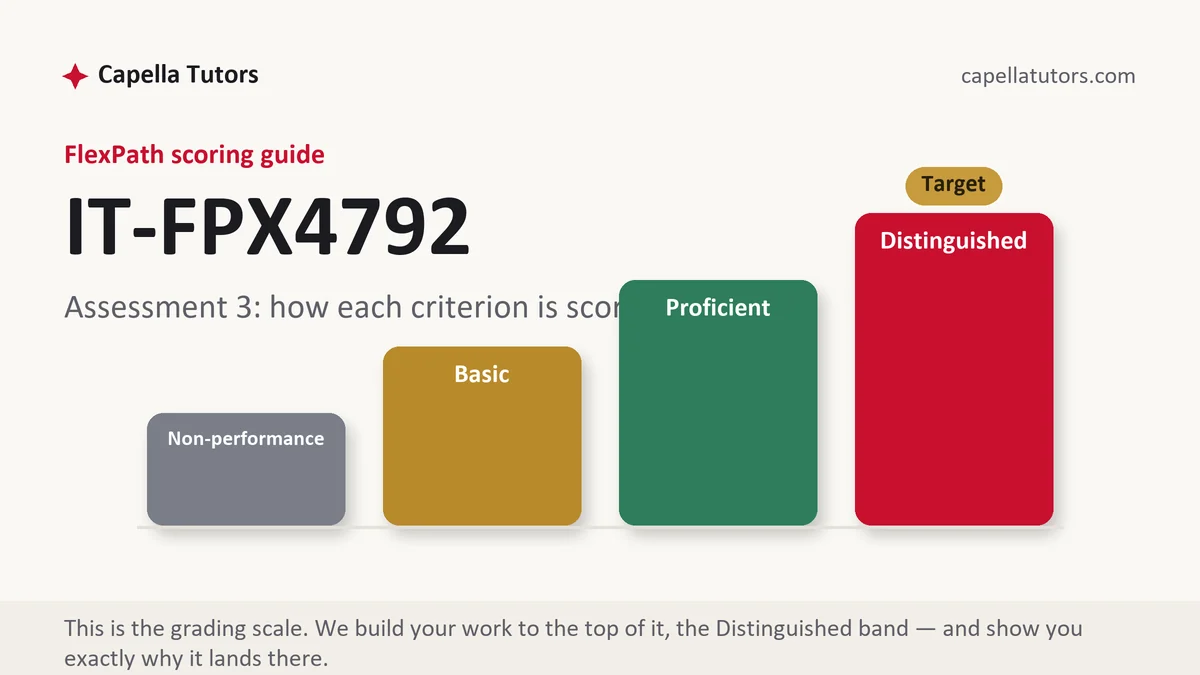
How IT FPX 4792 Assessment 3 is scored
Four levels per criterion, decided one at a time, with no total and no curve underneath them. The description of the highest level is the sentence to write toward:
| Level | What it means on an accessibility and performance deliverable |
|---|---|
| Distinguished | Conformance is cited by success criterion number with measured values beside it, performance figures name the tool and the conditions, and the test table contains failures that were fixed and retested. The extra move the criterion wants is usually the issue you accepted and why. |
| Proficient | The checks were run and the results are reported. Credible and complete, one column short because nothing was traced to a numbered criterion or a named instrument. |
| Basic | A site described as accessible and fast. Plausible summary language with no measurement behind it lands here more often than a failing site does. |
| Non-performance | A required element is not present at all, most often the test results or any measured load figure. Absence is graded harder than a poor result. |
Version control belongs in this section too. A commit history that shows the work happening is evidence in a way a zipped folder never is, and a marker who opens the repository and finds a connection string in it has a finding before reading your prose.
The IT FPX 4792 Assessment 3 method, step by step
-
State the conformance target and cite by number
Name the guidelines version and the level you are claiming, then cite the individual success criteria you checked rather than declaring the site compliant. Contrast minimum, keyboard operation, visible focus, and name, role and value are the four that carry the most weight in a project this size.
-
Measure rather than judge
Record contrast ratios for body text, for large text and for interface components separately, each against the background it actually sits on. Then keep the values in the document, because a number in the report is checkable and a number in a screenshot you did not include is not.
-
Run the keyboard pass and write what happened
Tab through every interactive element in order, confirm the focus indicator is visible on each, and note anything reachable by mouse and not by keyboard. Then check that headings descend without skipping a level, since a jump from a first-level to a third-level heading is a defect somebody using a reader will hit.
-
Produce performance figures with the conditions attached
A load figure means nothing without the tool, the page, the connection profile and the number of runs. Record all four, then say what you changed, whether that was resizing an image, switching its format, deferring a script or setting a caching header, and what each change bought in measured terms.
-
Write the test table so a stranger could repeat it
Case identifier, input, expected result, actual result, browser and width, status and date. Include the failures, because a run where every case passed on the first attempt reads as a table written after the results were already known.
-
Report the issues you accepted
Some findings are not worth fixing inside a course project, and saying which ones, why, and what it would take to close them is a stronger section than a clean sheet nobody believes. Then add the deployment note and the limitations paragraph naming the feature you scoped out.
A structure that maps to the criteria
Internal planning lengths for a closing evidence document rather than Capella rules; lengthen whichever criterion your own guide weights hardest.
| Section | What it must do | Guide |
|---|---|---|
| Conformance target and method | The guidelines version, the level claimed, the pages covered, and the tools and manual checks used to reach the conclusion. | ~200 words |
| Accessibility results | Measured contrast values, keyboard pass results, heading order, alternative text decisions and status message handling, each cited by success criterion number. | ~350 words |
| Performance measurement | Tool, page, connection profile, run count, the figures recorded, and what each optimization changed in measured terms. | ~300 words |
| Test cases and results | Cases with input, expected, actual, browser, width, status and date, including the failures the run produced. | ~300 words |
| Fixes, accepted issues and deployment | Defects closed with the case that found them, issues accepted with reasons, and what a marker must do to run the project. | ~250 words |
| Limitations and sources | What was out of scope, and specifications, guidelines and tool documentation cited by number and version in current APA. | ~150 words |
Annotated sample excerpt
A short model paragraph our team wrote at the level a guide's strongest column sits. Take the structure, then produce and report your own measurements.
The permit fee calculator page was measured five times in the same browser against a simulated connection of 1.6 megabits down with 150 milliseconds of latency, and the median time to first contentful paint before any change was 4.9 seconds, of which 2.1 seconds was one uncompressed 840 kilobyte header photograph.1 Resizing that image to the largest width it is ever displayed at and serving it in a modern format brought it to 96 kilobytes, deferring the two non-critical scripts removed a further 0.6 seconds, and the median came down to 1.8 seconds across another five runs.2 The figure that did not move was the fee lookup itself at roughly 300 milliseconds of server time, which is a database round trip on a shared host and is the next thing worth attention, so it is recorded here as a known limit rather than folded into the improvement claim.3
- 1States the instrument, the conditions, the run count and the baseline before claiming anything. Four details turn a load time into a measurement.
- 2Attributes the improvement to specific changes with their own numbers. A total that can be decomposed is a total a marker can check.
- 3Separates what did not improve and refuses to bundle it into the headline. Naming the unmoved figure is what makes the moved ones believable.
The full premium sample for your exact assessment, written fresh to your scoring guide and issue, is free to request. Study it, revise it into your own voice, and submit work you understand.
The five mistakes that cost Distinguished
- Compliance declared without a single criterion number. A claim of conformance is only checkable when it points at the numbered items you tested against.
- Load times reported with no conditions. A figure with no tool, connection profile or run count behind it cannot be reproduced, so it cannot be credited.
- Alternative text describing decoration. Text on an image has to carry the function the image performs, and a decorative graphic is better left unannounced than described.
- Focus indicators removed for appearance. Taking away the visible outline breaks keyboard use entirely and fails a numbered criterion by itself.
- Testing reported as a single sentence. Without case numbers, inputs, widths and observed results there is nothing for the evidence criterion to weigh.
Pre-submission checklist
- Each criterion in the guide has its own labeled section
- Conformance cited by success criterion number, not as general compliance
- Measured contrast values recorded for text and for interface components
- Keyboard pass and heading order both reported, with what failed
- Performance figures carrying tool, connection profile and run count
- Test table with failures, fixes traced to cases, current APA both ways
Evidence and testing sections due?
Send the site or the repository and the criteria for this stage. Accessibility comes back cited by success criterion with measured ratios, performance comes back with the tool and the conditions attached, and the test table comes back with real failures and the fixes that closed them. Your first premium sample is free.