This manual is for IT FPX 4775 Assessment 3, start to submission. The closing deliverable in IT FPX 4775, Internet of Things Fundamentals, is usually where the design has to survive being owned by somebody for five years: per-device identity, protected sessions, signed firmware, an update path to a device nobody will touch again, enrollment and revocation, and a failure analysis with safe states in it. Assessment of this one runs criterion by criterion against whatever guide your courseroom attached to it. Underneath sits the order our tutors work in, an outline mapped to the criteria, and a worked passage carrying notes. Prefer to hand it off? A premium original sample for this exact assessment comes back in 24 to 48 hours, reviewed by a second technical reader, and revised free until the guide is satisfied. Capella's catalog lists the course as IT-FPX4775, and some courserooms print IT4775; both point to this same Assessment 3.
One honesty note before the manual: Capella revises courses and scoring guides over time, so always write to the exact scoring guide attached to your assessment in the courseroom. The course identity above is verified on capella.edu; the method and structure below are our tutors' approach to it, not Capella's official rubric text.
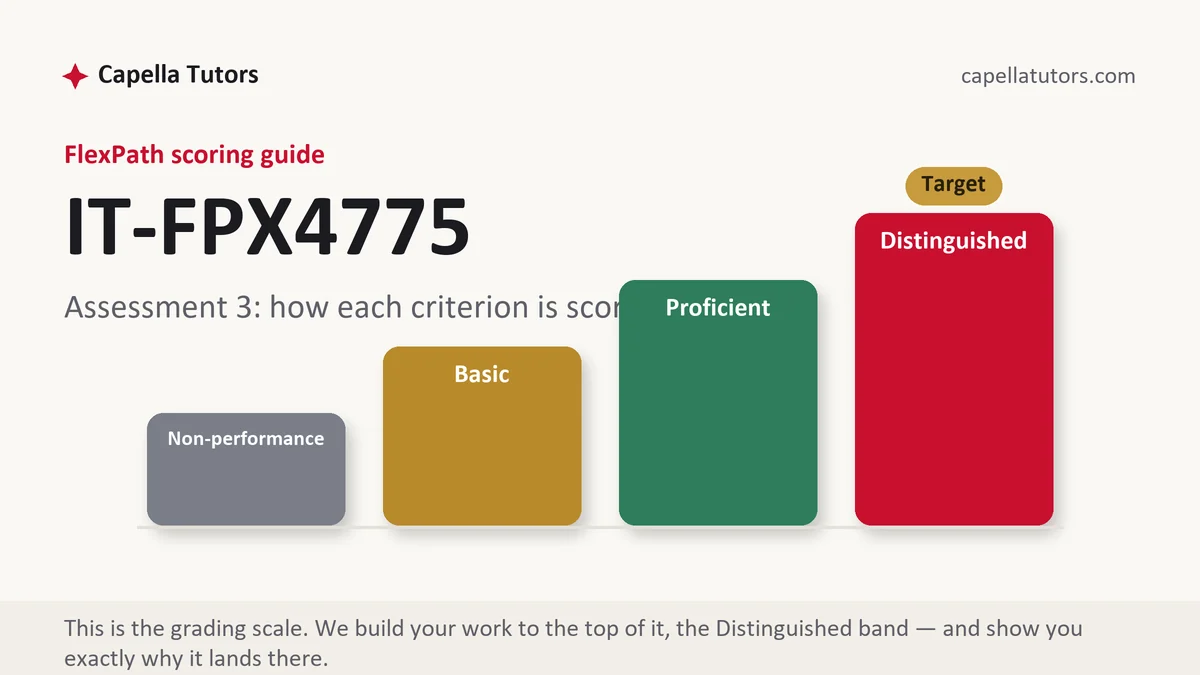
How IT FPX 4775 Assessment 3 is scored
There are four levels, one verdict per criterion, no averaging, and no letter waiting at the end. Those level descriptions are the clearest instructions in the courseroom:
| Level | What it means on a security and lifecycle deliverable |
|---|---|
| Distinguished | Identity, transport protection, key handling and firmware signing are each specified with the mechanism named, and the enrollment and revocation story works for a device bolted to a roof. The criterion also asks for what remains unprotected, and saying it plainly is the move that earns the column. |
| Proficient | The controls are correct and the update path exists. Complete and defensible, one step short, usually because nothing on the page admits a limit. |
| Basic | Security written as a list of good practices with no mechanism and no operator behind them. Advice rather than design lands here regularly. |
| Non-performance | A required element is missing outright, most often revocation or the firmware update path. What is absent is judged more harshly than what is underdeveloped. |
Everything you argued in the earlier deliverables is on trial here. A per-device credential changes the enrollment workload, a signed image changes the flash budget you sized, and a revocation rule changes what the gateway has to remember, so expect this section to send you back to amend one earlier number and say that you did.
The IT FPX 4775 Assessment 3 method, step by step
-
Start from what an attacker reaches, not from a control list
Write the trust boundaries first: the node, the radio link, the gateway, the link to the platform, the platform, and the operator's console. For each boundary name what crosses it and who could stand there. Controls chosen against a named boundary read as design, while controls chosen from a checklist read as recitation.
-
Give every device its own identity and say how it gets one
One credential shared across a fleet means recovering a single unit yields the deployment, which is the history behind the largest denial-of-service events assembled from consumer hardware. Specify what the per-device secret is, where it is stored, whether it is injected in manufacturing or enrolled on first power, and who is allowed to run that enrollment.
-
Protect the session with the mechanism the link can carry
Say which transport security profile runs on each hop, and where the link is datagram-based say so and name the datagram form. Then state the key sizes, the certificate or pre-shared arrangement, and what happens to a session when a node wakes after nine hours asleep.
-
Write the update path as an operation, not an intention
Signed images, a version the platform can read back, storage for two images so a failed write does not brick the unit, a rollback rule, and the bandwidth and battery cost of one update multiplied by the fleet. A design that cannot be patched has an expiry date and the criteria treat it that way.
-
Define the failure behavior and the safe state
What each actuator holds when instructions stop arriving, how long readings buffer locally, what the platform concludes when a node goes quiet, and how long silence has to last before somebody is told. Answer those four and the evaluation criterion has something concrete to mark.
-
Name the residual exposure and who accepts it
No control set reaches zero. Write what remains after your design, why that remainder is tolerable for this deployment, which role accepts it, and the single change in circumstances that would make you revisit the decision before the next scheduled review.
A structure that maps to the criteria
Internal planning figures for a closing design document, not Capella instructions; the criterion your guide leans on hardest deserves the extra words.
| Section | What it must do | Guide |
|---|---|---|
| Trust boundaries and threats | A data-flow view of the deployment with boundaries drawn, and what could go wrong at each crossing stated in one line each. | ~250 words |
| Device identity and enrollment | The per-device secret, where it lives, how it is provisioned, who may enrol a unit, and how a unit is removed from service. | ~300 words |
| Transport protection and keys | The security profile on each hop, key material and sizes, session behavior after long sleep, and what is deliberately unencrypted. | ~250 words |
| Firmware and update path | Signing, version reporting, dual-image storage, rollback, and the bandwidth and power cost of an update across the fleet. | ~250 words |
| Failure modes and safe states | Actuator behavior without instructions, local buffering duration, node-silence detection, and the alert somebody actually receives. | ~200 words |
| Residual risk and sources | What remains unprotected, who accepts it, the review trigger, then standards and datasheets cited by version in current APA. | ~150 words |
Annotated sample excerpt
A short model paragraph our team wrote at the level a guide's highest column describes. Learn how the argument is put together, then write the version your own deployment needs.
Each of the ninety-two rooftop air-handling controllers carries its own key pair generated on the device at first power, with only the public half leaving the unit, so no shared fleet credential exists to be recovered from a controller behind an unlocked service hatch.1 Enrolment is deliberately narrow: a technician scans the enclosure label, the platform issues a certificate valid for thirteen months against a work order that names that building, and the facilities supervisor is the only role able to approve one, which means a stolen controller powered up in somebody's garage never receives an identity at all.2 Revocation is the half most designs omit, so it is stated as an operation with an owner: the supervisor marks the unit retired, the platform refuses its certificate within one polling interval, and the district's asset record is updated the same afternoon, while the honest limit is that a controller removed and re-powered inside that interval can still publish one final batch of readings.3
- 1Names the mechanism and the physical exposure it answers in one sentence. Keys generated on the device rather than shared is a design decision, not a slogan.
- 2Turns enrollment into a workflow with a role, a document and a lifetime attached. A control nobody operates is not a control, and the criterion is looking for the operator.
- 3Supplies revocation, the step most submissions skip, and then states what the mechanism still cannot prevent. Owning the gap is what lifts this from Proficient.
The full premium sample for your exact assessment, written fresh to your scoring guide and issue, is free to request. Study it, revise it into your own voice, and submit work you understand.
The five mistakes that cost Distinguished
- One credential for the whole fleet. Recovering a single unit then yields every unit, and the enclosure on a roof is not a secure location.
- A firmware update described as possible. Signing, dual images, rollback and the cost of pushing an image to the whole fleet are the parts a criterion can actually mark.
- Default passwords treated as a convenience. A shipped default is a design defect at this level, and leaving one in the document invites the marker to assume the rest was equally casual.
- Revocation left unwritten. Enrolment without a documented way to remove a device means the fleet only ever grows, including the units somebody walked off with.
- An actuator with no safe state. A valve or a damper that holds its last instruction indefinitely when the network dies is a physical consequence, not a software detail.
Pre-submission checklist
- Each criterion in your guide addressed under its own heading
- Per-device identity specified, with storage and provisioning named
- Transport protection stated per hop, including the datagram case
- Update path with signing, dual images, rollback and its fleet-wide cost
- Safe state and buffering duration written for every actuator and node
- Residual risk owned by a role, with one review trigger, current APA both ways
Security section standing between you and submission?
Send the design you have already written and the criteria attached to this stage. Identity, enrollment, revocation and the update path come back as operations with owners and costs rather than as good intentions, and the residual-risk paragraph comes back written. The opening premium sample is free.