This manual is for IT FPX 4775 Assessment 2, start to submission. The middle deliverable in IT FPX 4775, Internet of Things Fundamentals, generally moves you up the stack: pick the radio, defend the topology, choose the application protocol, design the message and topic scheme, and show the gateway pipeline that carries readings into a platform. Every criterion gets its own verdict against the guide you were issued, and comparison is the thing the top level pays for. Our tutors' approach to it is set out underneath, next to a criterion-by-criterion outline and a worked passage with notes against it. Would you rather delegate it? A premium original sample for this exact assessment lands in 24 to 48 hours with every layer compared against the option it beat, revised free until the guide is met. Capella's catalog lists the course as IT-FPX4775, and some courserooms print IT4775; both point to this same Assessment 2.
One honesty note before the manual: Capella revises courses and scoring guides over time, so always write to the exact scoring guide attached to your assessment in the courseroom. The course identity above is verified on capella.edu; the method and structure below are our tutors' approach to it, not Capella's official rubric text.
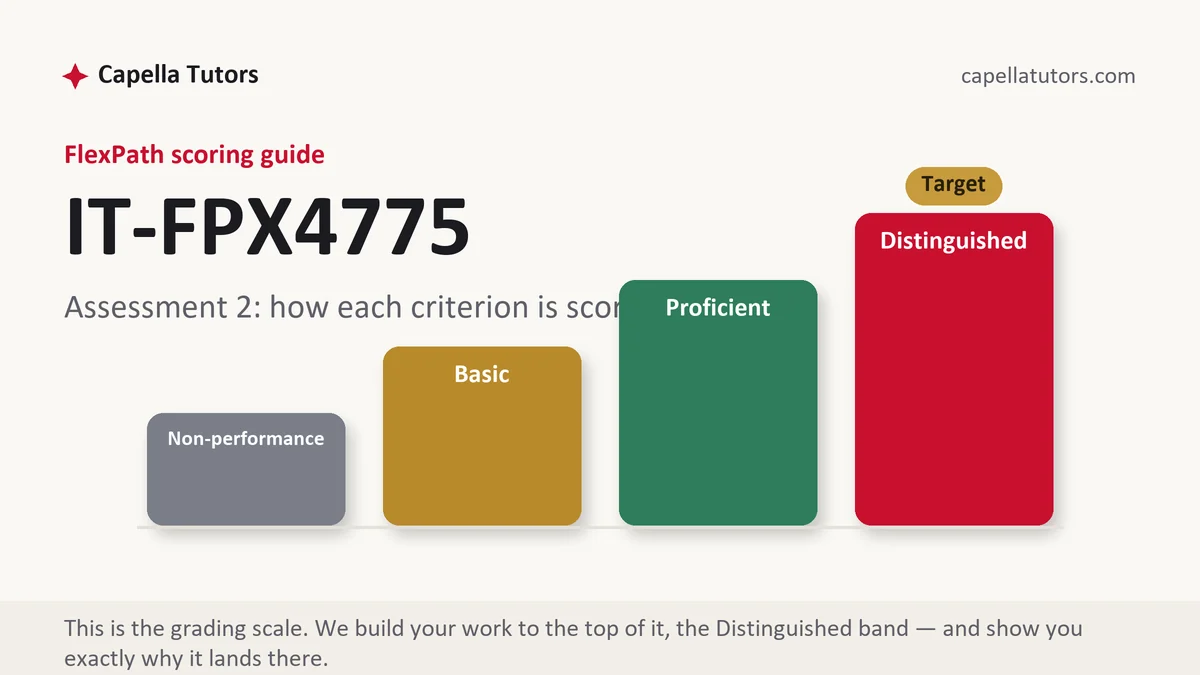
How IT FPX 4775 Assessment 2 is scored
An evaluator awards no total and averages nothing. Each criterion is fixed at one of four levels by itself, and those four descriptions tell you what to build:
| Level | What it means on a network and protocol design |
|---|---|
| Distinguished | Each layer is chosen against a named alternative, the payload and duty limits are respected in numbers, and the message scheme is specific enough that another developer could implement against it. The top column always asks for one move past correct, and it is printed there for you to find. |
| Proficient | The radio, the topology and the protocol are appropriate and correctly described. Sound work that stops at description where the criterion asked for comparison. |
| Basic | Layers announced rather than argued. A stack that would probably work, with nothing on the page showing why it beat the stack you did not pick. |
| Non-performance | A required element is not present, most often the delivery guarantees or the addressing scheme. Absence drops a criterion to the floor faster than weakness does. |
This is the deliverable that decides whether your design can be built. A protocol chosen here without a payload ceiling behind it becomes the contradiction your security and lifecycle sections have to write around later.
The IT FPX 4775 Assessment 2 method, step by step
-
Re-read your own constraint table first
The rows you numbered in the earlier deliverable are the evidence for everything in this one. Payload size, reporting interval, range and power source between them eliminate most of the radio options before you have compared anything, and saying which row eliminated which option is a criterion answered cheaply.
-
Compare radios in a table, not in paragraphs
Put the candidates in rows and the deciding properties in columns: range in the environment you actually have, payload ceiling, duty-cycle or airtime limit, power draw per transmission, infrastructure required, and recurring cost. A reader can see a trade in a table. The same content as prose reads as a survey.
-
Choose the application protocol on traffic direction and connection cost
A battery node that reports a small reading and occasionally needs an instruction pushed down does badly with request and response, because hearing an instruction means asking, and every ask costs a radio wake. Name the delivery guarantee by level rather than by adjective, and say what a retained message and a last-will notice are doing in your design.
-
Specify the message and topic scheme as though somebody must implement it
Write the topic hierarchy with its segments explained, the payload as named fields with types and units, and the identifier that ties a message to a device. Then show one full example message with its byte count. A specification a second developer could code against is what the design criterion is looking for.
-
Draw the pipeline and label every line
Sensor to gateway to broker to store to rule engine to surface, with the protocol written on each link, the direction marked, the trust boundary drawn where traffic leaves a network you control, and buffering shown wherever it happens.
-
Read the figure and the narrative side by side
The cheapest marks in this deliverable are lost to disagreement between a diagram and the text beside it. If the figure shows the gateway holding readings for six hours and no paragraph mentions buffering, the consistency criterion is the one that suffers, so check that the nouns match before you submit.
A structure that maps to the criteria
The numbers here are internal planning targets for a second-stage design document rather than published requirements; whichever criterion your guide leans on is the one to lengthen.
| Section | What it must do | Guide |
|---|---|---|
| Requirements carried forward | The constraint rows this deliverable answers to, restated compactly, with anything that has changed since the earlier document flagged. | ~150 words |
| Radio and topology selection | Candidates compared on range, payload, duty limits, power and cost, then a decision with the deciding property named. | ~350 words |
| Application protocol and delivery | The protocol chosen, the alternative rejected, delivery guarantees by level, and what happens to a message when a node is asleep or gone. | ~300 words |
| Message and topic specification | Topic hierarchy, payload fields with types and units, device identifier, and one worked example with its byte count. | ~250 words |
| Gateway and platform pipeline | The path a reading takes, where it is buffered, where it is stored, and the message volume the platform will actually see. | ~250 words |
| Sources | Protocol specifications cited by version, standards by number, datasheets by revision, current APA reconciled in both directions. | as needed |
Annotated sample excerpt
An excerpt from our team, written where a guide's strongest level actually sits. Study the moves, then argue your own deployment with your own figures.
Long-range wide-area radio wins this deployment on one row of the requirement table, which is that 340 occupancy sensors sit in curbside bays spread over 1.4 square kilometers of a town center with no municipal power in the pavement.1 A single gateway on the library roof reaches all of them, and an occupancy change is nine bytes, so even a regional duty limit of one percent airtime leaves room for a state change every two minutes per bay with headroom to spare, while Wi-Fi would need eleven access points and mains power at each one.2 The decision reverses if the council later asks for a photograph on each change, because at forty kilobytes an image the payload ceiling stops being an inconvenience and becomes a wall, and the honest note is that this radio was chosen on the assumption that occupancy stays a boolean.3
- 1Ties the choice to one identified row rather than to a general property of the technology. Evaluators reward a decision that cites its own evidence.
- 2Carries the arithmetic and the cost of the rejected option in the same sentence. Eleven access points and mains power is a comparison; saying Wi-Fi is unsuitable is not.
- 3States the reversal condition and the assumption underneath it. Naming the boundary of your own decision is the move that reliably lifts an analysis criterion.
The full premium sample for your exact assessment, written fresh to your scoring guide and issue, is free to request. Study it, revise it into your own voice, and submit work you understand.
The five mistakes that cost Distinguished
- A protocol chosen before the payload is known. Deciding how messages travel before you know how big they are settles the design in the wrong order.
- Delivery guarantees described as reliable. A guarantee is a level with a defined behavior, and an adjective in its place answers no criterion.
- Topics invented ad hoc across the document. A hierarchy that changes shape between the diagram and the example message tells a reader the scheme was never designed.
- Duty-cycle limits ignored. An airtime ceiling is a legal constraint on how often you may transmit, not a performance suggestion, and a reporting interval that breaches it invalidates the design.
- An unlabeled architecture diagram. Five arrows with no protocol, direction or trust boundary written on them adds nothing your prose had not already said.
Pre-submission checklist
- Each criterion in the guide has a section with the same name
- A radio comparison table with the deciding property called out underneath
- Delivery guarantee named by level, with the behavior it produces described
- Topic scheme, payload fields and one example message with a byte count
- Diagram labeled with protocol, direction, trust boundary and buffering
- Specifications cited by version, current APA reconciled in both directions
Protocol section fighting you?
Send the deployment, the node count and the criteria. Radios come back compared in a table with the airtime arithmetic shown, the protocol comes back argued on traffic direction and wake cost, and the topic scheme comes back specified tightly enough to implement. The first premium sample costs nothing.