This manual is for IT FPX 4775 Assessment 1, start to submission. Assessment 1 of IT FPX 4775, Internet of Things Fundamentals, usually asks you to take a deployment somebody described in a paragraph and turn it into engineering: a constraint table, a device class chosen for a reason, and sensing decisions that answer to a power budget instead of a catalog. Grading happens one criterion at a time against the guide sitting in your own courseroom, and the numbers get read as carefully as the sentences. The method our tutors work through on it follows, together with a structure drawn from the criteria and an excerpt annotated line by line. Prefer to hand it off? A premium original sample for this exact assessment returns in 24 to 48 hours with a second technical reader re-deriving every figure, and revisions cost nothing until the guide is satisfied. Capella's catalog lists the course as IT-FPX4775, and some courserooms print IT4775; both point to this same Assessment 1.
One honesty note before the manual: Capella revises courses and scoring guides over time, so always write to the exact scoring guide attached to your assessment in the courseroom. The course identity above is verified on capella.edu; the method and structure below are our tutors' approach to it, not Capella's official rubric text.
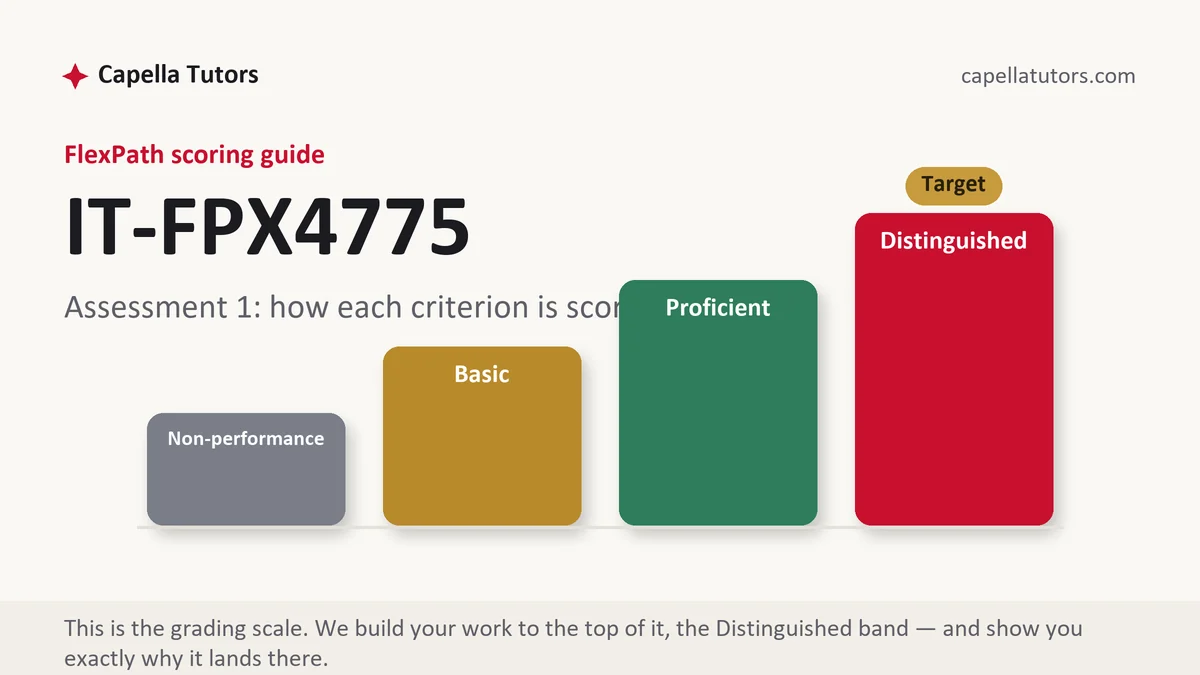
How IT FPX 4775 Assessment 1 is scored
Nothing in FlexPath is expressed as a percentage. A criterion settles at one of four levels, and the sentence describing each level tells you what the section needs:
| Level | What it means on a constraint and device analysis |
|---|---|
| Distinguished | Every hardware and sensing decision points back to a numbered row in the constraint table, the power arithmetic sits on the page, and the option you rejected is named with the condition that would reverse the choice. That extra move is written into the criterion, so read the top column and make it. |
| Proficient | Constraints are stated and the devices suit them. Complete work, one move short of the top, usually because the rejected alternative never made it onto the page. |
| Basic | A parts list with adjectives attached. Sensible-looking hardware that no stated requirement asked for lands here more often than genuinely wrong hardware does. |
| Non-performance | Something the guide requires is simply absent, most often the duty-cycle reasoning behind a service life. What is missing costs you more than what is merely thin. |
Everything the course grades after this stands on the rows you number here. The network layer you argue later and the security model you write after that both cite them, so a constraint invented now becomes a contradiction two submissions from now.
The IT FPX 4775 Assessment 1 method, step by step
-
Read the criteria before you read the scenario
The scenario tells you what the deployment is; the criteria decide what earns marks. Copy each criterion into your outline as a heading, park its top-level wording underneath, and mark which ones can only be satisfied by a number. Anything you write that does not sit under a criterion is unpaid work.
-
Build the constraint table before any prose
Ten rows: the physical quantity, the interval at which a reading is genuinely useful, the record size in bytes, the tolerable delay between event and alert, the power source, how often a human can reach the device, the node to gateway distance, the environment the enclosure must survive, the node count at launch and at scale, and the ceiling on cost per node. Fill them from the scenario and move every unfillable cell into a dated assumptions list at the front.
-
Choose the node class from the workload, not the shelf
A microcontroller that sleeps at microamps and wakes to take a reading answers a different question from a single-board computer running a general-purpose operating system. Decide how much processing has to happen on the node, let the power row settle the rest, and write one sentence saying what the other class would have bought you and what it would have cost.
-
Do the energy arithmetic where the marker can see it
Put the sleep current, the wake duration, the transmit draw, the wake count per hour and the cell capacity on the page, then divide. A service life quoted without a duty cycle behind it cannot be checked, so the justification criterion has nothing to reward. Then change one interval and recompute, because the comparison between two intervals is worth more than either figure alone.
-
Separate what senses from what acts
A sensor reporting a wrong temperature produces a misleading chart. An actuator wired to a fan on that same wrong reading runs a motor for a week. Anything that moves or switches in the physical world gets a defined safe state and a written rule for what it holds while the network is gone.
-
Self-score against the guide, then submit early in the week
Walk the draft criterion by criterion and mark yourself at one of the four levels honestly, then repair everything sitting below the top. An evaluated attempt can take two business days to come back, so work submitted late on a Thursday may not be read until Monday, and a design flaw found then costs a week.
A structure that maps to the criteria
The lengths below are what our tutors plan a first design deliverable against, not anything Capella publishes, so let the heaviest criterion in your guide run long.
| Section | What it must do | Guide |
|---|---|---|
| Deployment and constraints | Describe the site physically, then state the measurement, interval, record size, power source, range, environment, node count and cost ceiling as numbered rows. | ~300 words |
| Assumptions and exclusions | List every figure you could not obtain, who would supply it, and what is deliberately out of scope, each item dated and owned. | ~120 words |
| Sensing decisions | Sensor type, accuracy, placement and sampling rate for each quantity, each tied to the constraint row that demanded it. | ~250 words |
| Node class and power budget | The device class chosen, the class rejected, and the arithmetic that turns sleep current and wake cycles into a service life. | ~300 words |
| Failure behavior and safe states | What a node does when a reading is impossible, what it does when the gateway is unreachable, and what any actuator holds meanwhile. | ~200 words |
| Sources | Datasheets cited by revision, standards by version, current APA both ways, every figure traceable to a source or a visible calculation. | as needed |
Annotated sample excerpt
One paragraph from a model our team built for a deliverable of this shape. Read it for the moves rather than the numbers, then rebuild them around the deployment your faculty described.
Each of the cooperative's fourteen storage bins needs grain temperature at three depths and relative humidity in the headspace every thirty minutes, which is a fourteen-byte record per bin and 672 records a day across the site.1 Power binds this design harder than range does: the bins are unpowered steel cylinders 1.8 kilometers from the office, a technician stands on top of one twice a season, and a cell change outside those two windows means hiring a lift, so the target is one battery for two harvests rather than the longest life the chemistry allows.2 Four figures were not available when this table was built, namely the enclosure temperature inside a bin in August, the attenuation through the bin wall, the office uplink capacity, and the price ceiling per node, and each is carried below as a dated assumption with the person who would confirm it named.3
- 1Converts a paragraph of description into countable quantities. A record size and a daily count are what every later decision cites, and they cost one sentence.
- 2Names which constraint binds and why, in the operator's own terms. A power budget expressed as a service interval is the specificity that separates the top two columns.
- 3Declares the gaps rather than filling them. Dated assumptions read as engineering discipline, while an invented figure reads as a number the evaluator now has to check.
The full premium sample for your exact assessment, written fresh to your scoring guide and issue, is free to request. Study it, revise it into your own voice, and submit work you understand.
The five mistakes that cost Distinguished
- A board named in the first paragraph. Choosing hardware before the interval and the power source exist inverts the order the criteria are marking.
- Service life quoted as a season. A figure in months with no sleep current, wake count or transmit draw behind it is a claim nobody can verify.
- Accuracy borrowed from a product page. A tolerance belongs to a datasheet revision, and promotional copy describes ideal conditions rather than a steel bin in August.
- Every quantity sampled at one rate. Headspace humidity and grain temperature move on different timescales, so a single interval for both wastes either power or information.
- No assumptions list at all. Filling an unknown silently means the whole design rests on a figure the marker cannot trace to anybody.
Pre-submission checklist
- Every criterion in your guide carries its own labeled section
- A numbered constraint table that later sections cite by row
- Node class defended against the class you rejected, in one sentence
- Service life shown as arithmetic, with all five inputs named
- A safe state written for anything that moves, switches or heats
- Datasheets and standards cited by revision, current APA reconciled both ways
Constraint table due this week?
Send the deployment paragraph your faculty wrote and the criteria attached to it. The table comes back numbered, the node class comes back argued against the one it beat, and the battery figure comes back as arithmetic a marker can re-run line by line. Your opening premium sample is free.