This manual is for IT FPX 4545 Assessment 3, start to submission. The final deliverable in this course usually asks you to impose structure on an estate that grew without any, meaning account boundaries, ownership, change control, monitoring, and cost attribution, with each control written as a mechanism rather than as a policy statement. Grading runs criterion by criterion against whichever guide your courseroom is showing. What follows is how our tutors build it, the structure we key to the criteria, and one excerpt annotated. Prefer to have us draft it? A premium original sample for this exact deliverable is back inside 24 to 48 hours, and every revision to the guide is free. Capella's catalog lists the course as IT-FPX4545, and some courserooms print IT4545; both point to this same Assessment 3.
One honesty note before the manual: Capella revises courses and scoring guides over time, so always write to the exact scoring guide attached to your assessment in the courseroom. The course identity above is verified on capella.edu; the method and structure below are our tutors' approach to it, not Capella's official rubric text.
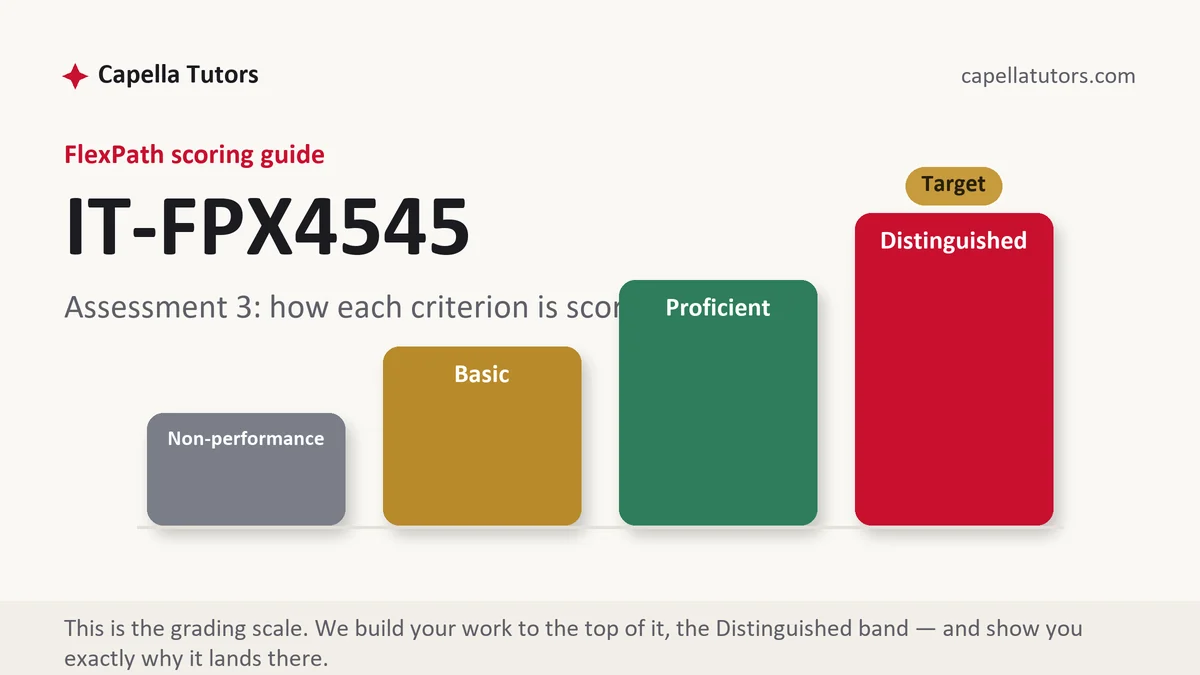
How IT FPX 4545 Assessment 3 is scored
Nothing here averages into a percentage. Every criterion is marked at one of four levels, and the top descriptor names the moves the document has to make:
| Level | What it means on a governance and cost deliverable |
|---|---|
| Distinguished | Each control names what enforces it, who owns it, and how the organization would notice it had stopped working, and the cost section attributes waste to a role rather than reporting a total nobody is answerable for. |
| Proficient | A complete governance model with sensible controls and an accurate cost review. The controls have no enforcement mechanism and the report has no recipient. |
| Basic | A list of good practices. Tagging, monitoring, and review all appear as things the organization should do, with nothing said about what makes any of them happen. |
| Non-performance | A required element is absent, most often the account structure or the cost attribution the guide asked for by name. |
Management is the half of this course students underweight, and it is where the higher-level marks sit. The rule to write by is that a control with no enforcement and no owner is a sentence rather than a safeguard, so every recommendation in this deliverable should end with what makes it true on a Tuesday when nobody is watching.
The IT FPX 4545 Assessment 3 method, step by step
-
Put the criteria on the page, then describe the estate as it is
Turn each criterion into a heading, then write down what actually exists: how many accounts or subscriptions, how many directories, who can create resources, and what nobody can currently answer. Governance recommendations are unassessable without the disorder they are supposed to fix.
-
Set the account boundary before anything else
Separate accounts or subscriptions contain blast radius and keep production away from experimentation, so decide the boundary first and say what it isolates. Everything downstream, including cost attribution and permission design, inherits whatever you decide here, and changing it later is expensive.
-
Make ownership mechanical, not aspirational
Require the owner, environment, and cost centre at creation by policy, then send a weekly report of unlabelled resources to the account owner by name, then state the consequence when the report is ignored twice. Attribution without enforcement produces estimates, and estimates cannot be charged to anybody.
-
Express change control as reviewable code
Configuration held in version control lets a change be reviewed before it exists rather than discovered afterward, which is the whole argument. Say who approves, what the pipeline blocks, and how an emergency change is recorded so the exception does not quietly become the process.
-
Write objectives against user-visible behavior
Monitoring that reports whether a machine is alive answers a different question from whether the service is doing what people need. Define the objective on the second, name who receives the alert, and say what action the alert is supposed to cause, since an alert with no action attached trains people to ignore it.
-
Attribute the waste to a role, then self-score
Price the idle and the unattached, name the role that owns each line, and set the review cadence. Then score yourself criterion by criterion against the guide and rewrite anything below the top level. Submit early, because an evaluated attempt can take two business days to come back.
A structure that maps to the criteria
These figures are the planning targets our tutors work to on a governance deliverable rather than Capella rules, so shift them toward whichever criterion carries the most weight on your guide.
| Section | What it must do | Guide |
|---|---|---|
| Estate as found | Accounts, directories, who can create resources, and the questions nobody can currently answer. | ~200 words |
| Account structure | The boundary chosen, what it isolates, and how production is separated from experimentation. | ~250 words |
| Ownership and change control | Labelling enforced at creation, configuration as reviewable code, approval, and the emergency path. | ~350 words |
| Operations and monitoring | Objectives written on user-visible behavior, alert recipients, and the action each alert should cause. | ~250 words |
| Cost attribution and waste | Priced waste, the role answerable for each line, commitment coverage, and the review cadence. | ~300 words |
| Sources and format | Control catalogs and benchmarks by version, provider guidance with retrieval dates, current APA both ways. | as needed |
Annotated sample excerpt
An original excerpt from our team, showing waste priced and then handed to somebody by name. Read what makes the mechanism work, then write the equivalent for the estate in your scenario.
Two acquisitions left Calderhouse Engineering with three directories and 61 cloud accounts, and 42 percent of resources carry no owner label, which means chargeback reports are estimates and nobody can be asked to justify a line they are not linked to.1 The measurable waste sits in two places, 19 load balancers with no registered targets and 7.3 terabytes of unattached volumes billed at eight cents a gigabyte-month, close to 600 dollars a month for storage nothing reads.2 The mechanism rather than the intention is what recovers it: labels required at creation by policy, a weekly unlabelled-resource report addressed to the account owner by name, and a stated deletion date for anything still unclaimed after two reports.3
- 1Gives the estate as counts and then states the consequence of the missing labels, so the governance problem is quantified before it is solved.
- 2Prices the waste with a rate and a volume, which turns an observation about tidiness into a figure a finance reader will act on.
- 3Proposes enforcement, a named recipient, and a consequence, which is the three-part shape that separates a control from a wish.
The full premium sample for your exact assessment, written fresh to your scoring guide and issue, is free to request. Study it, revise it into your own voice, and submit work you understand.
The five mistakes that cost Distinguished
- Governance expressed as intentions. A control with no enforcement mechanism and no owner is a sentence, and evaluators mark it as one.
- Cost reported without attribution. A total nobody is answerable for changes nothing, and attribution is only as good as label coverage.
- Account boundaries decided last. Permission design and cost attribution both inherit that decision, so making it late means redoing both.
- Monitoring aimed at machines. Processor utilization does not tell you whether the service is doing what users need, which is what an objective should measure.
- Benchmarks and control sets quoted with no version. Both are reissued on a cycle, so an undated reference leaves a reader nothing to check against.
Pre-submission checklist
- The estate described as counts before any recommendation appears
- Account or subscription boundary chosen and what it isolates stated
- Labelling enforced at creation with a named report recipient and a consequence
- Change control expressed as reviewable configuration with an emergency path
- Waste priced with rate and volume, and each line attributed to a role
- Every framework reference carries its version, then self-scored before submission
Governance and cost deliverable due?
Send the estate description, any constraints your faculty attached, and the criteria. Every control comes back with an enforcement mechanism, an owner, and a way of noticing failure, and the cost section comes back priced and attributed rather than totalled. Eight specialists handle the file and it returns inside 24 to 48 hours.