This manual is for IT FPX 4545 Assessment 2, start to submission. The middle deliverable in this course usually asks you to turn recovery objectives into a backup and replication design and then show that the design has been exercised, whether by a restore test or by a structured walk-through with the people who would run it. Each criterion is scored separately against the guide attached to your own assessment. Below is the approach our tutors take, a section plan the criteria can score, and an excerpt with notes beside it. Want it taken off your week? A premium original sample for this exact deliverable is with you inside 24 to 48 hours, and revision continues free until the guide is met. Capella's catalog lists the course as IT-FPX4545, and some courserooms print IT4545; both point to this same Assessment 2.
One honesty note before the manual: Capella revises courses and scoring guides over time, so always write to the exact scoring guide attached to your assessment in the courseroom. The course identity above is verified on capella.edu; the method and structure below are our tutors' approach to it, not Capella's official rubric text.
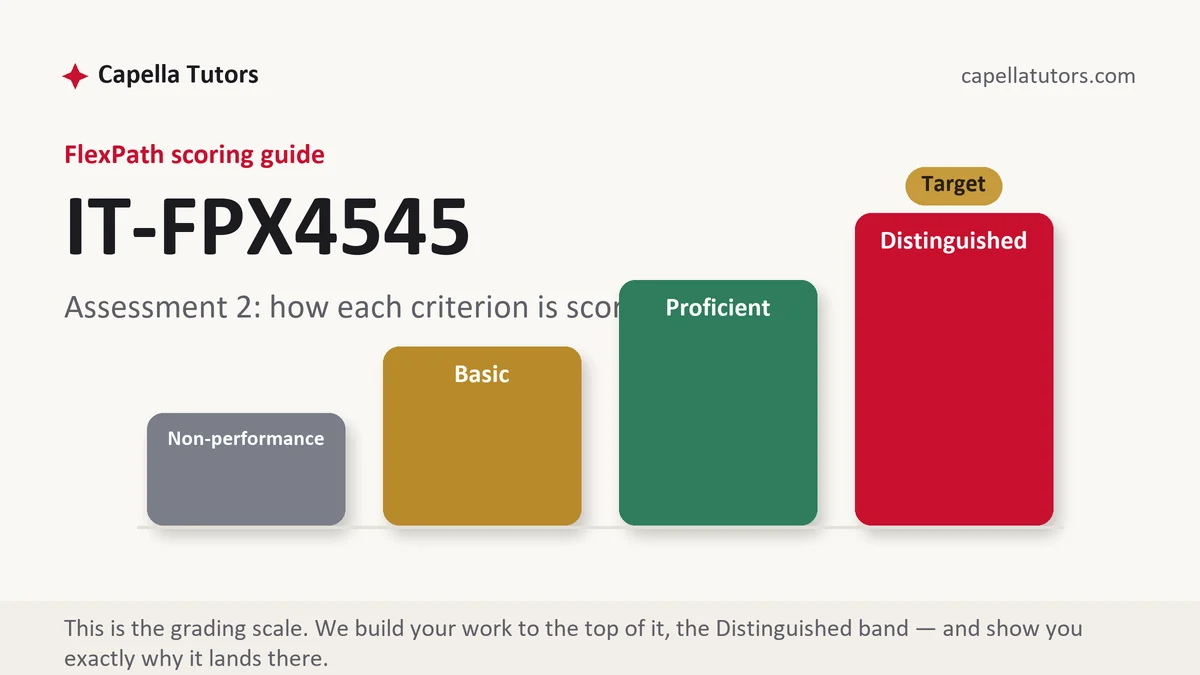
How IT FPX 4545 Assessment 2 is scored
There is no numeric grade to chase. Each criterion is placed at one of four levels, and the level wording is the design brief for the plan you are writing:
| Level | What it means on a resilience and continuity deliverable |
|---|---|
| Distinguished | The backup frequency is reconciled against the recovery point objective in the same sentence, the recovery time objective is checked against a measured restore rather than an estimate, and the exercise produces decisions instead of reassurance. |
| Proficient | A complete plan with correct objectives and a sensible schedule. The parts are all present and none of them has been tested against another. |
| Basic | A backup schedule and a paragraph about business continuity. The objectives appear somewhere, the nightly job contradicts one of them, and nothing has been exercised. |
| Non-performance | A required element is absent, most often the recovery objectives themselves or any evidence that recovery has been attempted. |
The contradiction evaluators find fastest in this deliverable is a recovery point objective of one hour sitting above a nightly backup schedule. Write the two figures in the same paragraph, do the subtraction in public, and either change the schedule or change the objective, because a plan that cannot meet its own numbers loses two criteria at once.
The IT FPX 4545 Assessment 2 method, step by step
-
Rebuild the criteria as headings, then separate the two objectives
Recovery time is how long the service may be down; recovery point is how much data may be lost. They select different mechanisms and they cost different amounts, so write them as separate durations in the requirements section and never let one stand in for the other.
-
Reconcile the schedule against the data loss limit
A five-minute recovery point rules out a nightly snapshot and requires replication or very frequent snapshots instead. Put the objective and the schedule in adjacent sentences and state whether they agree, because the arithmetic is trivial and skipping it is the most common way this deliverable falls to Basic.
-
Measure a restore rather than estimating one
Recovery time claims are only worth what a test says. Record how long a real restore took, at what data volume, on what class of instance, and compare it to the objective. A plan whose restore takes twice its stated recovery time is a finding, and reporting it scores better than hiding it.
-
Exercise the plan with the people who would run it
A structured walk-through against one injected condition finds the gaps a document review never will, because it forces somebody to say who calls whom and what they do with no console access. Record who attended, what condition was injected, and what nobody could answer.
-
Protect the evidence and the failover trigger
Say what condition causes failover, who is authorized to declare it, and how the decision is recorded, then say what stops an automated policy destroying a machine somebody needed to examine. Isolate and snapshot before terminating, because in a cloud estate the evidence deletes itself.
-
Turn findings into funded decisions, then self-score
Every gap the exercise produced needs an owner, a date, and a cost. Then run the guide yourself, criterion by criterion, and rewrite whatever sits below the top level. Submit early in the week, since returning an evaluation may take faculty two business days.
A structure that maps to the criteria
The lengths below are the planning figures our tutors use on a continuity deliverable, not Capella rules, so weight them toward whichever criterion your guide treats as heaviest.
| Section | What it must do | Guide |
|---|---|---|
| Workload and objectives | What must keep running, the recovery time objective, and the recovery point objective as separate durations. | ~200 words |
| Backup and replication design | Frequency, retention, where copies live, and the reconciliation against the data loss limit. | ~350 words |
| Failover and authority | The trigger condition, who declares it, how the decision is recorded, and how traffic actually moves. | ~250 words |
| Test evidence | The measured restore, its volume and duration, and the comparison against the recovery time objective. | ~250 words |
| Exercise findings | The condition injected, who took part, what nobody could answer, and the decisions that followed. | ~300 words |
| Sources and format | Contingency planning guidance by number and revision, control sets by version, current APA both ways. | as needed |
Annotated sample excerpt
An original excerpt from our team, showing an exercise producing decisions instead of confidence. Take the structure, then write up whatever your own walk-through actually exposed.
The walk-through ran for ninety minutes with the fulfilment lead, the database administrator, and the store operations manager in the room, working from one injected condition: the primary region stops accepting writes at 06:40 on a Saturday.1 Two stated objectives collapsed inside the first ten minutes of discussion, because the recovery point objective is five minutes and the 02:00 nightly snapshot cannot meet it, and the most recent restore moved 640 gigabytes in three hours and ten minutes against a recovery time objective of ninety.2 The session therefore produced two funded decisions rather than reassurance: continuous replication for the order tables only, and a re-timed restore test run with the database in the state it will actually be in.3
- 1Names the participants, the duration, and the single injected condition, so the exercise is a documented event rather than a claim that planning occurred.
- 2Puts both objectives beside the mechanisms meant to meet them and reports the arithmetic failing, which is the reconciliation the criterion is scored on.
- 3Ends on scoped decisions with a boundary around each, which is what separates a finding from an observation.
The full premium sample for your exact assessment, written fresh to your scoring guide and issue, is free to request. Study it, revise it into your own voice, and submit work you understand.
The five mistakes that cost Distinguished
- Recovery objectives the schedule cannot meet. An hourly data loss limit above a nightly job is a contradiction an evaluator finds in the first pass.
- Recovery time estimated rather than measured. A claim about how long a restore takes is worth exactly what the last real restore proved.
- The two objectives used interchangeably. Downtime tolerance and data loss tolerance select different mechanisms and cost different amounts.
- No failover authority named. A trigger with nobody empowered to declare it means the decision gets made late by whoever is awake.
- Evidence destroyed by automation. An instance suspected of compromise has to be isolated and snapshotted before termination, because a scaling policy will happily delete it.
Pre-submission checklist
- Recovery time and recovery point stated as separate durations
- Backup frequency reconciled against the data loss limit in adjacent sentences
- A measured restore reported with its volume, duration, and comparison
- Failover trigger, declaring authority, and recording method all named
- The exercise documented with participants, injected condition, and gaps
- Every finding given an owner and a date, then self-scored before submission
Continuity plan due?
Send the objectives, the current schedule, and the criteria. The design comes back reconciled against the data loss limit, the recovery time comes back checked against a measured restore, and one reviewer exists only to find the place where the plan contradicts itself. Delivery is 24 to 48 hours and revision continues until the guide is met.