This manual is for IT FPX 4545 Assessment 1, start to submission. The opening deliverable in an architecture and management course usually asks you to write requirements as numbers first and then design something that can be traced back to them, with the availability arithmetic done rather than asserted. FlexPath grades it criterion by criterion, against the guide your own courseroom carries. The method our tutors follow comes next, with a structure built from the criteria and an annotated excerpt. Rather we did the first pass? A premium original sample for this exact deliverable comes back inside 24 to 48 hours, with revisions included until it clears the guide. Capella's catalog lists the course as IT-FPX4545, and some courserooms print IT4545; both point to this same Assessment 1.
One honesty note before the manual: Capella revises courses and scoring guides over time, so always write to the exact scoring guide attached to your assessment in the courseroom. The course identity above is verified on capella.edu; the method and structure below are our tutors' approach to it, not Capella's official rubric text.
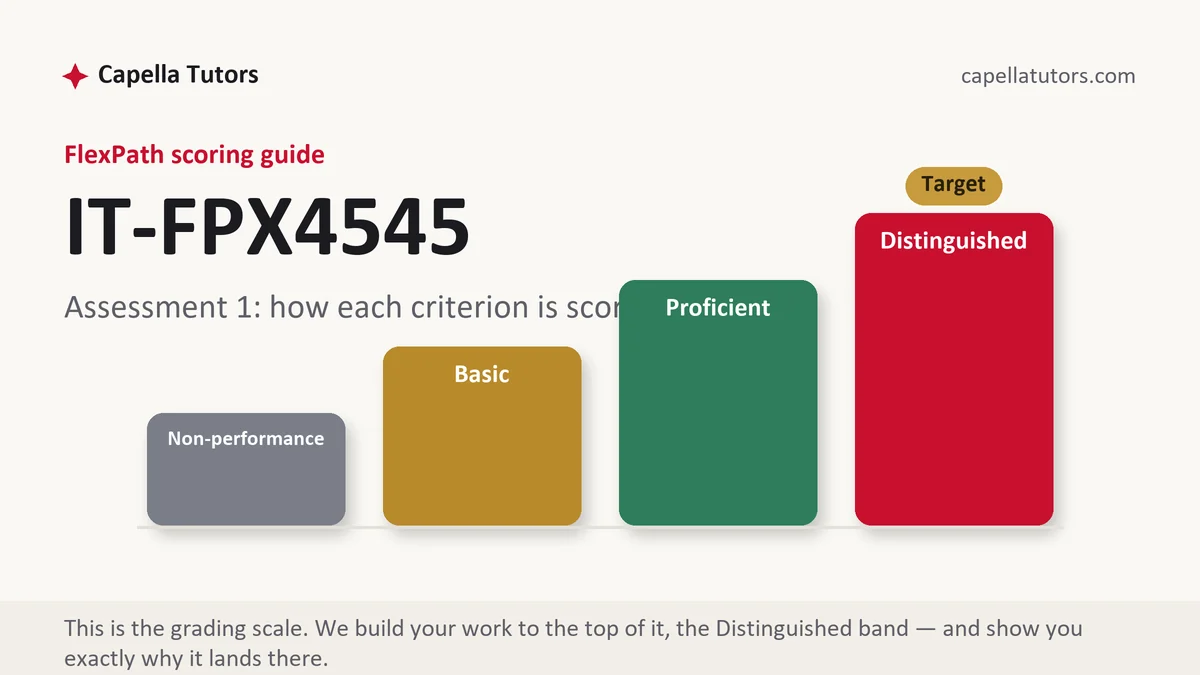
How IT FPX 4545 Assessment 1 is scored
A FlexPath evaluator records a level, never a mark. Four descriptors cover each criterion, and the top one is a checklist disguised as a paragraph:
| Level | What it means on a requirements and architecture deliverable |
|---|---|
| Distinguished | The availability target is converted into minutes and spent, the composite figure for the request path is calculated rather than claimed, single points of failure are identified by name, and every component in the design ends its paragraph with the requirement it satisfies. |
| Proficient | A sound architecture, correctly described. The components are appropriate, the redundancy is sensible, and no number has been worked out to show any of it was necessary. |
| Basic | A diagram with a service list beside it. Nines are promised, nothing is calculated, and the requirements section is a paragraph of adjectives about performance. |
| Non-performance | A required element is absent, most often the requirements block itself or the failure paths the guide asked you to trace. |
Architecture is graded here as arithmetic wearing a diagram. Nines are a budget of minutes, and dependencies multiply rather than average, so a request path crossing several components is always less available than the weakest promise in it. A design that spends its budget in front of the reader is very hard to mark below the top level.
The IT FPX 4545 Assessment 1 method, step by step
-
Turn the criteria into headings, then write five requirements
Availability as a percentage, recovery time and recovery point as separate durations, the residency or sovereignty constraint, the compliance regime, and the spending ceiling. Without those five, an architecture section becomes a list of services with no way to argue that any of them were needed.
-
Convert the availability target into minutes
Three nines allows 8.76 hours across a year, four nines allows about 53 minutes, and the same targets monthly are roughly 43 minutes and a little over 4 minutes. Write the budget down in minutes, because a percentage is a slogan and a duration is something a design can be shown to spend.
-
Calculate the composite before you draw anything
Multiply the component figures along the request path rather than quoting the best one. Two components each promised at three nines land near 99.8 percent, which is closer to 17 hours a year than to nine, and finding that the design misses its own target is a result worth more than any diagram.
-
Choose each pattern from a requirement, not from fashion
Instances behind a load balancer only help when the application holds no session state locally, spreading across failure-isolated zones protects against losing one facility while spreading across regions protects against losing a geography at much higher cost, and a queue between services turns a downstream outage into a delay.
-
Name the single points of failure out loud
Two application instances that both depend on one unreplicated database are one instance with extra cost. Walk the request path and mark every component that exists once, then say for each whether you removed it, accepted it, or could not afford to change it, and what that decision costs in minutes.
-
Reconcile the diagram with the prose, then self-score
Every component on the picture needs a paragraph, and every paragraph needs a component on the picture. Then mark each criterion D, P, B, or N yourself and lift anything that is not at the top. Submit early, because an evaluated attempt can rest with faculty for two business days.
A structure that maps to the criteria
These lengths are planning targets our tutors use for a first architecture deliverable rather than Capella requirements, so expand whichever section your own guide weights most heavily.
| Section | What it must do | Guide |
|---|---|---|
| Scenario | The organization, the workload, its users, and the load pattern the design has to survive. | ~150 words |
| Requirements | Availability, recovery objectives, residency, compliance regime, and budget, each as a number or named obligation. | ~200 words |
| Availability budget | The target converted to minutes, the composite calculated along the request path, and the shortfall if any. | ~250 words |
| Architecture | Components, redundancy across zones or regions, state handling, and each paragraph closing on its requirement. | ~400 words |
| Failure paths and decisions | Single points of failure named, what happens when each fails, and the choice made about it. | ~300 words |
| Sources and format | Government publications by number and revision, provider guidance with retrieval dates, current APA both ways. | as needed |
Annotated sample excerpt
An original excerpt from our writers, showing an availability budget being spent and coming up short in public. Read what it does with the shortfall, then run the same calculation on your own path.
Requirement 1 sets availability at 99.9 percent measured monthly, which is a budget of 43 minutes against a thirty-day month rather than a phrase to repeat in the conclusion.1 The proposed request path for the results site crosses three components, an edge tier, an application tier, and a single database, each carrying a provider commitment of 99.95 percent, so the composite is roughly 99.85 percent, or about 65 minutes a month, and the design misses its own requirement before anything unexpected happens.2 That leaves one decision worth arguing rather than a diagram worth admiring: replicate the database and remove it as a single point of failure, or take the requirement back to the athletic association and have it lowered in writing.3
- 1Turns the percentage into a duration in the first sentence, which is the move that makes every later claim about redundancy checkable.
- 2Multiplies along the path instead of quoting the best component, then states the shortfall plainly rather than rounding it away.
- 3Converts the arithmetic into two funded options, which is what the justification criterion is written to reward.
The full premium sample for your exact assessment, written fresh to your scoring guide and issue, is free to request. Study it, revise it into your own voice, and submit work you understand.
The five mistakes that cost Distinguished
- An availability promise with no calculation. Nines convert to a budget of minutes, and a design that never spends that budget has not been designed.
- Component figures averaged instead of multiplied. Dependencies compound, so a chain is always worse than its best link and usually worse than its worst.
- Redundancy claimed while shared state remains. Two instances depending on one unreplicated database are one instance with a larger bill.
- A diagram with forty icons and no request path. A reader who cannot trace one request from entry to storage cannot check whether the design works.
- Requirements phrased as adjectives. Highly available and scalable cannot be traced to, so no component in the design can be shown to be necessary.
Pre-submission checklist
- Five requirements written as numbers or named obligations
- The availability target converted into minutes for the stated measurement window
- The composite figure calculated along the actual request path
- Every single point of failure named with the decision taken about it
- Each component paragraph closes on the requirement it satisfies
- Diagram and prose agree, then self-scored at the top level before submission
Architecture deliverable due?
Send the requirements you were given and the criteria. The nines come back calculated, the composite comes back worked along the request path, every single point of failure comes back named with a funded decision attached, and one reviewer exists only to test the design against itself. Turnaround is 24 to 48 hours.