This manual is for IT FPX 4535 Assessment 3, start to submission. The final deliverable in this course usually asks you to review a system that affects people, name its failure modes and the group most likely to be harmed, and propose controls mapped to a recognized risk framework with an owner attached to each. It is marked criterion by criterion against the guide your courseroom carries. What follows is the tutor approach, a section plan the criteria can grade, and one annotated excerpt. Rather hand this one to us? A premium original sample for this exact assessment arrives within 24 to 48 hours, revised at no cost until it meets the guide. Capella's catalog lists the course as IT-FPX4535, and some courserooms print IT4535; both point to this same Assessment 3.
One honesty note before the manual: Capella revises courses and scoring guides over time, so always write to the exact scoring guide attached to your assessment in the courseroom. The course identity above is verified on capella.edu; the method and structure below are our tutors' approach to it, not Capella's official rubric text.
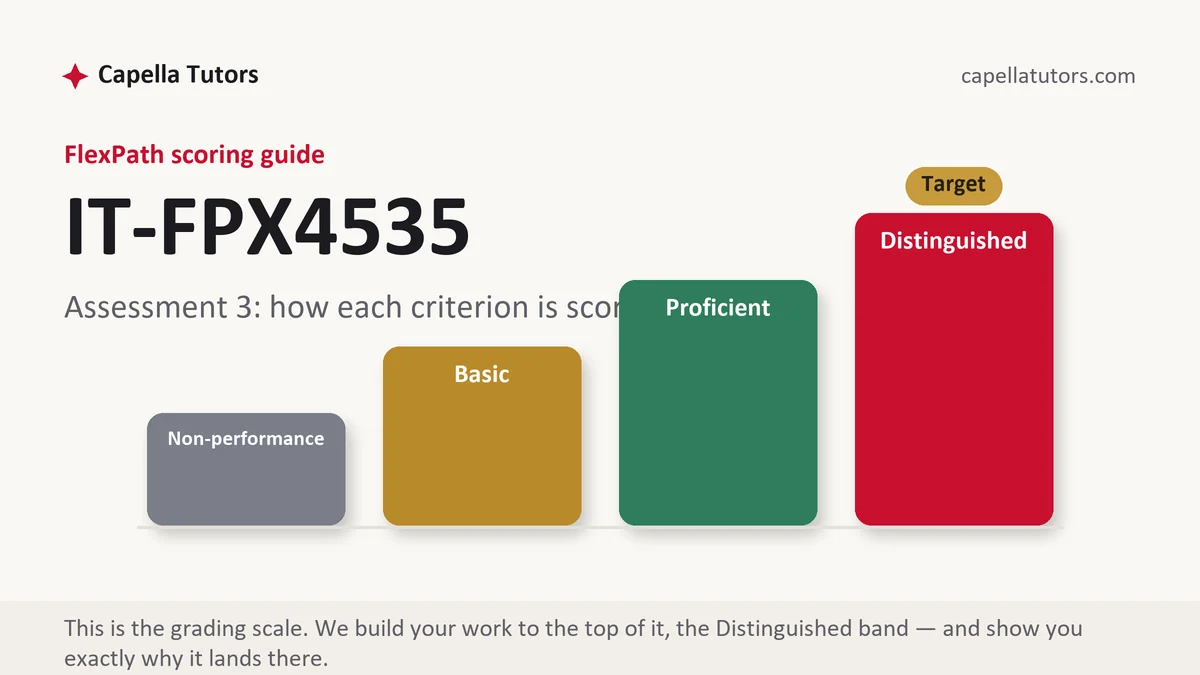
How IT FPX 4535 Assessment 3 is scored
Every criterion is placed at one of four levels, and none of them is a percentage. Reading the top level as a set of required moves is the technique:
| Level | What it means on a risk and governance deliverable |
|---|---|
| Distinguished | Each control is mapped to a named function of a recognized framework, carries an owner by role, and specifies what triggers it, and the harm analysis points at a measurable disparity rather than at fairness in general. |
| Proficient | The risks are identified correctly and reasonable controls are proposed. Nothing is anchored to a framework and no control has a named operator. |
| Basic | A paragraph acknowledging bias, followed by recommendations phrased as intentions. Nothing is measured, nobody is accountable, and the section reads as compliance theatre. |
| Non-performance | A required element is missing, most often the accountability question or the framework mapping the guide asked for by name. |
Governance is graded here as a set of decisions rather than as sentiment. Say what the system must not be used for, who reviews its output before it affects anybody, what would trigger retraining, and what happens when the system is unsure, because a model obliged to answer every input will return confident nonsense at the edges.
The IT FPX 4535 Assessment 3 method, step by step
-
Put the criteria on the page, then describe the system in use
Turn each criterion into a heading, then write what the system decides, who it decides about, and what happens to a person after the output arrives. Governance questions are unanswerable in the abstract, and a review that never says who is affected cannot identify a harm.
-
Trace the training data back to the decisions inside it
Where the labels came from, who made them, and over what period. A system trained on past decisions learns the preferences behind them rather than the requirements of the task, and naming that mechanism is the most direct way to earn the bias criterion.
-
Convert bias into something measurable
Choose a comparison the organization already reports, define the disparity you would measure, and state the threshold that triggers a review. A number with a threshold is a control; a paragraph acknowledging that bias exists is a paragraph, and evaluators separate the two immediately.
-
Map each control to a named framework function
Governing, mapping, measuring, and managing give you four places for a control to sit, and management system standards and tiered regulatory approaches give you the vocabulary for an auditable programme. Cite the document by version and put each control under the function it actually belongs to.
-
Give every control an owner and a trigger
Name the role that operates it, what makes it run, and what happens when it fires. Include the low-confidence path, because routing uncertain cases to a person is a design decision worth its own sentence, and a system with no named owner is an unmanaged risk however well it scored.
-
Verify every reference yourself, then self-score
Open each source and confirm it exists and says what your citation claims, since fabricated references are the fastest route to an integrity conversation and a conversational model is not a source. Then mark the draft against every criterion and rewrite anything that is not at the top. Submit early, because two business days can pass before an evaluation returns.
A structure that maps to the criteria
These targets are our tutors' planning figures for a governance deliverable rather than Capella requirements, so shift them toward whichever criterion your guide weights most.
| Section | What it must do | Guide |
|---|---|---|
| System in use | What it decides, about whom, and what happens to a person once the output is produced. | ~200 words |
| Data provenance | Where the labels came from, who made those decisions, over what period, and what that teaches the model. | ~250 words |
| Failure modes and affected groups | What goes wrong, who is most exposed, and the disparity you would measure to detect it. | ~300 words |
| Controls mapped to a framework | Each control under a named framework function, cited by version, with its trigger and threshold. | ~350 words |
| Accountability and review | The named owner, the human review step, the low-confidence path, and the retraining trigger. | ~250 words |
| Sources and format | Framework and standards documents by version, primary papers, documentation conventions, current APA. | as needed |
Annotated sample excerpt
An original excerpt from our team showing two controls written as mechanisms under named framework functions. Take the shape, then write the equivalent for the system you are reviewing.
The screening tool at Ardenfield Manufacturing ranks applicants for maintenance technician roles and was trained on eight years of hiring decisions, which means it learned the preferences of the managers who made them rather than the requirements of the job.1 Mapped to the measure function of the risk framework, the control is a quarterly disparity check comparing selection rates across the groups the employer already reports on, with a threshold that opens a review rather than a report that circulates unread.2 Mapped to the manage function, the control is a named owner, the recruitment director, who holds authority to suspend the tool, together with a standing rule that no applicant is rejected on the score alone.3
- 1States the mechanism by which bias entered, in one clause, instead of asserting that the system might be biased.
- 2Puts the control under a named framework function and gives it a measurement and a threshold, which is what makes it auditable.
- 3Attaches a role, an authority, and a standing rule, so accountability is a person rather than a sentence about oversight.
The full premium sample for your exact assessment, written fresh to your scoring guide and issue, is free to request. Study it, revise it into your own voice, and submit work you understand.
The five mistakes that cost Distinguished
- Bias raised and then abandoned. A paragraph that admits bias without measuring or mitigating it reads as compliance theatre to anyone grading it.
- Controls written as intentions. A safeguard with no trigger, no threshold, and no owner is a statement of hope rather than a control.
- No accountability named. A system with no owner is an unmanaged risk, and the criterion usually asks the question directly.
- Nothing said about uncertainty. A model obliged to answer every input returns confident nonsense at the edges unless low-confidence cases route to a person.
- References produced rather than verified. A citation nobody opened is the fastest route to an integrity case, and in this subject the irony will not help.
Pre-submission checklist
- What the system decides, and about whom, stated before any control appears
- Label provenance traced to the decisions and the period behind them
- One measurable disparity defined with a threshold that triggers review
- Every control placed under a named framework function cited by version
- A named owner, a human review step, and a low-confidence path all present
- Every reference opened and verified, then self-scored before submission
Governance review due?
Send the system description, the framework your faculty named, and the criteria. The harm analysis comes back pointing at a measurable disparity, every control comes back under a framework function with an owner and a trigger, and each source is opened and verified before it enters the list. Turnaround is 24 to 48 hours.