This manual is for IT FPX 4535 Assessment 2, start to submission. The middle deliverable in this course usually asks you to choose a technique, split the data properly, and evaluate the result with a metric defended against the class balance rather than accepted by default. Marking happens one criterion at a time, against the guide attached to your own assessment. Below: how our tutors handle it, a structure tied to the criteria, and an excerpt with its moves marked. Prefer a tutor to build it? A premium original sample for this exact assessment is delivered inside 24 to 48 hours, with unlimited free revision to the guide. Capella's catalog lists the course as IT-FPX4535, and some courserooms print IT4535; both point to this same Assessment 2.
One honesty note before the manual: Capella revises courses and scoring guides over time, so always write to the exact scoring guide attached to your assessment in the courseroom. The course identity above is verified on capella.edu; the method and structure below are our tutors' approach to it, not Capella's official rubric text.
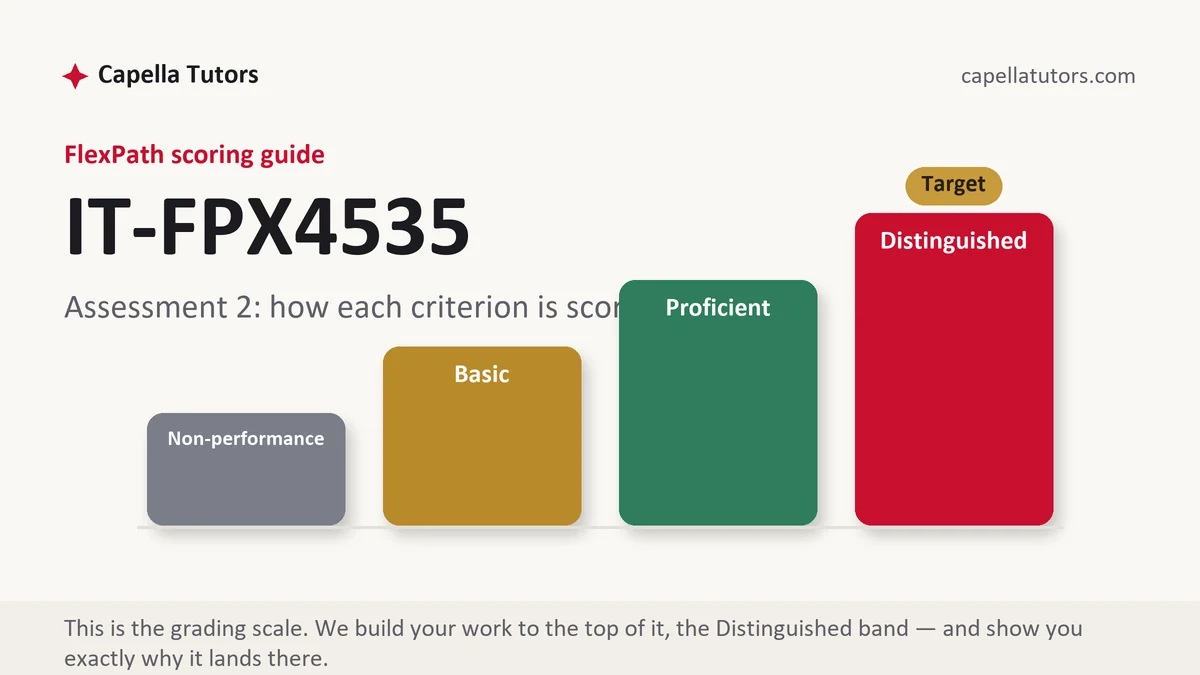
How IT FPX 4535 Assessment 2 is scored
Each criterion resolves to one of four levels and nothing is averaged. The top descriptor is the most useful paragraph you will read all week:
| Level | What it means on a method and evaluation deliverable |
|---|---|
| Distinguished | A simpler baseline is reported on identical data so the gain is visible, the metric is defended against the class balance, the raw counts reconcile to the sample, and the result is translated into what it costs the organization in each direction. |
| Proficient | The method is appropriate, the split is correct, and the metrics are computed accurately. Nothing sits beside the result to give it scale. |
| Basic | Accuracy reported and treated as the finding. The classes are lopsided, the number is high, and the model may well be predicting the common answer every time. |
| Non-performance | A required element is absent, most often the holdout split or the confusion matrix the guide asked for by name. |
Two habits do most of the work here. Split the data before anything is trained, into a portion to learn from, a portion for tuning, and a portion touched once at the end, because a model scored on data it was fitted to is grading its own work. Then report what a simple rule achieves on the same data, since a model is only ever good relative to something.
The IT FPX 4535 Assessment 2 method, step by step
-
Rebuild the criteria as headings, then restate the task
Give each criterion its own heading, then repeat in one sentence what is being predicted and for what unit. Everything in this deliverable depends on that sentence, and a paper that shifts task type halfway through will compare an accuracy figure against a similarity score without noticing.
-
Split before you train, and say how
Describe the training, tuning, and holdout portions with their sizes, and state that the holdout was used once. If the data has a time order, split on time rather than at random, because a model allowed to learn from the future will look excellent and fail in service.
-
Report a baseline on identical data
Predicting the majority class every time, or applying the single threshold a domain expert already uses, gives you the number your model has to beat. Report it, then show the improvement as a difference. Without it, a strong-looking figure has no scale and the analysis criterion has nothing to weigh.
-
Choose the metric against the class balance
Accuracy is close to useless when one class is rare, because predicting the common answer scores well and catches nothing. Precision, recall, and their harmonic mean exist for that case, so name which error is more expensive in the scenario and let that answer choose the metric.
-
Show the counts and make them reconcile
Give the confusion matrix with all four cell counts visible and derive every rate from them, then check that the cells add to the sample size. A matrix that does not reconcile invalidates every figure computed below it, and it is the first thing a careful evaluator adds up.
-
Translate the result into cost, then self-score
Say what the error pattern means operationally, in the units the organization uses, and name the decision the threshold implies. Then take the guide criterion by criterion yourself and rewrite anything under the top level. Submit early, since evaluation can occupy two business days.
A structure that maps to the criteria
The lengths below are the planning figures our tutors use on an evaluation deliverable, not Capella rules, so weight them toward whichever criterion your guide treats as heaviest.
| Section | What it must do | Guide |
|---|---|---|
| Task restated | What is predicted, for what unit, and what the deliverable is claiming about performance. | ~150 words |
| Method and rationale | The technique chosen, why it fits the task and the data, and what was set aside. | ~300 words |
| Data split | Training, tuning, and holdout sizes, how the split was made, and confirmation the holdout was used once. | ~200 words |
| Baseline and results | The simple rule and its score, then the model's counts with every rate derived from them. | ~350 words |
| Interpretation | Which errors matter more here, what the threshold implies, and the cost of each mistake in the scenario. | ~300 words |
| Sources and format | Primary papers for the methods used, textbook by edition, framework documents by version, current APA. | as needed |
Annotated sample excerpt
An original excerpt from our writers, showing four numbers reported in the order that makes them mean something. Read the sequence, then apply it to your own counts.
Of the 8,400 service requests logged in the quarter, 1,260 belonged to Water and Sewer, and the router assigned 1,410 requests to that department, 1,134 of them correctly.1 Precision is therefore 1,134 of 1,410, or 80 percent, and recall is 1,134 of 1,260, or 90 percent, giving a harmonic mean near 0.85, while overall accuracy of 78 percent sits against a majority-class baseline of 35 percent and is the least informative number on the page.2 The operational reading is the part the criterion pays for: 276 requests reached a crew that could not act on them, each one costing a triage call, so the city has to decide whether that is worth catching nine of every ten genuine water complaints on the first pass.3
- 1Gives the class size and both assignment counts before any rate appears, so every percentage in the paragraph can be recomputed from the sentence itself.
- 2Reports precision and recall with their fractions visible and puts accuracy in its place against a stated baseline rather than omitting it.
- 3Converts the false positives into a cost the organization recognizes and names the trade as a decision, which is the analysis the criterion is looking for.
The full premium sample for your exact assessment, written fresh to your scoring guide and issue, is free to request. Study it, revise it into your own voice, and submit work you understand.
The five mistakes that cost Distinguished
- Accuracy quoted on lopsided classes. A high score where the target is rare usually means the model learned to answer with the majority.
- No baseline offered. Without a simple rule scored on the same data, a percentage has no scale and the improvement cannot be seen.
- Performance measured on training data. That is a description of memory rather than of ability, and the holdout exists precisely to prevent it.
- Counts that fail to reconcile. A confusion matrix whose cells miss the sample size invalidates every rate derived from it.
- A metric adopted by default. The criterion asks which error is more expensive here, and the answer to that question is what selects precision or recall.
Pre-submission checklist
- Training, tuning, and holdout portions named with sizes and split method
- A simple baseline reported on identical data with its score
- Confusion matrix printed with four cell counts that add to the sample
- Precision, recall, and their harmonic mean computed from those counts
- The more expensive error named in the scenario's own units
- Every figure recomputable from the document, then self-scored before submission
Evaluation section due?
Send the scenario, the dataset description, and the criteria. The metric comes back defended against the class balance, the baseline comes back reported beside the model, the counts reconcile to the sample, and a separate pass exists only to recompute the arithmetic. Delivery is inside 24 to 48 hours.