This manual is for IT FPX 4535 Assessment 1, start to submission. The opening deliverable in an introductory artificial intelligence course usually asks you to take a scenario, decide what kind of problem it actually is, and describe the data that would be needed, including where it came from and who it leaves out. The FlexPath way of grading it is criterion by criterion, against the guide attached in your courseroom. The tutor method is below, with a section plan drawn from the criteria and an excerpt annotated line by line. Would you rather delegate this one? A premium original sample built for this exact assessment reaches you within 24 to 48 hours, and revisions are free until the guide is met. Capella's catalog lists the course as IT-FPX4535, and some courserooms print IT4535; both point to this same Assessment 1.
One honesty note before the manual: Capella revises courses and scoring guides over time, so always write to the exact scoring guide attached to your assessment in the courseroom. The course identity above is verified on capella.edu; the method and structure below are our tutors' approach to it, not Capella's official rubric text.
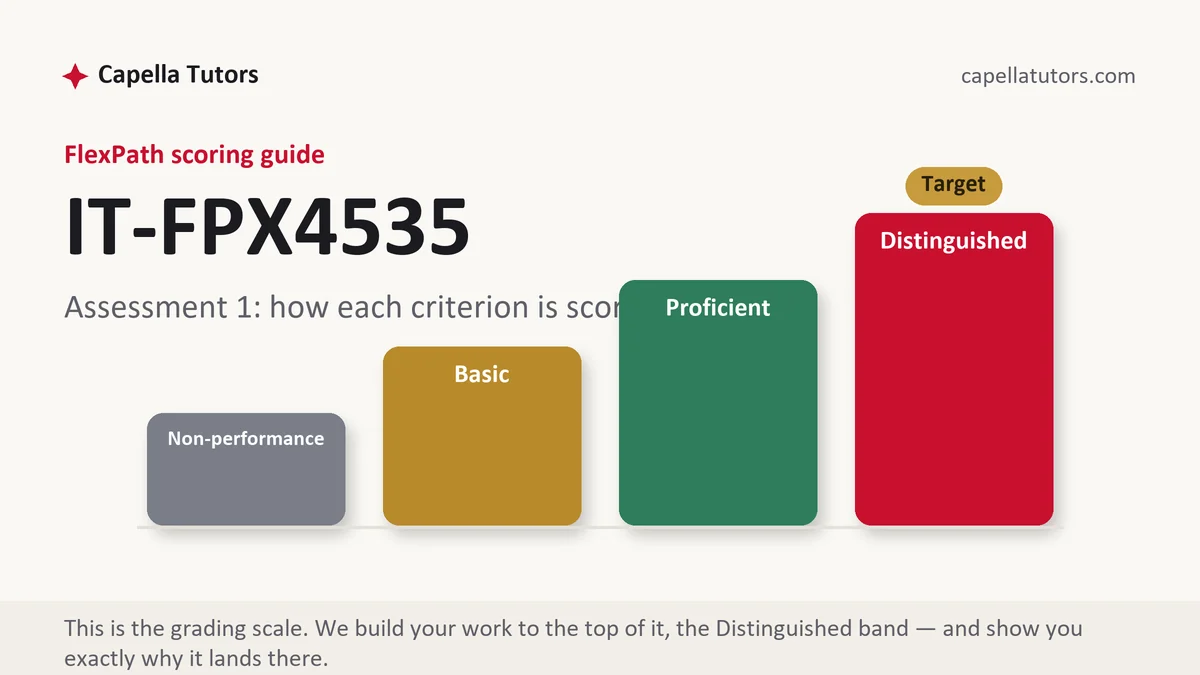
How IT FPX 4535 Assessment 1 is scored
FlexPath produces a level per criterion instead of a mark. The wording of those four levels is the most useful thing on the page, because it is the instruction set:
| Level | What it means on a problem framing and data deliverable |
|---|---|
| Distinguished | The task type is argued from the scenario with the alternatives named and set aside for a reason, the unit of prediction is stated, and the data section examines whether the sample resembles the population the system would be used on, with the exclusions counted. |
| Proficient | The problem is correctly identified and the data described accurately. The classification is asserted rather than argued, and representativeness is mentioned in general terms. |
| Basic | A summary of what artificial intelligence is, with the scenario attached at the end. Field, subset, and technique are used interchangeably, and this is where a first submission usually lands. |
| Non-performance | A required element is absent, most often the data description or any statement of what the system is being asked to predict. |
Vocabulary discipline decides more of this grade than anything technical. Artificial intelligence is the field, machine learning is the part that improves from data rather than from written rules, deep learning is a subset of that, and generative systems are one family of application. A paper that uses those words as synonyms loses the foundational criterion in its first paragraph.
The IT FPX 4535 Assessment 1 method, step by step
-
Turn the criteria into headings, then decide the problem type
Build the outline from the guide, then spend the first paragraph settling what kind of problem this is. Predicting a category is classification, predicting a quantity is regression, grouping unlabelled records is clustering, and producing text or images is generation. That one choice constrains the metric, the data, and every failure mode discussed later.
-
State the unit of prediction and what a correct answer looks like
Say what one prediction is about, meaning one student, one ticket, one device, or one month, and describe what the right answer would be in the scenario's own terms. Without that sentence the paper cannot say later whether a result was any good, because nobody agreed what good meant.
-
Separate the learning settings and pick one honestly
Supervised learning needs labelled examples, unsupervised learning finds structure in data nobody labelled, and reinforcement learning improves through reward collected by acting. Say which one your scenario supports, and if the labels do not exist yet, say who would create them and at what cost, because that is often the real constraint.
-
Describe the data as an inventory, not an impression
Source, collection window, row count, what one row represents, the label and how it was derived, known gaps, and the consent or licence covering it. Count the exclusions. A dataset described in adjectives cannot support a claim about representativeness in either direction.
-
Compare the sample against the deployment population
Say who the system would be used on and who is actually in the data, then name the difference. An exclusion rule that removes a group is a finding, and stating which population the model would therefore be unreliable for is usually the exact move the top level of the criterion pays for.
-
Keep the symbolic option on the table, then self-score
Search, constraint satisfaction, and rule-based inference are still examinable and still correct where the rules are known and the answer must be explainable. Say why you did or did not choose one. Then score the draft against every criterion yourself and rewrite whatever is not at the top. Submit early, because an evaluation can hold the assessment for two business days.
A structure that maps to the criteria
These lengths are planning targets our tutors use for a first framing deliverable rather than Capella requirements, so expand whichever section your own guide weights most heavily.
| Section | What it must do | Guide |
|---|---|---|
| Scenario and decision | The organization, the decision the system would inform, and who is affected by the output. | ~200 words |
| Problem type | Classification, regression, clustering, or generation, argued from the scenario with alternatives set aside. | ~300 words |
| Unit of prediction | What one prediction is about, the label, how it was derived, and what a correct answer means here. | ~200 words |
| Data inventory | Source, window, row count, columns, label origin, exclusions counted, and the consent or licence behind it. | ~300 words |
| Representativeness and gaps | Who the system would be used on, who is in the data, and the group the difference would fail. | ~250 words |
| Sources and format | Textbook by edition, primary papers for methods, framework documents by version, current APA. | as needed |
Annotated sample excerpt
An original excerpt from our team, written to show a task type being chosen rather than announced. Study how each sentence narrows the problem, then do the same for your own scenario.
Calder Community College wants to know which of its 6,100 continuing students will not register for the following term, which makes this binary classification with one row per enrolled student per term rather than a regression on total headcount.1 The unit matters because a student who withdraws in week two and a student who never registers at all are different outcomes, and the label has to choose one of them and say which.2 The available data covers four prior terms and 21,400 student-term rows, and it excludes anybody enrolled through the dual-credit agreement, which removes 1,850 rows and with them most of the youngest students the system would later be used on.3
- 1Names the task type and rejects the alternative in the same sentence, so the classification is a decision with a reason attached rather than a label.
- 2Fixes the unit of prediction and shows why the choice changes the label, which is the sentence that stops the paper measuring two different things.
- 3Counts the exclusion and says which population it removes, turning a data description into the representativeness argument the criterion rewards.
The full premium sample for your exact assessment, written fresh to your scoring guide and issue, is free to request. Study it, revise it into your own voice, and submit work you understand.
The five mistakes that cost Distinguished
- The vocabulary used loosely. Treating machine learning, deep learning, and generative systems as one thing collapses the distinction the first criterion asks for.
- A chatbot treated as the whole subject. Generative systems are one family of application, and a paper that equates them with the field has misdescribed what it is writing about.
- No unit of prediction stated. Without it the paper cannot say what was predicted, and no later metric can be interpreted at all.
- Data described in adjectives. Large and diverse are not counts, and representativeness cannot be argued in either direction without numbers.
- Exclusions left uncounted. A rule that quietly removes a group changes who the system is about, and naming that group is the graded move.
Pre-submission checklist
- The task type is named and the rejected alternatives given reasons
- The unit of prediction appears in one sentence with the label defined
- Source, window, row count, and column meanings all present
- Exclusions counted and the population they remove identified
- The learning setting stated, with label creation costed if labels do not exist
- Self-scored at the top level on every criterion, submitted early in the week
Framing deliverable due?
Send the scenario, the dataset or its description, and the criteria. The task type comes back argued from the scenario, the unit of prediction comes back stated, and the data section comes back with the exclusions counted and the affected population named. Turnaround is 24 to 48 hours with revisions until the guide is met.