This manual is for IT FPX 4525 Assessment 3, start to submission. The final deliverable in this course usually asks you to model what a workload costs on a public provider against the alternative, show the arithmetic rather than the total, and turn the numbers into a recommendation a manager could act on. It is graded criterion by criterion against the guide in your own courseroom. The tutor method follows, together with a section plan the criteria can mark and an excerpt with its moves annotated. Prefer to let us finish it? A premium original sample for this exact deliverable returns inside 24 to 48 hours, and revision is free until the guide is cleared. Capella's catalog lists the course as IT-FPX4525, and some courserooms print IT4525; both point to this same Assessment 3.
One honesty note before the manual: Capella revises courses and scoring guides over time, so always write to the exact scoring guide attached to your assessment in the courseroom. The course identity above is verified on capella.edu; the method and structure below are our tutors' approach to it, not Capella's official rubric text.
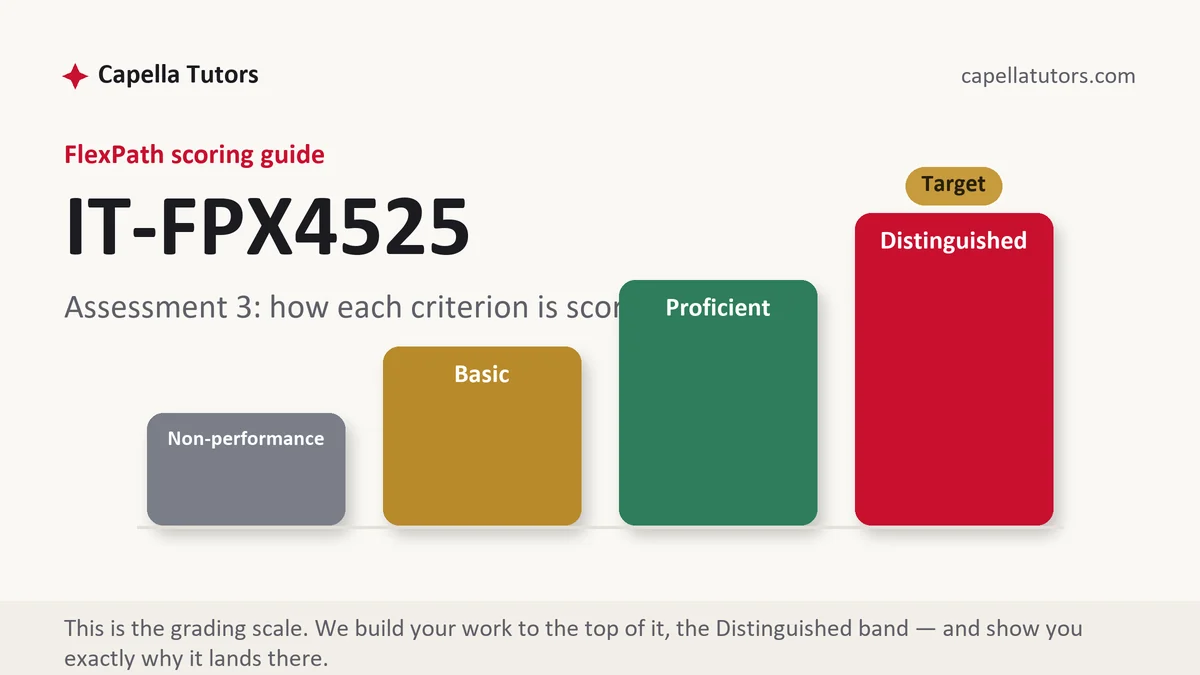
How IT FPX 4525 Assessment 3 is scored
No percentage is recorded anywhere in FlexPath. Each criterion sits at one of four levels, and the level descriptions are the specification for the document:
| Level | What it means on a cost model and recommendation |
|---|---|
| Distinguished | Every rate carries its source and the date it was read, the calculation is shown line by line instead of summarized, a break-even is stated, and the paper says how much the answer changes if one assumption is wrong. |
| Proficient | The arithmetic is correct and the comparison is fair. Totals appear, the workings mostly do not, and no sensitivity is tested. |
| Basic | A quoted price presented as a cost model. Compute is priced, storage class and data transfer are absent, and no assumption block tells a reader what the figures depend on. |
| Non-performance | A required element is missing, most often the comparison the guide asked for or the recommendation the numbers were meant to support. |
Cost is graded here as an engineering constraint rather than as accounting, which is why the assumption block matters more than the total. A reader who disagrees with one of your rates should be able to substitute their own and rerun your arithmetic, and a model built so that they can is very hard to mark below the top level.
The IT FPX 4525 Assessment 3 method, step by step
-
Put the criteria on the page, then write the duty cycle
Turn each criterion into a heading, then describe how the workload actually runs: hours per day, days per month, whether load varies, and whether the process tolerates interruption. Cost follows the duty cycle, so a model that never states it is guessing with decimal places attached.
-
Build an assumption block before the first number
Instance size, region, storage class, published rate, and the date you read the price list, all in one labelled block. Say which figures are illustrative. An undated rate cannot be verified by anyone reading the paper later, and that alone can cost the sourcing criterion.
-
Show the calculation as separate lines
Hours times rate, gigabytes times rate, requests times rate, and transfer out times rate each get their own line with the subtotal visible. A single total invites the reader to accept or reject it, while visible lines invite them to check it, and the criterion rewards the second.
-
Price the lines students usually omit
Storage class and access frequency, request charges, and data leaving the provider network are routinely larger than the compute line everybody models. Commitment pricing and interruptible capacity belong here too, with a sentence on what the workload gives up to earn each discount.
-
State a break-even and then test it
Find the point where the two options cost the same, express it in the units of the duty cycle, and say which side of it the workload falls on. Then rerun the model with usage thirty percent higher and report whether the recommendation survives. That sensitivity note is often the whole difference at the top of the guide.
-
Write the recommendation as a conditional, then self-score
Say what you would do, under what conditions it stops being right, and what has to be measured to confirm it. Then mark yourself against each criterion and lift anything sitting below the top level. Submit early, because an evaluated attempt can wait two business days with faculty.
A structure that maps to the criteria
These targets are the planning figures our tutors use for a cost deliverable rather than Capella requirements, so shift them toward whichever criterion your guide weights most.
| Section | What it must do | Guide |
|---|---|---|
| Workload and duty cycle | What runs, when, for how long, whether load varies, and whether interruption is tolerable. | ~200 words |
| Assumptions | Rates with region, size, class, source, and retrieval date, plus anything flagged as illustrative. | ~150 words |
| Cost model | Compute, storage, requests, and transfer out as separate lines with visible subtotals and an annual figure. | ~350 words |
| Comparison and break-even | The alternative costed on the same basis, the point where they meet, and which side the workload sits on. | ~300 words |
| Sensitivity and recommendation | What changes if an assumption is wrong, the conditional recommendation, and what to measure next. | ~300 words |
| Sources and format | Price lists by retrieval date, standards by number, peer-reviewed evidence, current APA both ways. | as needed |
Annotated sample excerpt
An original excerpt from our team showing an assumption block doing its job and a transfer line refusing to be ignored. Take the structure, then price your own workload the same way.
Assumptions: six worker instances at 1.24 dollars an hour on demand, taken from the published price list for the region on 14 July, each running 3.5 hours a night.1 Thirty nights of that schedule is 781 dollars of compute a month, and the identical schedule on interruptible capacity at 38 cents an hour is 239 dollars, a saving near 6,500 dollars a year for a transcoding batch that can restart from the last completed file without harm.2 The line the model must not omit is transfer, because nine terabytes of finished video leaving the provider network each month at 8.5 cents a gigabyte is about 783 dollars, which by itself equals the entire compute bill the design was arguing over.3
- 1Puts the rate, the region, and the retrieval date in the first sentence, so every figure that follows can be rechecked or replaced by a reader with different prices.
- 2Prices the same duty cycle two ways and names the property of the workload that makes the cheaper option safe, which is the justification the criterion asks for.
- 3Adds the transfer line and states its size relative to compute, turning an omission most submissions share into the finding the recommendation rests on.
The full premium sample for your exact assessment, written fresh to your scoring guide and issue, is free to request. Study it, revise it into your own voice, and submit work you understand.
The five mistakes that cost Distinguished
- A price quoted with no date or source. Rates change constantly, and an undated figure cannot be verified by anyone reading the paper a month later.
- Compute modelled alone. Storage class, request charges, and outbound transfer regularly cost more than the instance line nobody read past.
- Only totals shown. A reader who cannot see hours times rate cannot check the model, so they either accept it on trust or dismiss it.
- No break-even calculated. Without the point where the two options meet, the recommendation is a preference rather than a finding.
- Sensitivity never tested. A model that collapses when usage runs thirty percent high is worth knowing about, and saying so protects the recommendation.
Pre-submission checklist
- The duty cycle is stated in hours, days, and variability before any pricing
- An assumption block carries region, size, class, rate, source, and date
- Compute, storage, requests, and transfer out each appear as their own line
- The alternative is costed on the same basis over the same period
- A break-even is stated in the units of the duty cycle and tested for sensitivity
- Recommendation written as a conditional, then self-scored before submission
Cost model and recommendation due?
Send the workload, any rates your faculty told you to use, and the criteria. Every figure comes back with its source and date, the calculation comes back as visible lines, the break-even is stated, and a separate reviewer recomputes the arithmetic before you see it. Turnaround is 24 to 48 hours.