This manual is for IT FPX 4525 Assessment 2, start to submission. The middle deliverable in this course usually asks you to draw the responsibility boundary for a named workload, then propose a security configuration where every setting is tied to a control reference and every control has an operator. Each criterion on the guide in your courseroom is marked on its own, so the document has to answer them one at a time. Below: the method our tutors work to, a section plan built from the criteria, and an excerpt broken down line by line. Rather we took the first draft? A premium original sample for this exact deliverable lands within 24 to 48 hours, and the revisions that follow cost nothing. Capella's catalog lists the course as IT-FPX4525, and some courserooms print IT4525; both point to this same Assessment 2.
One honesty note before the manual: Capella revises courses and scoring guides over time, so always write to the exact scoring guide attached to your assessment in the courseroom. The course identity above is verified on capella.edu; the method and structure below are our tutors' approach to it, not Capella's official rubric text.
How IT FPX 4525 Assessment 2 is scored
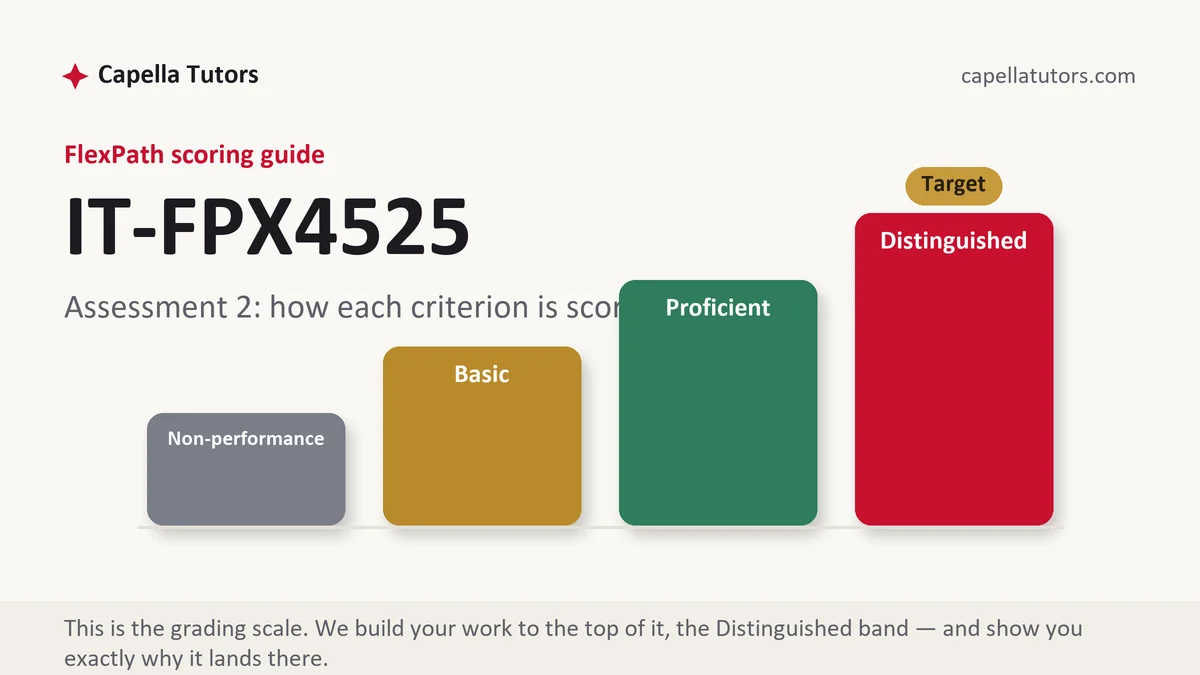
Your evaluator does not award a percentage. Each criterion is marked at one of four levels, and reading the top level as a set of instructions is the whole method:
| Level | What it means on a responsibility and control mapping |
|---|---|
| Distinguished | The boundary is drawn per component rather than in general, every proposed setting names the control reference behind it and the party who operates it, and the paper says which duties never transfer at any tier. |
| Proficient | The split is accurate and the controls are sensible. Each one is described as good practice and none of them is anchored to a named framework or an owner. |
| Basic | A diagram of the shared responsibility model reproduced from a vendor page, followed by generic security advice that would be equally true on a laptop. |
| Non-performance | A required element is absent, most often the customer side of the boundary or the control mapping the guide asked for by name. |
One sentence tends to decide this deliverable: identity, configuration, and data classification stay with the customer at every tier, and most reported cloud incidents come from that residue rather than from a provider failure. A paper that says so, and then shows where the residue sits in its own scenario, has answered the analysis criterion before it reaches the recommendations.
The IT FPX 4525 Assessment 2 method, step by step
-
Rebuild the criteria as headings, then fix the tier in place
Give every criterion its own heading, then write the service model at the top of the document in a single sentence. The boundary moves with the tier, so a paper that leaves the tier ambiguous will contradict itself somewhere in the middle and lose two criteria for the price of one.
-
Draw the boundary component by component, not in general
Take the workload apart into its parts, meaning the operating system, the runtime, the application code, the dependencies, the data store, the network exposure, and the accounts. Assign each to the provider or the customer at your tier. A table with a row per component is worth more than three paragraphs of description.
-
Name the duties that never move
Who holds an account, what those accounts may reach, how data is classified, and whether the tenant configuration was set safely stay with the customer whatever you rent. Say that explicitly, because the criterion usually rewards it and because it is where the incidents in this subject actually come from.
-
Attach each proposed setting to a control reference
Account structure, authentication and a second factor on privileged access, network exposure, encryption in transit and at rest, and logging at the control plane. Cite the framework or catalog item behind each one by name and version rather than presenting the setting as general good practice.
-
Give every control an operator and a way of noticing failure
For each control, say who runs it, what enforces it, and how the organization would find out if it stopped working. A control with no owner is a sentence rather than a safeguard, and that distinction is usually written directly into the top level of the criterion.
-
Test the attestation claim, then self-score
State plainly that a provider certification covers the provider's layer and that your configuration is assessed separately. Then score yourself against every criterion and rewrite whatever falls below the top. Send it in early in the week, since an evaluation may take two business days.
A structure that maps to the criteria
The lengths below are planning figures our tutors use on a responsibility and configuration deliverable, not Capella rules, so weight them toward the criterion your guide treats as heaviest.
| Section | What it must do | Guide |
|---|---|---|
| Workload and tier | The application, the data it holds, and the service model this whole document assumes, stated once and plainly. | ~150 words |
| Responsibility split | A row per component saying who operates it, plus the duties that stay with the customer at every tier. | ~350 words |
| Security configuration | Account structure, authentication, network exposure, encryption, and logging, each with the setting proposed. | ~350 words |
| Control mapping | Each setting tied to a named framework item by version, with the operator and the enforcement mechanism. | ~250 words |
| Assurance and residual risk | What the provider attestation covers, what it does not, and the exposure that remains after the controls. | ~200 words |
| Sources and format | Government publications by number, control sets by version, vendor pages with retrieval dates, current APA. | as needed |
Annotated sample excerpt
A short original excerpt from our team, included to show what a boundary sentence looks like when it names components rather than layers. Read the sequence, then run it over your own workload.
Meridian Credit Union runs its member portal on rented infrastructure, so the guest operating system and its patch level, the virtual firewall rules, the database engine version, and every account that can reach the machine are the credit union's to operate, while the provider's duty stops at the hypervisor.1 Mapping that boundary against the Cloud Controls Matrix puts identity and access management, logging and monitoring, and data security in the customer column at this tier, and the provider attestation covers facility security and infrastructure resilience only.2 The mapping exposes one gap immediately: four staff accounts hold permanent administrative rights to the production tenancy, which no domain in that matrix contemplates and which the provider's audit report says nothing about.3
- 1Lists the components by name and puts the provider's duty at a specific technical line, so a reader can check the split rather than accept a picture of layers.
- 2Names the control set being mapped and reports which domains land on the customer, which is what turns a boundary description into a control mapping.
- 3Ends on a finding rather than a summary, and says explicitly that the provider attestation does not cover the gap, which is the distinction the criterion tests.
The full premium sample for your exact assessment, written fresh to your scoring guide and issue, is free to request. Study it, revise it into your own voice, and submit work you understand.
The five mistakes that cost Distinguished
- A vendor diagram reproduced instead of a boundary drawn. The picture is generic; the criterion wants your components assigned at your tier, with the ambiguous ones argued.
- Controls presented as good practice. A setting with no framework item behind it cannot be verified, and the mapping criterion has nothing to reward.
- A provider certificate read as your own compliance. An attestation speaks for the layer the provider operates, and your own configuration is assessed on its own.
- Public storage exposure blamed on the platform. A permissive default left in place is a customer configuration decision, and misreading that misreads the whole subject.
- Controls listed with no operator. Naming who runs each control, and how failure would be noticed, is what separates a safeguard from an intention.
Pre-submission checklist
- The service model appears once, early, and nothing later contradicts it
- A component-by-component table assigns every part to a named party
- The duties that never transfer are stated as their own short paragraph
- Each configuration setting carries a framework item with its version
- Every control names an operator and a way failure would be detected
- Provider attestation scope stated honestly, then self-scored before submission
Boundary and control mapping due?
Send the workload, the framework your faculty named, and the criteria. The boundary comes back drawn per component, every control comes back with an operator and a versioned reference, and the residual exposure is stated rather than implied. Delivery is inside 24 to 48 hours with revisions until the guide is satisfied.