This manual is for IT FPX 4525 Assessment 1, start to submission. The opening deliverable in a cloud fundamentals course usually asks you to take one workload, describe its requirements in testable terms, and recommend a service model and a deployment model with the rejected options given a real reason. It is graded the FlexPath way, criterion by criterion against the guide in your courseroom. The rest of this page is the tutor method, a structure keyed to the criteria, and an excerpt with notes attached. Prefer to have it done for you? A premium original sample written to this exact assessment arrives inside 24 to 48 hours, with free revisions until the guide is met. Capella's catalog lists the course as IT-FPX4525, and some courserooms print IT4525; both point to this same Assessment 1.
One honesty note before the manual: Capella revises courses and scoring guides over time, so always write to the exact scoring guide attached to your assessment in the courseroom. The course identity above is verified on capella.edu; the method and structure below are our tutors' approach to it, not Capella's official rubric text.
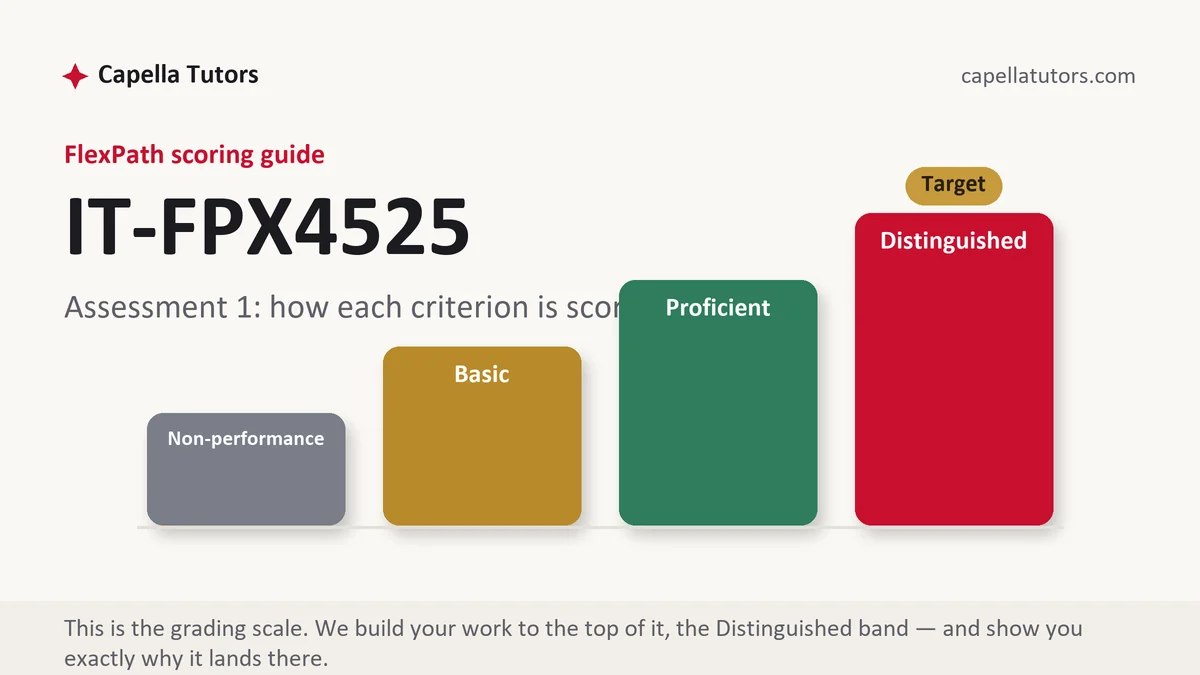
How IT FPX 4525 Assessment 1 is scored
FlexPath has no letter grades and no partial credit to average. Each criterion is placed at one of four levels, and the level wording is the brief you are actually writing to:
| Level | What it means on a workload and model recommendation |
|---|---|
| Distinguished | The recommendation is argued from requirements written down earlier in the same document, the tier is named before any control or cost appears, and the options you rejected are dismissed for a reason tied to the workload rather than to preference. |
| Proficient | The right model is chosen and correctly described. The reasoning is present in outline, and the alternatives are listed without being genuinely weighed. |
| Basic | A summary of cloud definitions with a recommendation attached at the end. The five characteristics are recited, the workload never constrains anything, and this is where most first attempts sit. |
| Non-performance | A required element is missing, most often the deployment model or the requirements the recommendation was supposed to satisfy. |
The habit that lifts this deliverable is committing to one workload in the first paragraph and referring back to it every time the guide asks you to justify something. A paper that keeps its options open describes four scenarios badly, while a paper that names a single application, its data, and its users can defend every later sentence by pointing three paragraphs upward.
The IT FPX 4525 Assessment 1 method, step by step
-
Turn the criteria into headings, then pick a workload rather than a provider
Build the outline from the guide first. Then choose one application and write it down in three sentences, including what data it holds and who is allowed near it. The workload is what makes every later answer specific, and a provider chosen first makes the paper a product tour.
-
Write the requirements as statements somebody could test
Availability, expected load and its shape, the data classification, the residency constraint, and the regulation in scope. Each one needs a number or a named obligation, because an adjective about performance cannot be satisfied or violated and therefore cannot justify a design decision later in the document.
-
Use the reference definition as a tool, not a recital
On-demand self-service, broad network access, resource pooling, rapid elasticity, and measured service each imply something about your workload. Say what pooling means for a system holding confidential records, and what measured service means for a process that runs continuously. That is the difference between using the definition and quoting it.
-
Name the tier before you recommend anything else
Infrastructure, platform, or software delivered as a service changes who operates what, so the tier has to be settled first. State it, then show what moves. On rented infrastructure the guest operating system and its patches are yours; on a managed platform the runtime is not, while your code and its libraries still are.
-
Choose the deployment model and reject the others in writing
Private, community, public, or a deliberate hybrid describes who the other tenants are. Pick one, tie the choice to the residency and classification requirements you wrote earlier, and give each rejected option a sentence naming the requirement it fails rather than a general remark about security or cost.
-
Self-score, then check every claim against the tier you named
Read the draft one criterion at a time and mark each D, P, B, or N yourself. Then reread every control sentence asking whether it is true at the tier you selected, since the same sentence is correct at one tier and false at another. Get it in early, since faculty may take two business days over an evaluation.
A structure that maps to the criteria
These lengths are planning targets our tutors use for a first cloud deliverable rather than Capella requirements, so expand whichever section your own guide weights most heavily.
| Section | What it must do | Guide |
|---|---|---|
| Workload and users | The application, who uses it, the data it holds, and the load pattern across a typical month. | ~200 words |
| Requirements | Availability, residency, classification, regulation, and budget, each written as a number or a named obligation. | ~200 words |
| Service model | The tier chosen, what it moves to the provider, what stays with the customer, and the tiers rejected. | ~350 words |
| Deployment model | Private, community, public, or hybrid, argued from residency and classification rather than from habit. | ~250 words |
| Risks and open questions | What the choice exposes, what the provider agreement does not cover, and what has to be confirmed before commitment. | ~250 words |
| Sources and format | Standards by publication number, provider documentation by retrieval date, current APA both ways. | as needed |
Annotated sample excerpt
An original excerpt from our writers showing how requirements select a tier instead of decorating one already chosen. Study the order of the sentences, then apply it to your own workload.
Ridgeway County Library circulates about 9,400 digital loans a month through a catalog maintained by a two-person technology team, and the load is not flat, since the first week of each month carries roughly 40 percent of the borrowing.1 The catalog holds borrower names, card numbers, and title history, which the library's own confidentiality policy treats as protected, so residency and access control are requirements rather than preferences.2 Those two facts select the tier before any product is named. A managed platform removes runtime patching from a team that cannot cover it overnight, and public deployment is acceptable only because the protected fields stay inside a tenancy the library alone administers.3
- 1Opens with the load and its shape as numbers, so the elasticity argument later in the paper has something to rest on rather than an assertion about demand.
- 2Names the sensitive fields and the obligation attached to them, turning residency and access control into requirements the recommendation must satisfy.
- 3Selects the tier from the two preceding facts and states what the choice moves, which is the reasoning the criterion is scored on.
The full premium sample for your exact assessment, written fresh to your scoring guide and issue, is free to request. Study it, revise it into your own voice, and submit work you understand.
The five mistakes that cost Distinguished
- A provider named before a workload is chosen. The paper then explains product names before it can make a point, and the criteria are about concepts rather than brands.
- Requirements written as adjectives. Highly available and secure cannot be satisfied or violated, so no later design choice can be traced back to them.
- Service models treated as interchangeable. A duty that belongs to the provider on a managed platform belongs to you on rented infrastructure, so the tier has to come first.
- Elasticity claimed for a flat workload. A process pinned at full utilization all year is the argument against paying by the hour, not for it.
- Rejected options dismissed in a clause. Naming the requirement each rejected model fails is what converts a list of alternatives into an analysis.
Pre-submission checklist
- One workload named in the first paragraph and referred to throughout
- Every requirement carries a number, a date, or a named obligation
- The service model is stated before any control or cost sentence appears
- Each rejected model is refused for a requirement it fails, in writing
- Provider documentation cited with the date it was retrieved
- Self-scored at the top level on every criterion, submitted early in the week
Cloud recommendation due?
Send the scenario, the regulation your faculty attached to it, and the criteria. The tier comes back named before the controls, every requirement comes back as something testable, and the rejected options come back refused for stated reasons. Eight specialists touch the file and it returns inside 24 to 48 hours.