This manual is for IT FPX 4250 Assessment 3, start to submission. The final deliverable in this course usually asks for the two sections most submissions leave as bullet points: who may read what, and what the thing costs. Both are graded closely. A managed service divides the work, and the customer keeps responsibility for the data, the permissions, the network configuration, and the identities that reach it, which is why the well-known failures in this space are almost always a customer misconfiguration. Cost has to arrive as unit prices multiplied by volume, because adjectives are not estimates. Below is the method our tutors use for it, a structure that maps to the criteria, and an annotated sample excerpt. Prefer to hand it off? A premium original sample for this exact assessment comes back in 24 to 48 hours, revised free until it meets the guide. Capella's catalog lists the course as IT-FPX4250, and some courserooms print IT4250; both point to this same Assessment 3.
One honesty note before the manual: Capella revises courses and scoring guides over time, so always write to the exact scoring guide attached to your assessment in the courseroom. The course identity above is verified on capella.edu; the method and structure below are our tutors' approach to it, not Capella's official rubric text.
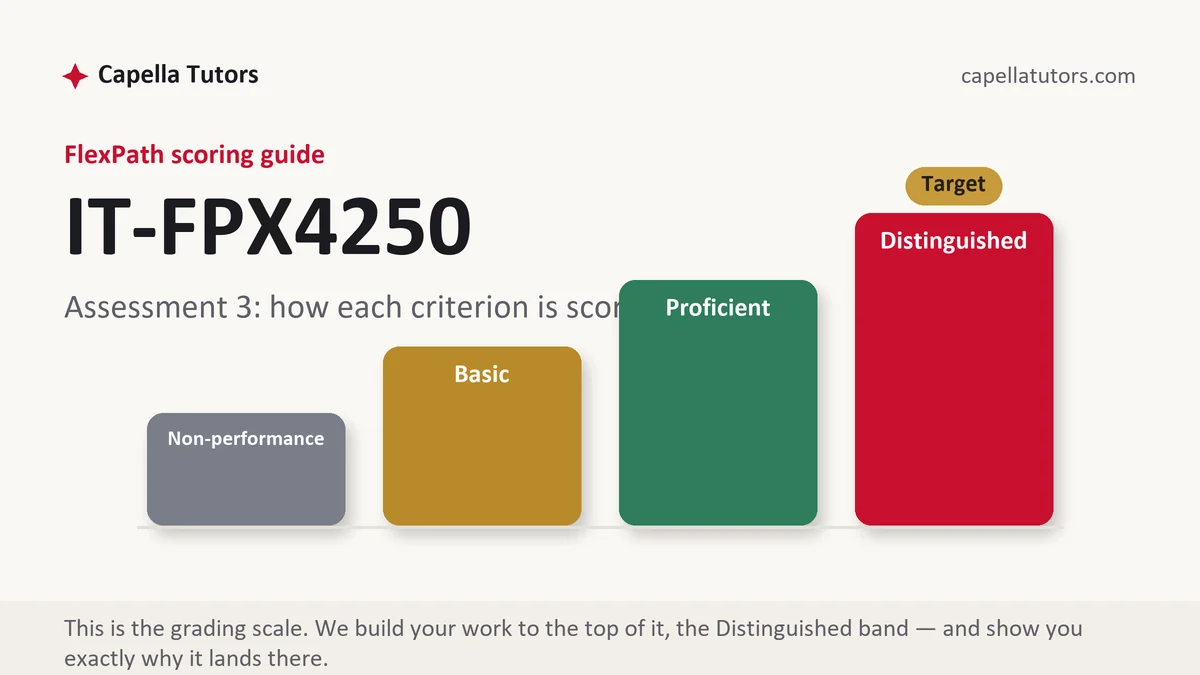
How IT FPX 4250 Assessment 3 is scored
Each criterion ends at one of four levels rather than at a number, and reading the level above your draft is the fastest way to find the work that is left:
| Level | What it means on a governance and cost recommendation |
|---|---|
| Distinguished | Least privilege is shown by role, identifying fields are removed or masked by design, and the cost arithmetic uses published unit prices with a named lever that reduces the largest line. There is an extra move in each criterion; take it. |
| Proficient | A complete governance model with a credible cost figure. Solid work that has not yet shown the arithmetic or named what it would change to spend less. |
| Basic | A security section that lists good practices and a cost section that calls the platform inexpensive and scalable. |
| Non-performance | A required element is missing, commonly retention or the unit prices behind the estimate. An empty section settles its own row. |
Prefer not holding a field to protecting it forever. If the analysis works without names, addresses, full dates of birth, or account numbers, remove them at ingestion and record that you did, because data you deleted cannot leak and retention written into the design beats retention written into a policy nobody applied.
The IT FPX 4250 Assessment 3 method, step by step
-
Separate human users from service identities in the first paragraph
Take a regional grocery cooperative building a demand forecasting platform across 34 member stores. Buyers, analysts, member-store managers, the scheduled forecasting job, and the reporting service are five kinds of identity with five different needs. Grant permissions to roles rather than to individuals, and name the highest-privilege path explicitly so a reader can see how it is controlled.
-
Classify each field, then design the layers around the classification
Say which fields identify a person, which are commercially sensitive, and which are ordinary. Loyalty identifiers and payment fragments in point-of-sale data are the ones to decide about before the pipeline is built, since a forecast by product and store needs neither. Remove or replace them at ingestion, keep any linking map somewhere the analytical environment cannot reach, and record what you did.
-
Write retention per layer with a deletion process behind it
Raw, curated, and serving layers do not deserve the same lifetime, and a retention figure with no deletion mechanism is a wish. Say how long each layer holds data, what triggers deletion, who confirms it happened, and how a deletion request from a member is executed across every layer including any copy an analyst made.
-
Cost it with unit prices and show the multiplication
Suppose 1.4 terabytes of history growing 60 gigabytes a month, object storage quoted at 23 dollars per terabyte per month, and a nightly forecasting job using 8 compute hours at 19 cents an hour. Storage is near 32 dollars a month and compute near 46, so neither is the driver, and the analyst-facing warehouse is. Take every unit price from a dated provider page, since a price with no date is an assertion rather than a reference.
-
Name the lever that reduces the biggest line
Partitioning a table so a typical query scans a fraction of it, materializing a summary the dashboards read instead of the raw history, or scheduling the job to release its compute the moment it finishes are levers with numbers attached. Show the before and after figure for one of them, because a saving expressed as a percentage of an unstated total persuades nobody.
-
State what the model does not know, then self-score
A system trained on last year's behavior will keep recommending last year's behavior, and a store or a product that was underrepresented in the training data will be served worse by the result. Say who reviews that, how often, and on what evidence. Then mark each criterion D, P, B, or N, revise the weak rows, and upload early in the week.
A structure that maps to the criteria
The counts here are our tutors' planning shape for a governance and cost document rather than Capella requirements; tables sit outside them.
| Section | What it must do | Guide |
|---|---|---|
| Identities and roles | Human users and service identities separated, each role with what it may read and write. | ~250 words |
| Field classification | Each field grouped by sensitivity, with the identifying ones removed, replaced, or justified. | ~250 words |
| Access model | Permissions by role, the highest-privilege path and its control, and what the audit log records. | ~250 words |
| Retention and deletion | Lifetime per layer, the trigger, the mechanism, who confirms, and how a deletion request is executed. | ~250 words |
| Cost | Unit prices with dates, the multiplication for each line, the projected monthly total, and the largest driver. | ~300 words |
| Limits and sources | What the model cannot know, who reviews that and how often, and provider documentation dated in current APA. | ~250 words |
Annotated sample excerpt
A closing piece of original model text from our team, set at the level the top column expects. Take the way it turns a cost line into a decision.
Storage is the smallest line: 1.4 terabytes of point-of-sale history growing about 60 gigabytes a month, at the 23 dollars per terabyte per month quoted on the provider's pricing page retrieved 18 July 2026, is close to 32 dollars a month and will pass 40 dollars within two years.1 The driver is the analyst-facing warehouse, where 11 member-store dashboards each refresh four times a day against the full history, and at the published rate per terabyte scanned those refreshes account for more than four fifths of the projected monthly total.2 Partitioning the sales table by week and pointing the dashboards at a materialized weekly summary reduces the data each refresh reads from the full history to the most recent 13 weeks, which cuts the scanned volume by roughly nine tenths and moves the platform from the largest line in the estimate to a minor one; the figure should be re-derived from current prices before anyone commits to it.3
- 1Shows the multiplication and dates the unit price. A cost claim with a retrieval date is a reference, and one without is an opinion about money.
- 2Identifies which line dominates rather than listing everything at the same weight. Naming the driver is what makes the next paragraph worth writing.
- 3Gives a specific lever with a before and after, then hedges the figure honestly. A recommendation that says re-derive this from current prices is more credible, not less.
The full premium sample for your exact assessment, written fresh to your scoring guide and issue, is free to request. Study it, revise it into your own voice, and submit work you understand.
The five mistakes that cost Distinguished
- Cost written as inexpensive and scalable. Adjectives are not estimates, and the criterion is asking for a unit price multiplied by a volume.
- Permissions granted to individuals. A model built on named people stops describing reality the first time somebody changes job.
- Personal data addressed in a closing paragraph. The identification decision belongs in the design, because the pipeline has already copied the field.
- Retention with no deletion mechanism. A stated lifetime that nothing enforces is a sentence rather than a control.
- No statement of what the model cannot know. A system trained on last year will recommend last year, and saying so is part of the recommendation.
Pre-submission checklist
- Human users and service identities are separated, with permissions granted by role
- Every field is classified, and identifying fields are removed, replaced, or justified
- The highest-privilege path is named along with the control over it
- Retention per layer has a trigger, a mechanism, and somebody who confirms deletion
- Every unit price is dated, every line shows its multiplication, and the driver is named
- One lever with a before and after figure is given, and every criterion self-scored
Governance and cost sections due?
Send the platform, the data description, and the criteria. A premium original comes back inside 24 to 48 hours with an access model by role, retention that has a mechanism behind it, and cost arithmetic built from dated unit prices. First sample free.