This manual is for IT FPX 4157 Assessment 3, start to submission. The final deliverable in Networking Architectures usually spans sites, which brings in the cost argument students avoid and the documentation that makes a design buildable. A private circuit buys predictability and a service commitment at a price, ordinary internet transport buys bandwidth cheaply with no guarantee, and an overlay across several transports buys flexibility at the cost of another management plane somebody has to run. The criteria want the comparison, the recommendation tied to a requirement, and drawings that agree with the prose line for line. Below is the method our tutors use for it, a structure that maps to the criteria, and an annotated sample excerpt. Prefer to hand it off? A premium original sample for this exact assessment comes back in 24 to 48 hours, revised free until it meets the guide. Capella's catalog lists the course as IT-FPX4157, and some courserooms print IT4157; both point to this same Assessment 3.
One honesty note before the manual: Capella revises courses and scoring guides over time, so always write to the exact scoring guide attached to your assessment in the courseroom. The course identity above is verified on capella.edu; the method and structure below are our tutors' approach to it, not Capella's official rubric text.
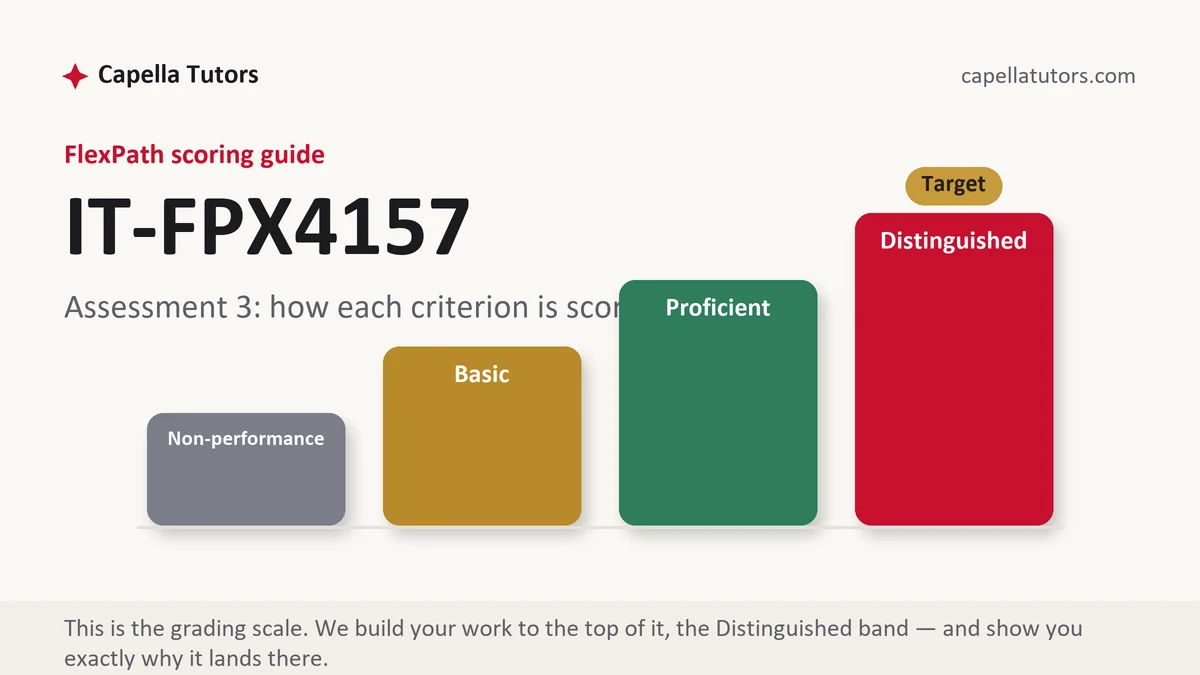
How IT FPX 4157 Assessment 3 is scored
Each criterion is placed at one of four levels rather than scored, and the level immediately above where your draft sits is a description of the work you have left to do:
| Level | What it means on a wide area design |
|---|---|
| Distinguished | Transport options are compared on predictability and price, the recommendation cites a numbered requirement, and the drawings carry legends and numbered components the prose refers to. One extra move sits in each criterion; take it. |
| Proficient | A workable multi-site design with a recommendation and a cost figure. Solid work that has not yet been made operable by somebody else. |
| Basic | One transport named as the answer, one diagram doing two jobs, and cost given as a hardware total. |
| Non-performance | A required element is missing, commonly the physical drawing or the recurring cost. An absent element settles its row without argument. |
Finish with the parts that make a design buildable rather than admirable: an addressing and naming convention, a monitoring plan that does not depend on the network being healthy, a migration sequence with maintenance windows, and a refresh horizon. Hardware reaching end of support in year three of a five-year plan is a decision you already made silently.
The IT FPX 4157 Assessment 3 method, step by step
-
Write the site profile before you choose a transport
Take a farm equipment dealership with eight branches, a central parts warehouse, and an enterprise resource planning system moving to a hosted service. Users per branch, the applications that cross the wide area, what each tolerates in delay and loss, and the hours each branch actually trades. Transport decisions come out of that table, and a recommendation made before it exists is a preference.
-
Compare transports on predictability and price in the same table
Private circuits, business internet access, and an overlay running across both are three answers with three cost shapes and three failure behaviors. Give each a monthly cost shape, a delay expectation, what the provider commits to in writing, and what happens when it degrades rather than fails. A comparison that only lists features has skipped the two columns the criteria care about.
-
Tie the recommendation to a numbered requirement
Say which requirement forces the choice: if the resource planning system tolerates 120 milliseconds one way and 1 percent loss, and branch trading hours make a two-hour outage costly, that combination points somewhere specific. Where the cheaper option would meet the requirement, recommend it and say what risk the organization is accepting by doing so.
-
Draw two pictures and make the prose reference them by number
The logical drawing shows segments, addressing, routing relationships, and where policy is enforced; the physical drawing shows buildings, rooms, cabling paths, device placement, and power. Give each a legend, a title, a date, and numbered components, then refer to those numbers in the text, since a diagram with no textual anchor is decoration and gets graded as decoration.
-
Say how the design is reached, addressed, and watched
Give the addressing scheme so that it summarizes cleanly at the aggregation point, give the naming convention that makes an outage call short, and say how the hosted resource planning service is reached from each branch and what happens to a branch that loses its primary path. Then say where monitoring runs from, because a management plane that depends on the network being healthy is the one you lose exactly when you need it.
-
Cost it over time, sequence the migration, then self-score
Separate the one-time purchase from the recurring circuits and support, put a refresh horizon on the hardware, and lay out the migration branch by branch with what happens in each window and how you fall back. Then mark each criterion D, P, B, or N and upload early, since an evaluation can take two business days.
A structure that maps to the criteria
The counts are how our tutors plan a multi-site design document rather than a Capella instruction; drawings and cost tables sit outside them.
| Section | What it must do | Guide |
|---|---|---|
| Sites and requirements | The branch profile, the applications crossing the wide area, their tolerances, and the trading hours behind them. | ~250 words |
| Transport comparison | Each option with its cost shape, its delay expectation, what the provider commits to, and its degraded behavior. | ~300 words |
| Recommendation | The choice, the numbered requirement forcing it, and the risk accepted by not choosing the alternative. | ~250 words |
| Drawings and addressing | Logical and physical drawings with legends and numbered components, plus addressing and naming conventions. | ~250 words |
| Operations | How the hosted service is reached, failover behavior per branch, and where monitoring runs from. | ~250 words |
| Cost, migration, sources | One-time against recurring cost, the refresh horizon, the window-by-window sequence, and references in current APA. | ~250 words |
Annotated sample excerpt
A short original model passage from our team, written where the top of the guide sits. Read it for how the recommendation is anchored, then anchor yours.
An overlay running across a business internet circuit at each branch with a cellular path as backup is recommended over private circuits to all eight sites, because requirement R-11 sets a one-way delay budget of 120 milliseconds to the hosted resource planning service and measured internet paths from all eight branch cities sit well inside it, at roughly a third of the monthly recurring cost.1 The trade is explicit: the provider commits to nothing on an internet circuit, so the design accepts a degraded-performance risk that a private circuit would have transferred to the carrier, and it manages that risk with a second transport per site rather than with a contract.2 The cost of that choice is a management plane the dealership does not run today, estimated at four hours a month of operational attention once the deployment settles, and named here because a recommendation that hides its own operating cost will be argued with later.3
- 1Cites the numbered requirement, the measurement that satisfies it, and the cost difference in one sentence. That is a recommendation a finance reader can repeat.
- 2States plainly what the cheaper option gives up and how the design compensates. Naming the trade is what the comparison criterion is written to reward.
- 3Puts a number on the ongoing operational load. Every overlay adds a management plane, and admitting it is more persuasive than letting a reviewer discover it.
The full premium sample for your exact assessment, written fresh to your scoring guide and issue, is free to request. Study it, revise it into your own voice, and submit work you understand.
The five mistakes that cost Distinguished
- One diagram asked to do two jobs. Logical relationships and physical paths cannot share a picture without one of them being hidden.
- A transport chosen with no comparison. Naming the answer first leaves the criterion that asks about alternatives with nothing to read.
- Cost given as a hardware total. Recurring circuits, support contracts, and the refresh horizon decide what the design actually costs.
- No addressing or naming convention. A design nobody can operate consistently begins drifting on the day it is handed over.
- Monitoring that rides the network it watches. The management path fails at the same moment as the thing you needed to see.
Pre-submission checklist
- A site table gives users, applications, tolerances, and trading hours per branch
- Every transport option carries a cost shape, a delay expectation, and a degraded behavior
- The recommendation names the numbered requirement that forces it and the risk accepted
- Both a logical and a physical drawing exist, with legends and numbered components
- Addressing, naming, failover per branch, and the monitoring vantage point are all stated
- One-time and recurring costs are separate, a refresh horizon is named, and rows self-scored
Multi-site design due and the cost case is missing?
Send the branch list, the applications crossing the wide area, and the criteria. A premium original returns inside 24 to 48 hours with transports compared on price and predictability, two drawings the prose actually references, and a migration sequence. First sample free.