This manual is for IT FPX 4157 Assessment 2, start to submission. The middle deliverable in this course is where arithmetic starts to decide the grade. Redundancy is graded on whether it removes a failure domain or merely duplicates hardware inside one, and capacity is graded on honesty about contention rather than on the size of the numbers. Two uplinks into the same switch, the same power feed, or the same conduit are one path drawn twice, and the criteria are written to catch exactly that. Below is the method our tutors use for it, a structure that maps to the criteria, and an annotated sample excerpt. Prefer to hand it off? A premium original sample for this exact assessment comes back in 24 to 48 hours, revised free until it meets the guide. Capella's catalog lists the course as IT-FPX4157, and some courserooms print IT4157; both point to this same Assessment 2.
One honesty note before the manual: Capella revises courses and scoring guides over time, so always write to the exact scoring guide attached to your assessment in the courseroom. The course identity above is verified on capella.edu; the method and structure below are our tutors' approach to it, not Capella's official rubric text.
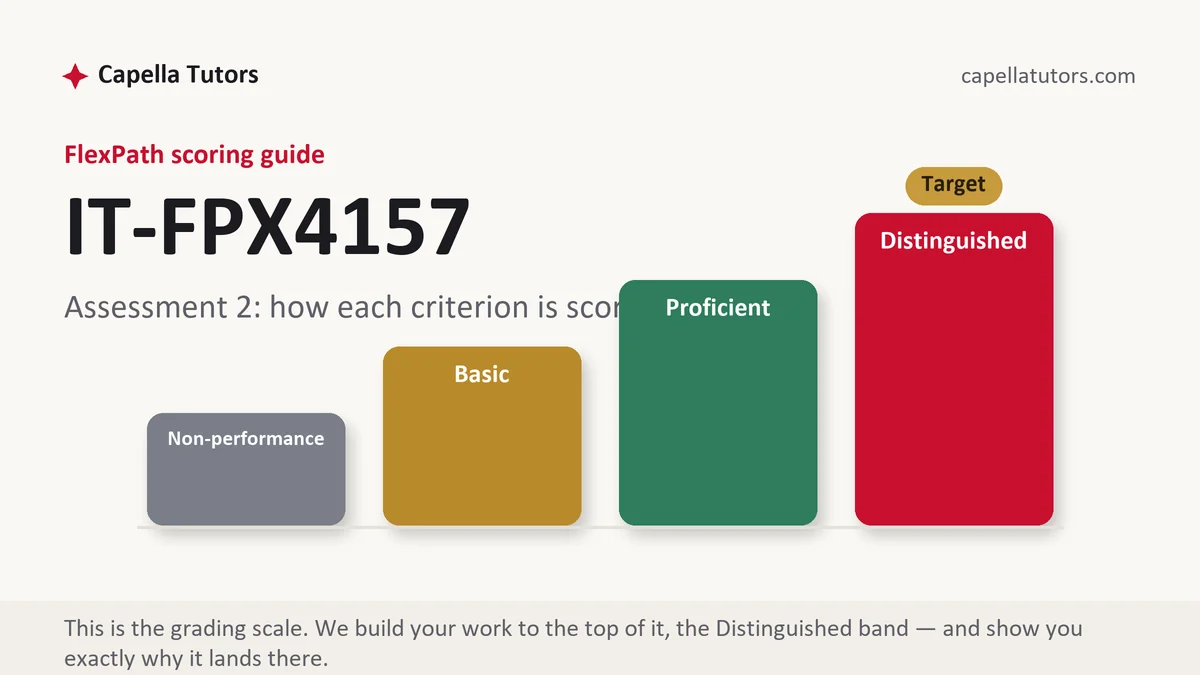
How IT FPX 4157 Assessment 2 is scored
No percentage appears anywhere. An evaluator places each criterion at one of four levels against the guide, so the level text is the most useful writing brief in the course:
| Level | What it means on an availability and capacity design |
|---|---|
| Distinguished | Availability is shown arithmetically, shared failure domains are explicitly ruled out, and oversubscription is stated as a ratio and defended against the traffic described. Each criterion holds one extra move; find it. |
| Proficient | Redundancy and sizing that are correct and clearly explained. Real engineering that has not yet been reduced to a number a finance reader could check. |
| Basic | A design with two of everything and a sentence saying the network is highly available, with capacity treated as a port count. |
| Non-performance | A required element is missing, most often the failure-domain analysis or the contention figure. An absent calculation takes its row to the floor. |
Every redundant design adds a protocol whose job is to decide which path is active, and those protocols fail in ways a single path cannot. Say which failures your design survives, which it does not, and what the people on the night shift have to understand for the redundancy to work at all.
The IT FPX 4157 Assessment 2 method, step by step
-
Turn the availability target into hours before you design anything
A target expressed as a percentage means nothing until it is time. Take a precision machining company with a plant floor and a design office, where the licensing service that lets the machine tools run is the thing that must not stop. Convert the target to hours per year, write it as a numbered requirement, and every later decision has something to be measured against.
-
Do the series arithmetic and let it settle the argument
Three devices in the path all have to be up for the path to work, so three components each available 99.95 percent of the time give roughly 99.85 percent for the path, which is about 13 hours of downtime a year. Show the multiplication rather than asserting the result, because the calculation is the criterion and the conclusion is only its output.
-
Then show what a genuinely independent second path buys
When two paths fail only together, the unavailability multiplies instead of adding, so a second path of the same quality takes that 13 hours to somewhere near 71 seconds a year. That gap is the entire business case for the second path, and it disappears the moment both paths enter the building through one duct or land on one chassis, which is why the physical drawing has to exist alongside the logical one.
-
Rule out the shared failure domains by name
List them and cross them off in writing: single chassis, single line card, single power feed, single conduit, single upstream provider, single air handler. A design that claims redundancy without this list is claiming something no reviewer can verify, and the reviewer's first question is always which of those six you actually solved.
-
State contention as a ratio and defend it
Two 24-port gigabit access switches uplinked by a single 10 gigabit fiber is 48 gigabits of access to 10 of uplink, a ratio of 4.8 to 1. Comfortable for office traffic, inadequate for a design office moving large model files, and saying which case you are in is the analysis. Only write about traffic prioritization after you have said where congestion actually occurs, since marking traffic on a link that never fills changes nothing.
-
Price both sides, then self-score
Put the cost of an hour of downtime beside the annual cost of the second path, including the circuit, the hardware, the support, and the operational time to run the failover mechanism. Where the numbers favor the single path, recommend it with the risk stated and accepted. Then mark every criterion D, P, B, or N and upload early in the week.
A structure that maps to the criteria
These proportions are our tutors' planning shape for an availability and capacity document rather than Capella limits; calculations and drawings are additional.
| Section | What it must do | Guide |
|---|---|---|
| Targets as requirements | The availability target converted to hours, the applications that drive it, and their delay and loss tolerances. | ~250 words |
| Path analysis | The components in series, the arithmetic for the single path, and the result in hours per year. | ~300 words |
| Redundancy | The second path, the multiplication that gives the combined figure, and the mechanism that switches between them. | ~300 words |
| Failure domains | Each shared domain named and either eliminated or accepted, with the physical evidence for the claim. | ~250 words |
| Capacity | Port counts, uplink sizing, the contention ratio, where congestion occurs, and how sensitive traffic is treated. | ~300 words |
| Cost and sources | Downtime cost against the cost of the second path, the recommendation, and specifications cited in current APA. | ~200 words |
Annotated sample excerpt
One original model passage written by our team at the level the guide's top column describes. Take the arithmetic habit and apply it to your own figures.
The path from a plant-floor controller to the licensing service crosses an access switch, a distribution switch, and the server's network module, and with each component rated at 99.95 percent availability the path calculates to 0.9995 cubed, or about 99.85 percent, which is roughly 13 hours of unplanned downtime a year against the 4 hour target in requirement R-03.1 Adding a second path that shares no component takes the combined unavailability to 0.0015 multiplied by itself, close to 71 seconds a year, and that difference is the whole of the business case for the second distribution switch.2 The claim only holds if the two paths are independent, so the physical drawing shows them on separate line cards, separate power feeds, and separate cable trays, and the one shared element that remains is the building's single incoming supply, which is accepted here and noted as the limiting factor on any figure above 99.9 percent.3
- 1Shows the multiplication and converts the result into hours against a numbered requirement. An availability claim expressed only as a percentage has not been made useful yet.
- 2Gives the improvement as a number rather than as an adjective, which is what turns a preference for redundancy into a recommendation somebody can approve.
- 3Names the remaining shared element and accepts it openly. Volunteering the limit is the move that separates the top column from a confident claim.
The full premium sample for your exact assessment, written fresh to your scoring guide and issue, is free to request. Study it, revise it into your own voice, and submit work you understand.
The five mistakes that cost Distinguished
- Availability quoted as a percentage only. Nobody can act on 99.9 percent until somebody converts it into hours a year.
- Two links through one chassis called redundant. A shared component makes a single path however many lines the drawing shows.
- Capacity treated as a port count. The question is the ratio between access and uplink and whether it suits the traffic described.
- Traffic prioritization discussed before congestion is located. Marking packets on a link that never fills changes nothing and earns nothing.
- A recommendation with no cost on either side. A design that ignores what downtime and redundancy each cost is not an engineering judgment yet.
Pre-submission checklist
- The availability target appears as hours per year in a numbered requirement
- The series calculation for the single path is shown, not just its result
- The combined figure for two independent paths is calculated and converted to time
- Every shared failure domain is named and either eliminated or explicitly accepted
- Contention is stated as a ratio and defended against the traffic in the scenario
- Downtime cost is set against the cost of the second path, then every row self-scored
Availability section due and the numbers are not there?
Send the sites, the applications that matter, and the criteria. A premium original comes back inside 24 to 48 hours with the arithmetic shown, shared failure domains ruled out by name, and a contention ratio defended against real traffic. First sample free.